Software Engineer Resume
A software engineer resume has to do two jobs at once: prove you can ship, and get past the ATS that screens you before a human ever reads it. Below is a real, ATS-safe example, the sections hiring managers actually look for, and the keywords that matter in 2026.
Free forever. No account, no card, no catch — your data never leaves your device.
What a software engineer resume must include
- A clear headline that names your specialty (backend, full-stack, mobile, ML) — not just “Software Engineer.”
- A 2–3 line summary with years of experience, your strongest stack, and one concrete outcome.
- Experience entries that lead with impact: metric, action, result. “Cut p95 latency 40% by …” beats “Responsible for …”
- Projects that show depth — especially if you're early-career or switching roles.
- A skills section grouped by category so both ATS parsers and humans can scan it.
Recruiters spend roughly 6–8 seconds on a first pass. The ATS spends less than that. If your resume is one long wall of responsibilities, both will miss the signal. Keep every bullet outcome-first.
Software Engineer Resume Example
Example resume
A single-page, ATS-safe software engineer resume. This is the exact structure our builder produces — switch templates, export PDF/DOCX, no account needed.
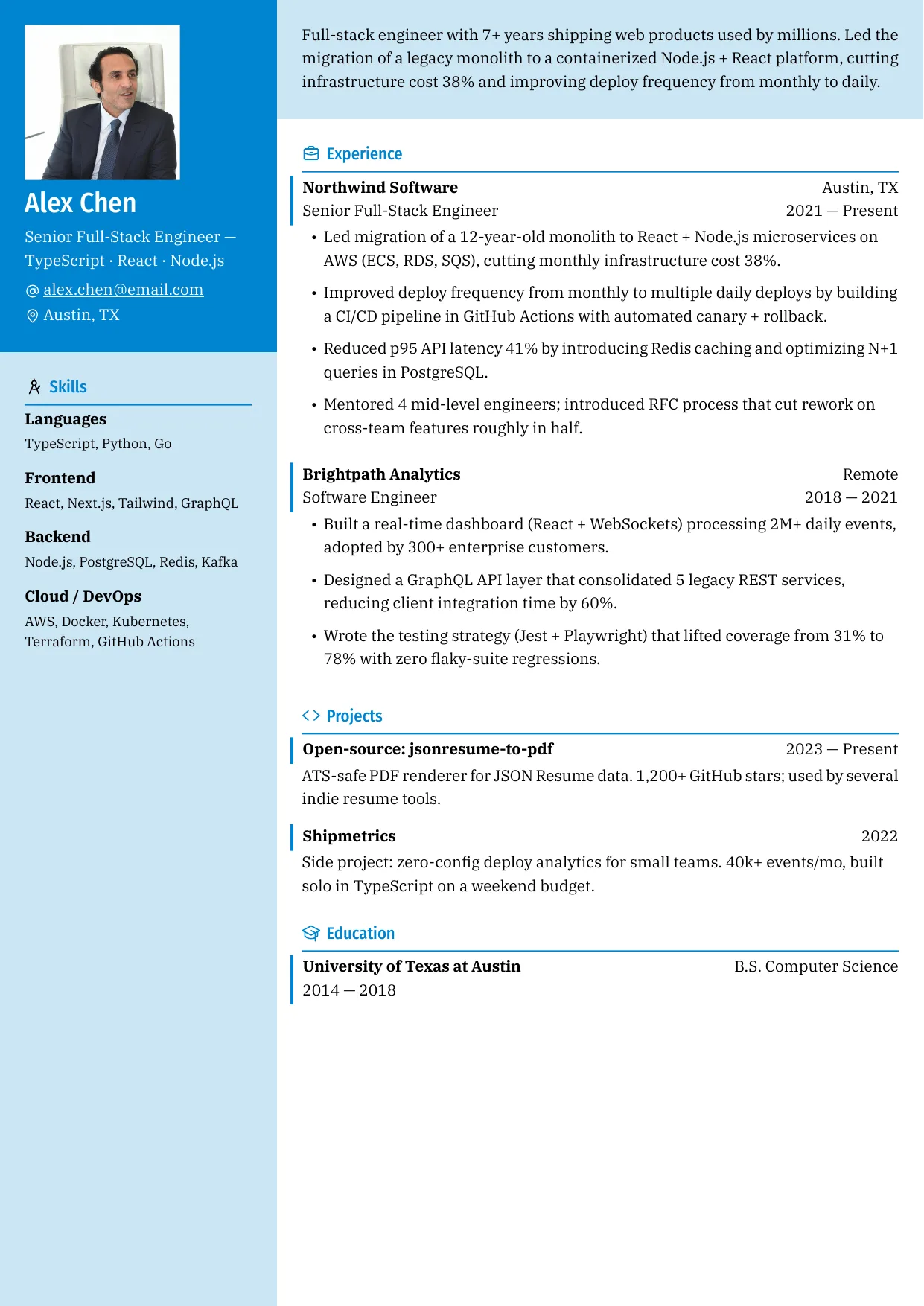
Showing 3 of 15 free templates — open the builder to browse every layout. All 15 are free.
Recommended sections for a software engineer resume
- Summary — 2–3 lines, your specialty + one standout metric.
- Experience — reverse-chronological, bullets that start with a metric or action verb.
- Projects — 1–3 with a link and a one-line impact statement. Essential if you have gaps.
- Skills — grouped (Languages / Web / Cloud / Data). Match the job posting's wording.
- Education — degree, school, year. Keep coursework only if you're a recent grad.
Software engineer skills keywords (2026)
ATS systems score your resume against the job description. Mirror its exact wording where you genuinely have the skill. Generic “team player” fluff scores zero; concrete stack keywords score.
- Languages: TypeScript, Python, Go, Java, C++, Rust
- Frontend: React, Next.js, Vue, Tailwind, GraphQL
- Backend: Node.js, Django, FastAPI, gRPC, REST
- Cloud/DevOps: AWS, GCP, Docker, Kubernetes, Terraform, GitHub Actions, CI/CD
- Data: PostgreSQL, MongoDB, Redis, Kafka
- Practices: system design, microservices, testing, observability
ATS tips for software engineers
- Use a single-column layout. Multi-column templates confuse ATS parsers and scramble your text order.
- Export to PDF or DOCX with real text — never a screenshot or image-based PDF. The ATS must be able to select your text.
- Put your most important keywords in the summary and experience bullets, not just a skills dump at the bottom.
- Spell out acronyms once (CI/CD, AWS) — parsers vary in how they tokenize.
- Skip tables, text boxes, icons in text runs, and header/footer content. They either get dropped or break parse order.
Most parser failures in engineering resumes trace back to multi-column layouts and text locked inside graphics. ShitResume removes the variable: every template shares one linear document structure, so the text you enter is the text the parser reads and the text that lands in the export. It is completely free, and you can build and download the file without creating an account.
ShitResume is free for every template and every export, and the builder is local-first — your contact details, employers and metrics are rendered in the browser and never sent anywhere. No account, no card, no trial. Draft it between deploys, export the PDF or DOCX, and put the saved time into system design prep.
Skills and keywords for this role
Use the terms that genuinely describe your work — an interviewer will ask about anything you list.
- Programming languages: TypeScript, Python, Go, Java, C++, Rust
- Web: React, Next.js, Node.js, GraphQL, REST APIs, Tailwind
- Cloud & infra: AWS, GCP, Docker, Kubernetes, Terraform, CI/CD
- Data: PostgreSQL, MongoDB, Redis, Kafka, Elasticsearch
- Practices: system design, testing, code review, agile
- Tools: Git, Linux, observability (Grafana, Prometheus)
Frequently asked questions
How long should a software engineer resume be?
One page if you have under about eight years of experience, two if you have more and the second page is genuinely full. Recruiters scan the top third first, so the summary and your most recent role carry the weight. Cutting an early role to keep one page is usually the better trade.
What skills should a software engineer list?
Group them so the list is scannable: languages, frameworks, infrastructure, and data. Include only what you would be comfortable being interviewed on, because every item is an invitation to a question. Drop anything you used once in 2019.
Should I include projects if I already have work experience?
Only projects that add something your jobs do not show — a different stack, open-source work, or real users. If a project duplicates what your last role already proves, it costs space and adds nothing.
Do software engineer resumes really need to pass an ATS?
Most mid-size and large employers screen with an applicant tracking system, so the file has to be parseable: a single-column layout, standard section headings, no text inside images, and no tables for content. ATS-safe formatting does not make a weak resume strong, it only stops a good one from being lost.
How many bullet points should each job have?
Three to five for a recent role, one or two for older ones. Lead each with an outcome and the scale behind it, then the action: 'Cut p95 checkout latency 40% by rewriting the pricing service' tells the reader more than a list of technologies.
Is a software engineer resume different for a startup and a large company?
Yes, in emphasis rather than structure. Startups look for breadth and ownership across the stack, so show range and shipping speed. Large companies usually screen against a narrower role, so mirror the language of the job description for the subsystem you would join.