QA Engineer Resume
A QA resume has a credibility problem before it has a formatting problem: anyone can write “tested the application,” and the reader knows it. This page walks through a complete QA engineer resume example, the numbers that separate someone who ran tests from someone who owns quality, and how to describe manual and automated work so an ATS and a hiring manager both read it the way you meant.
Free forever. No account, no card, no catch — your data never leaves your device.
What a QA engineer resume must include
- A headline that names which side of testing you sit on — manual QA, automation, SDET, or an explicit mix — because those three are hired against different job descriptions.
- A summary with your years, the surfaces you tested (web, mobile, API, data pipeline), and one number: defect escape rate, regression time, or coverage of the critical paths.
- Bullets that pair the tool with the outcome. “Rebuilt the Playwright suite so regression runs in four hours instead of three days” tells a reader what you did and what it was worth.
- A clear line between tests you wrote and tests you ran, so nobody mistakes executing someone else's scripts for owning the framework.
- A grouped tool section. Recruiters search by product name, and a flat list of thirty tools buries the three the job actually asks for.
- Evidence of how you find bugs — charters, exploratory sessions, a triage rota, a bug-bar — not just the fact that defects were logged somewhere.
If you are moving from manual testing into automation, say so in the headline. “Manual QA moving into automation — Cypress, Playwright, pytest” reads as a plan; leaving it out makes a reviewer guess why there is no framework experience listed.
QA Engineer Resume Example
Example resume
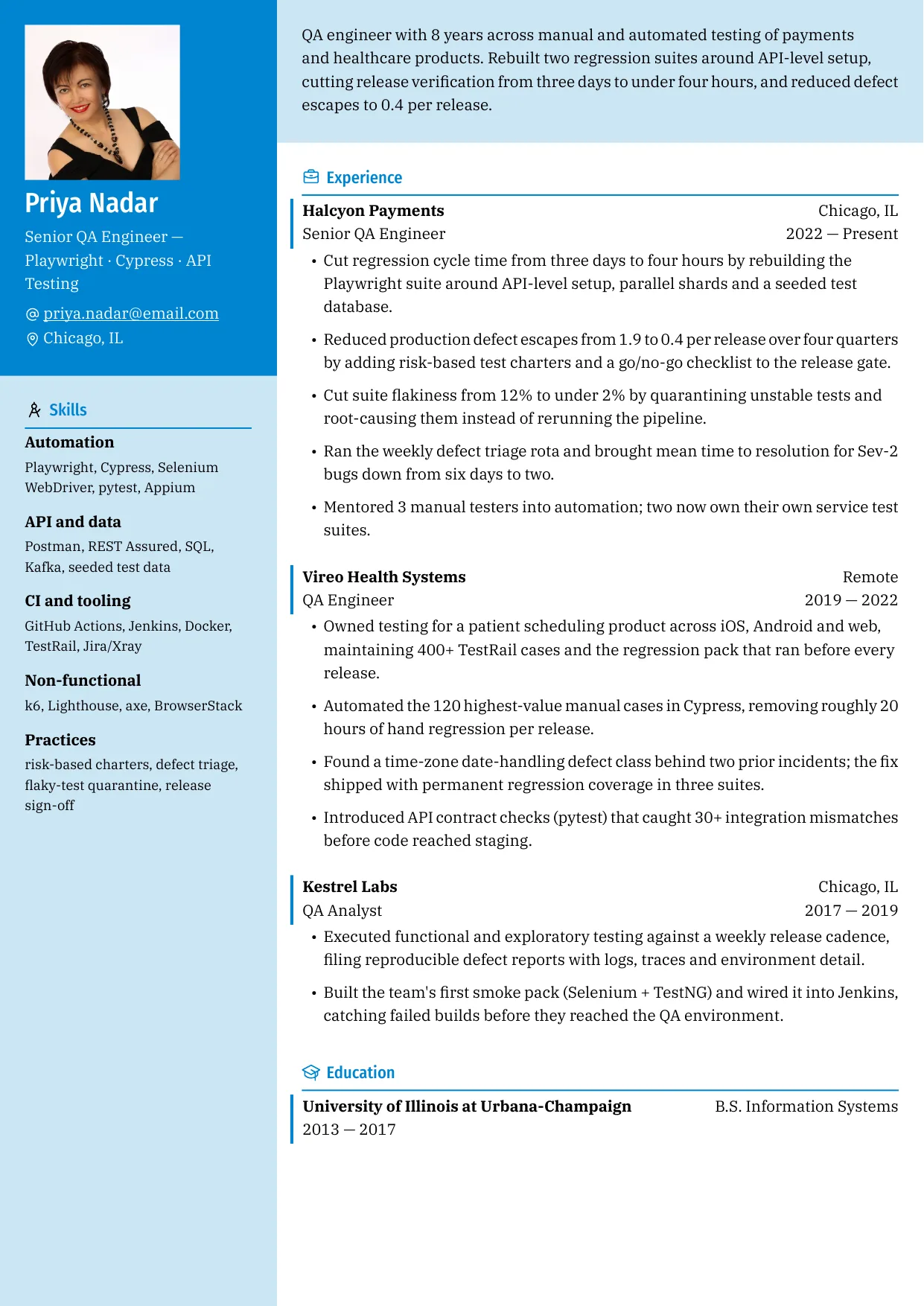
A one-page QA engineer resume with real quality metrics. This is the structure the builder produces — switch templates, export PDF or DOCX, no account needed.
Showing 3 of 15 free templates — open the builder to browse every layout. All 15 are free.
QA bullets: outcome first, then the mechanism
Quality work is easy to describe as activity and hard to describe as result, which is why so many QA resumes list process instead of impact. Rewrite each bullet as: the number that moved, the method that moved it, and the scope it applied to.
- Weak: “Responsible for manual and automated testing of the payments platform.” Better: “Cut regression cycle time from three days to four hours by rebuilding the Playwright suite around API-level setup and parallel shards.”
- Weak: “Found bugs and reported them in Jira.” Better: “Reduced production escapes from 1.9 to 0.4 per release across four quarters by adding risk-based charters to the release gate.”
- Weak: “Worked with developers on quality.” Better: “Ran a weekly bug bash with engineers that closed 60+ low-severity defects the backlog had carried for two releases.”
- Weak: “Wrote test cases.” Better: “Automated the 120 highest-value manual cases in Cypress, removing roughly 20 hours of hand regression per release.”
How to show the manual and automation split
Nobody believes a resume claiming everything is automated, and nobody wants to hire a tester who only scripts the happy path. Show the split the way you actually work: mostly-automated regression for the stable core, manual exploratory work on the parts that keep changing, and API or contract checks where the UI is slow and brittle to drive.
- Name the layer, not just the tool: unit, integration, API contract, end-to-end, and where you held the line on each.
- Give counts where they mean something — “roughly 300 automated checks over 40 critical paths” beats “extensive automation experience”.
- Say what you deliberately left manual, and why (new features, visual judgement, accessibility, payment flows).
- Mention flakiness honestly if you fixed it: “cut suite flakiness from 12% to under 2% by quarantining and root-causing failures instead of rerunning them”.
- If you built the CI wiring, claim it: running tests in a pipeline is a different skill from writing them.
QA engineer skills keywords (2026)
Job posts name their tools explicitly, so match the wording where you have the skill and cut the rest. A tester listing twelve frameworks they have touched once reads as a tester who has mastered none of them.
- Automation: Playwright, Cypress, Selenium WebDriver, pytest, Appium, Robot Framework
- Test design: risk-based charters, session-based exploratory testing, boundary and equivalence analysis, decision tables
- API and data: Postman, REST Assured, GraphQL, SQL, Kafka, seed and fixture data
- CI and tooling: GitHub Actions, Jenkins, Docker, TestRail, Zephyr, Jira/Xray
- Non-functional: k6, JMeter, Lighthouse, axe, OWASP ZAP, BrowserStack
- Practices: test pyramid, severity and triage rules, flaky-test quarantine, release sign-off
ATS notes for QA resumes
- Keep the document single-column. Test-case tables copied in as tables are the fastest way to scramble your parsing order.
- Never screenshot TestRail, Jira or a pipeline result and paste it in. A parser reads no pixels, so the evidence disappears and the page looks empty to it.
- Put your primary stack in the summary and the first bullet of your current role, not only in a tool list at the bottom — that is where keyword extraction weighs it.
- Spell out each abbreviation once: SDET, CI/CD, API, accessibility, regression. Parsers tokenise differently and a job description that spells it out will not match your abbreviation.
- Use the standard heading names (Summary, Experience, Skills, Education). A creative heading such as “Where I Break Things” can take the whole section out of the parser's field mapping.
- Export a text-based PDF or DOCX. A scan or an image-wrapped export has no selectable text at all.
Naming the technique matters as much as naming the tool. “Exploratory testing” and “test charter” are real terms a QA manager searches for, and they signal a method rather than an afternoon of clicking.
Screenshot-heavy templates are the quiet failure mode in QA hiring: the parser sees nothing where a test summary should be. ShitResume keeps every template on one linear structure, so your tool list, severity counts and release metrics survive parsing in the order they appear on screen. It is completely free and needs no account, which helps when the resume is being polished between contracts.
Manual QA, automation QA, or SDET?
The three titles overlap but are screened differently. A manual QA posting wants test design, exploratory judgement and clear defect reports. An automation QA posting wants a framework you can maintain, a pipeline you can wire up, and tests that survive a refactor. An SDET posting sits closer to engineering: test infrastructure, fixtures, reliability, and code review. Pick the track you are applying for, and lead your summary and first bullets with that track's vocabulary instead of trying to look strong in all three at once.
Certifications are optional in most QA hiring. ISTQB Certified Tester Foundation Level (administered in the US by ASTQB) is the one that appears most often, with advanced levels such as Test Analyst or Technical Test Analyst for senior roles, and IAAP accessibility certifications if you specialize in that area. Requirements vary by employer and country, so list a certification where it is relevant to the posting rather than treating it as a substitute for evidenced work.
ShitResume is free across every template and every export, and local-first — your resume is assembled in the browser and never uploaded anywhere. There is no account to make and no card to enter. Draft it between test runs, export the PDF, and keep your energy for the interview loop.
Skills and keywords for this role
Use the terms that genuinely describe your work — an interviewer will ask about anything you list.
- Automation: Playwright, Cypress, Selenium WebDriver, pytest, Appium, Robot Framework
- Test design: risk-based charters, session-based exploratory testing, equivalence partitioning, boundary analysis, decision tables
- API and data: Postman, REST Assured, GraphQL, SQL, Kafka consumer checks, fixture and seed data management
- CI and tooling: GitHub Actions, Jenkins, GitLab CI, Docker, TestRail, Zephyr, Jira with Xray
- Non-functional: k6, JMeter, Lighthouse, axe, OWASP ZAP, cross-browser grids (BrowserStack, Sauce Labs)
- Practices: test pyramid, defect severity and triage, flaky-test quarantine, release sign-off, shift-left reviews
Frequently asked questions
Should a QA resume focus on manual or automated testing?
Lead with the one the posting hires for, then show the other as support. An automation role wants a framework you have owned, a pipeline you have wired, and a flake rate you have driven down. A manual role wants test design, exploratory judgement and defect reports a developer can act on without asking you a question. Applying to both with one resume usually reads as a fit for neither.
What metrics should a QA engineer put on a resume?
Use numbers that describe the release, because that is what the team is paid to improve: defect escape rate per release, regression cycle time, suite flakiness, mean time to resolution for the severities you triage, and how much manual effort automation removed. Avoid counting test cases for their own sake — 2,000 shallow cases say less than 300 checks covering the paths that break.
How do I show testing work when the bugs and test cases belong to my employer?
Describe the class of problem and the outcome, not the internal identifier. “Found a time-zone date-handling defect class behind two prior incidents and added permanent regression coverage” is specific and verifiable in an interview without exposing a ticket number, customer data or anything confidential. Never attach internal screenshots or exported defect lists.
Is a QA engineer resume different from an SDET resume?
Yes. A QA engineer resume is judged on test design, coverage decisions and defect quality; an SDET resume is judged as software engineering — test infrastructure, fixtures, data setup, CI wiring, reliability, and code that other engineers review. If you are applying for SDET roles, show the code you maintain and how you made the suite trustworthy, not a longer list of test cases.
Are QA certifications worth listing?
Most QA roles do not require one. ISTQB Certified Tester Foundation Level, administered in the US by ASTQB, is the certification that shows up most often in postings, with advanced levels such as Test Analyst or Technical Test Analyst for senior positions. Spend the space on evidence of work first; add the certification if the posting names it.
How do I move from manual testing into automation on paper?
Show the automation you have already done, even if it is small: a smoke pack, a set of API checks, tests you wired into CI. Name the language and framework you are working in, state the transition in your headline so it reads as a direction rather than a gap, and keep one manual role visible — exploratory judgement is the part automation does not replace.
How long should a QA engineer resume be?
One page up to roughly eight years of experience, two pages after that if both are full. The last ten years of testing work carries nearly all the weight, so an early role can be one line while your current suite, metrics and release responsibilities get the space.