DevOps Engineer Resume
A DevOps resume has to prove something a job title cannot: which production systems you actually ran, and what measurably changed because you ran them. This guide covers the sections that carry that evidence — infrastructure as code, delivery pipelines, observability, and on-call ownership — with a complete example resume and the keywords worth including.
Free forever. No account, no card, no catch — your data never leaves your device.
What a DevOps engineer resume must include
- A headline that names your lane — platform, site reliability, cloud infrastructure, or release engineering — because “DevOps” on its own tells a reader almost nothing.
- Reliability numbers: deployment frequency, lead time for change, time to restore service, and change failure rate. Those four are the clearest evidence that you owned production, not just the pipeline that fed it.
- The scale of what you ran: clusters and node counts, services deployed, requests or jobs per day, environments managed, accounts under your Terraform state.
- Infrastructure as code you wrote, named by tool and scope. “Terraform modules covering 60 services across 3 AWS accounts” is evidence; “used Terraform” is a keyword.
- On-call ownership: rotation size, escalation path, and what you changed about alerting, runbooks or incident process as a result.
- Cost and toil reduction, because those are usually the two things a platform team was hired to move.
If you are early-career, show the same evidence at a smaller scale. A cluster you upgraded without downtime, a pipeline you replaced, a monthly restore test you introduced — all of that reads as ownership. A list of tools you have watched someone else operate does not.
How to write DevOps bullets: metric, mechanism, scope
- Lead with the number the business already tracks — deploys per day, minutes to restore, percentage of cost removed, pages per week.
- Name the mechanism that caused the change: progressive delivery, burn-rate alerting, Spot capacity, reusable pipeline workflows.
- State the scope so the number is believable: how many services, environments, clusters, or engineers were affected.
- Keep one outcome per bullet. Two half-results in one line read as one vague claim.
- Drop words like “spearheaded” and “responsible for”. They cost space and carry no information.
Weak: “Responsible for maintaining CI/CD pipelines and monitoring dashboards.” Strong: “Cut failed deploys 44% by adding canary analysis to the GitHub Actions release workflow and making rollback a single command for 40 services.” The second version gives an interviewer something specific to ask about, which is exactly what you want in the first five minutes.
DevOps Engineer Resume Example
Example resume
A single-page DevOps resume for someone with eight years in production. The layout is the same linear structure every template in our builder produces — switch templates, export to PDF or DOCX, no account needed.
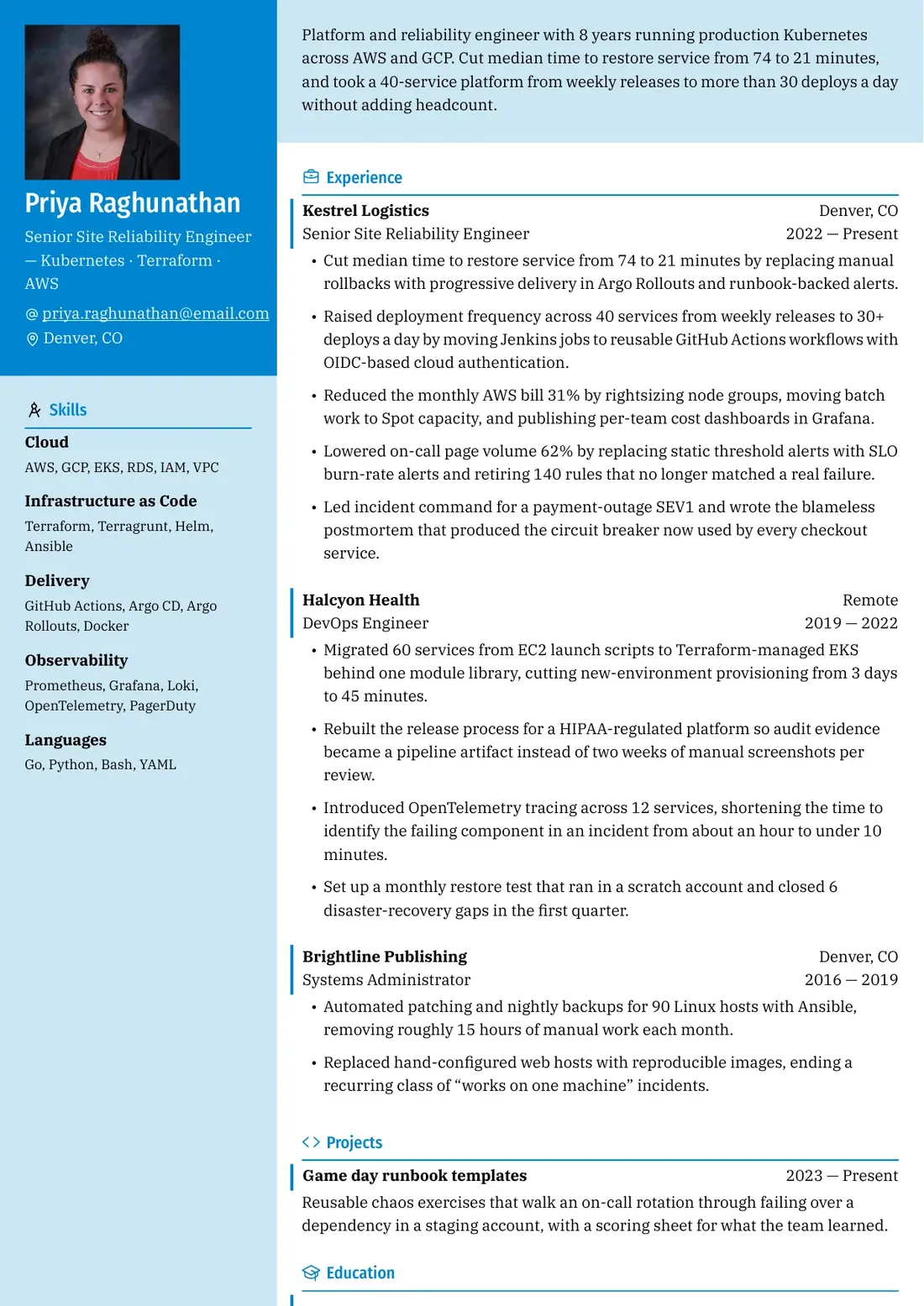
Showing 3 of 15 free templates — open the builder to browse every layout. All 15 are free.
Sections that need care in this field
- Selected platform work — optional, and useful when a migration or build-out was bigger than any single job title suggests.
- Certifications — a short, honest line. Name the certification fully, and add the year only if it is current.
- Education — degree, school, year. Once you have a few years of production experience, this belongs at the bottom.
- Skills — grouped by layer (cloud, IaC, delivery, observability) so a reader can find one tool in a single pass.
DevOps skills keywords (2026)
Postings for this role are tool-dense, which makes both matching and over-collecting easy. Include a tool only if you could answer a follow-up interview question about it; an inflated skills block invites questions you cannot answer, and interviewers do read it. Spelling matters too — write Kubernetes in full at least once rather than only “k8s”, because not every parser maps the abbreviation.
- Cloud platforms: AWS, Google Cloud, Azure, multi-account and multi-region setups
- Infrastructure as code: Terraform, Terragrunt, Pulumi, Ansible, Helm, Kustomize
- CI/CD: GitHub Actions, GitLab CI, Jenkins, Argo CD, Argo Rollouts, Spinnaker
- Containers and orchestration: Docker, Kubernetes, EKS, GKE, Istio, Linkerd
- Observability: Prometheus, Grafana, Loki, OpenTelemetry, Datadog, PagerDuty
- Reliability practice: SLOs, error budgets, incident command, blameless postmortems, game days
- Scripting: Bash, Python, Go, YAML, jq
- Security and supply chain: least-privilege IAM, OIDC federation, HashiCorp Vault, Trivy, SBOM, image signing
ATS notes for a DevOps resume
- Keep the document single-column. A two-column “skills matrix” is the most common layout mistake in this field, and parsers often read the left column before the right, scrambling your job history.
- Skip proficiency bars, dots and percentages next to skills. They carry no data, and the shapes are dropped or misread.
- Put the tool next to the outcome inside the bullet, not only in the skills block, so the keyword appears in the context a recruiter is already scanning.
- Use one date format throughout, with a plain hyphen rather than an en dash or slash, since date ranges are parsed as fields.
- Avoid diagrams, architecture screenshots and text inside images. A parser extracts text, and an image contributes none.
- Do not paste a wall of every tool you have touched. Long unrelated keyword lists match more postings but read as noise, and an interview exposes them.
Job titles in this field are parsed inconsistently, because “DevOps” spans infrastructure, delivery and reliability at different employers. If the posting uses a specific variant — Site Reliability Engineer, Platform Engineer, Cloud Engineer — include that exact phrase once in your summary.
Titles in this field vary, but parsing does not forgive variety: a migrations list read out of order can bury the exact phrase a recruiter searched. ShitResume keeps every template on one linear document, so Terraform scope, Argo delivery work and SLO ownership stay in reading order from browser to export. It is free and there is no account to provision.
ShitResume is completely free — templates, PDF, DOCX — and it runs locally, so cluster names, incident logs and cost figures never leave your browser. There is nothing to sign up for. You keep production honest by removing moving parts; your resume should not add one.
Skills and keywords for this role
Use the terms that genuinely describe your work — an interviewer will ask about anything you list.
- Cloud: AWS (EKS, ECS, RDS, IAM, VPC), Google Cloud, Azure
- Infrastructure as code: Terraform, Terragrunt, Pulumi, Ansible, Helm, Kustomize
- Delivery: GitHub Actions, GitLab CI, Jenkins, Argo CD, Argo Rollouts
- Containers: Docker, Kubernetes, EKS, GKE, Istio
- Observability: Prometheus, Grafana, Loki, OpenTelemetry, Datadog, PagerDuty
- Reliability: SLOs and error budgets, incident command, blameless postmortems, game days
- Scripting: Bash, Python, Go, YAML, jq
- Security: least-privilege IAM, OIDC federation, Vault, Trivy, SBOM
Frequently asked questions
Which metrics should a DevOps resume actually show?
Deployment frequency, lead time for change, time to restore service, and change failure rate are the four hiring managers recognize, because they describe delivery and reliability rather than activity. Cost and toil reduction are worth adding when you can quantify them. Pick the two or three you can defend with a real before-and-after.
Do I need certifications to get a DevOps job?
Not universally — requirements vary by employer. Ones that carry weight here include Certified Kubernetes Administrator (CKA), HashiCorp Certified: Terraform Associate, AWS Certified DevOps Engineer – Professional, and Google Cloud Professional Cloud DevOps Engineer. They help most when a recruiter screens on keywords, and matter least next to evidence you have run something in production.
How do I show on-call experience without sounding like a firefighter?
Describe ownership rather than heroics. A bullet about leading incident command is weaker than one saying what you changed afterwards: thresholds replaced, runbooks written, noise deleted, a postmortem action shipped. Interviewers want someone who reduces the number of emergencies, not someone who is proud of surviving them.
Should a DevOps resume include code or a portfolio?
Infrastructure as code is code, so treat it that way. Point at a public repository, a reusable module or a pipeline definition you may share, and give its scope in one line. If your work is private, describe the same thing in the bullet: what it provisioned, how many services used it, and what it replaced.
Is a DevOps engineer the same as an SRE on a resume?
They overlap heavily and are not identical. DevOps usually describes the tooling and process that connect development to operations; site reliability engineering tends to carry explicit ownership of service level objectives and error budgets. Use whichever title your employer used, and let the bullets show the reliability work rather than relabelling yourself to match a posting.
What if my team has no formal pipelines or SLOs to point at?
Describe what existed before you arrived and what you introduced, however small. “Introduced the first automated deploy for a service released by hand, cutting release time from four hours to twenty minutes” is a strong bullet whether or not your employer called it DevOps. Concrete before-and-after beats a tool list.