Cybersecurity Analyst Resume
A cybersecurity analyst resume has to survive two readers: the ATS that parses it, and the SOC lead deciding in ninety seconds whether you have worked an incident. This guide covers the sections that matter, a full example, the certifications worth naming, and how to write bullets when your day job is triage.
Free forever. No account, no card, no catch — your data never leaves your device.
What a cybersecurity analyst resume must include
- A headline naming the actual seat — SOC analyst, detection engineer, incident responder. “Cybersecurity professional” tells a screener nothing.
- A summary stating your coverage model: how many alerts or endpoints you support, and which tools you live in.
- Certifications near the top. For analyst roles this is read before education, and often before the summary.
- Bullets built on response metrics — mean time to detect, time to contain, alerts per shift, false-positive reduction — not tool names alone.
Security hiring is unusually concrete. A SOC manager is not guessing whether you can read a Splunk search or distinguish a true positive from a false one — the resume either shows it or it does not. Vague claims like “monitored network traffic” read as an absence of detail.
Cybersecurity Analyst Resume Example
Example resume
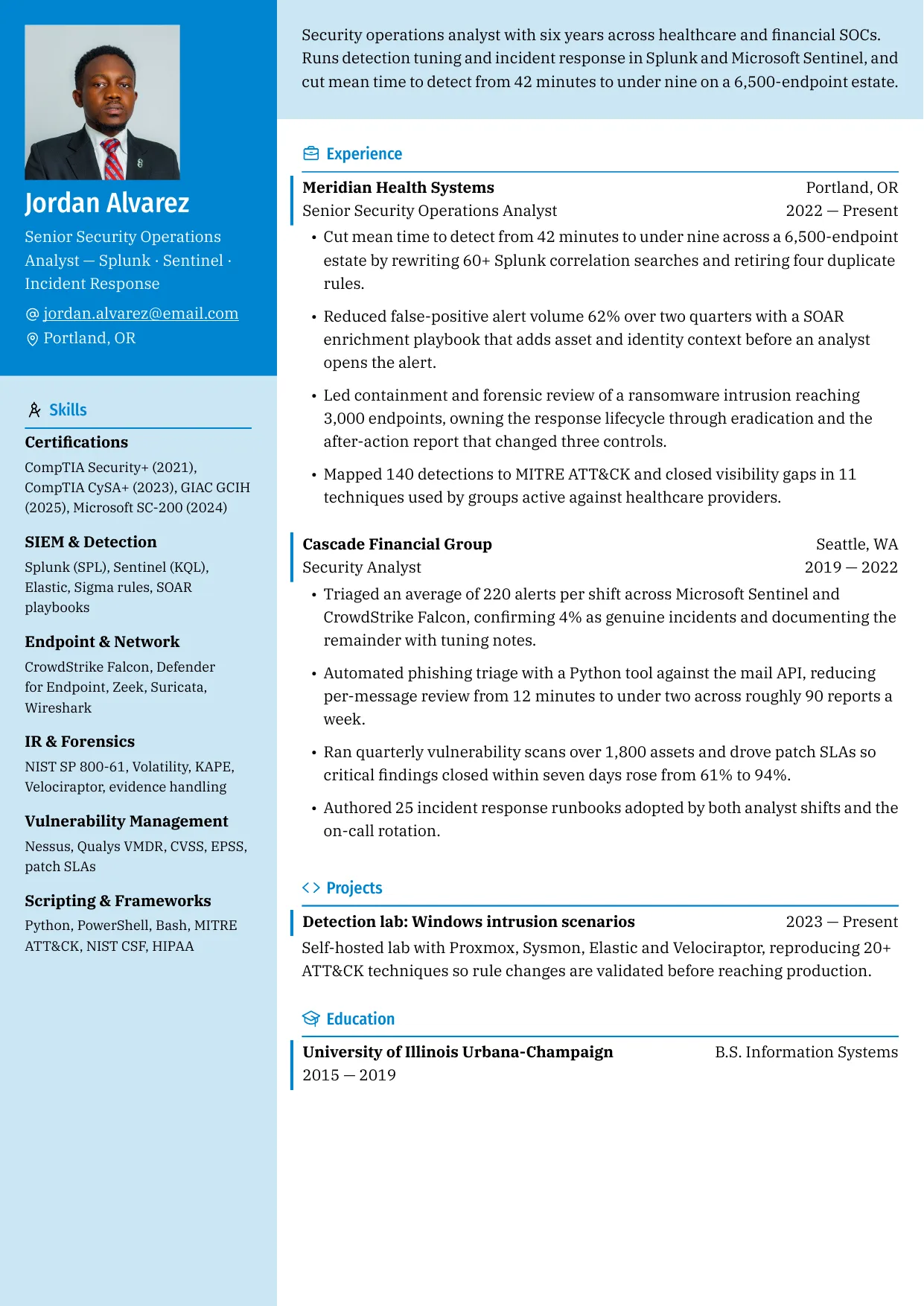
A one-page analyst resume with certifications, shift metrics and detection work up front, in the linear structure the builder produces.
Showing 3 of 15 free templates — open the builder to browse every layout. All 15 are free.
Recommended sections for a cybersecurity analyst resume
- Summary — shift or coverage model, your SIEM and EDR stack, one measurable result.
- Certifications — credential, issuing body, year. Above education for analyst roles.
- Experience — reverse-chronological, alert volume and response times in the first bullet.
- Tools — grouped by function, not one alphabetised dump.
- Education — degree, school, year. Keep coursework only when moving into security from another field.
Cybersecurity analyst skills and keywords
Security postings are repetitive by design, because most SOCs run a similar stack. Mirror the posting's exact tool names where you genuinely have them.
- SIEM and query languages: Splunk SPL, Sentinel KQL, Elastic DSL, QRadar AQL
- Endpoint: CrowdStrike Falcon, Defender for Endpoint, SentinelOne, Carbon Black
- Network: Zeek, Suricata, Snort, Wireshark, NetFlow, full packet capture
- Forensics: Volatility, KAPE, Velociraptor, memory and disk artefact review
- Vulnerability management: Nessus, Qualys VMDR, InsightVM, CVSS, EPSS, patch SLAs
- Frameworks: MITRE ATT&CK, NIST CSF, CIS Controls, ISO 27001, SOC 2, PCI DSS
- Scripting: Python, PowerShell, Bash, KQL for enrichment and log parsing
How to write bullets when your work is triage
Shift analysts often assume their work looks thin because they are not leading investigations. Triage is a volume business, and volume is measurable: state the scale you operate at, the judgement you applied, then the process improvement you made.
- Weak: “Monitored security alerts and escalated incidents.” Better: “Triaged 220 alerts per shift across Splunk and CrowdStrike Falcon, confirming 4% as genuine incidents.”
- Weak: “Reduced false positives.” Better: “Cut false-positive volume 62% over two quarters by enriching alerts automatically and retiring three noisy searches.”
- Weak: “Worked on incident response.” Better: “Contained a ransomware intrusion across 3,000 endpoints, owning identification through eradication.”
Certifications: what to list and where
- CompTIA Security+ and CySA+ — the common entry-level baseline, and the analyst-focused follow-on covering detection, monitoring and response.
- GIAC GCIH and GCIA — incident handling and intrusion analysis; well regarded for hands-on responder roles.
- ISC2 CISSP — expects several years of relevant security work before it is awarded, so it is normally a mid-career step.
- Cloud security specialisms — AWS, Azure or Google security certifications, useful when your SOC covers cloud audit logs.
- Government and contractor roles — United States defense roles often require a certification from a published baseline list, and may require clearance eligibility. These are conditions of the job, not universal.
ATS notes for security resumes
- Keep the layout to a single column. Multi-column templates reorder text, and a scrambled skills list is where analyst applications quietly die.
- Export a text-based PDF or DOCX. An image-only PDF gives the parser nothing to read.
- Skip tables, text boxes and header or footer content; parsers drop them or splice them into the wrong section.
- Check what the parser extracts before you send the file. Structural problems are invisible in a PDF viewer.
One point specific to this field: when you describe incidents, give the category, the scale and your own role — the threat class and the technology, not the victim or the unpatched weakness. Check your employer's policy first, since many require approval before incident details are published.
An ATS scan is the first triage your application goes through, and a two-column template is the false positive that gets it closed. ShitResume keeps every template to one linear document, so the Splunk, Sentinel and CrowdStrike terms you wrote are the terms the parser scores, and the export matches the preview. Nothing about it needs a budget line or a login.
ShitResume is completely free, from the first template to the final export, and the document is assembled in your browser — incident details, clearance status and certification numbers never go to a server. There is no account to maintain. You spend your shifts protecting other people's systems; your resume should not ship your own data to a third party.
Skills and keywords for this role
Use the terms that genuinely describe your work — an interviewer will ask about anything you list.
- SIEM & detection: Splunk (SPL), Microsoft Sentinel (KQL), Elastic, IBM QRadar, Sigma rules
- Endpoint & network: CrowdStrike Falcon, Defender for Endpoint, SentinelOne, Zeek, Suricata, Wireshark
- Incident response: NIST SP 800-61 lifecycle, containment, eradication, recovery, after-action review
- Vulnerability management: Nessus, Qualys VMDR, Rapid7 InsightVM, CVSS, EPSS, patch SLAs
- Threat intel & hunting: MITRE ATT&CK mapping, IOC enrichment, VirusTotal, MISP, threat feeds
- Scripting & automation: Python, PowerShell, Bash, KQL, SOAR playbooks
Frequently asked questions
Do I need a degree to become a cybersecurity analyst?
No single path is required, and what employers ask for varies. Many postings list a bachelor's degree or an equivalent combination of certification and experience. People enter SOC work from help desk and systems administration roles, from the military, and from self-directed lab work. What is consistent is the ability to read a log, judge an alert and explain your reasoning.
Which certifications should a cybersecurity analyst list first?
Lead with the ones the posting names. For entry roles that is usually CompTIA Security+ or a similar baseline. CySA+ maps onto detection and response, while incident responders add GIAC GCIH or GCIA. CISSP comes later because it expects several years of relevant experience. Check the posting rather than assuming a universal standard.
How do I make triage work sound substantial?
Quantify volume, judgement and process improvement: how many alerts you handled per shift, what proportion were genuine, and what you changed — rules tuned, enrichment automated, playbooks written. A measured reduction in false positives says more than any list of tools.
How long should a cybersecurity analyst resume be?
One page under roughly ten years of experience, and two only if the second page is genuinely full. Analyst resumes carry a lot of list content — certifications, tools, frameworks — so the risk is length from formatting rather than substance. Trim tools you would not want to be interviewed on.
Should I include home lab or capture-the-flag work?
Yes, particularly if you are early-career or moving into security from another discipline. Describe what you built and what you detected: the telemetry collected, the techniques reproduced, the rule written. A list of platform names reads as a hobby; a described lab reads as evidence you can operate the tooling.
How do I describe incident response work without breaching confidentiality?
Describe the category, the scale and your role: a ransomware intrusion across a number of endpoints, the phases you owned, the controls that changed. Leave out victim names, unremediated weaknesses and anything identifying an affected party. Many employers require approval before incident specifics are published.