Software Engineer Resume Template
A software engineer resume is screened twice: first by a recruiter matching your stack to the posting, then by an engineer who reads for whether you shipped anything that mattered. The template below is arranged for both — a skills block that lists the stack the way job posts write it, experience bullets that lead with the system and the outcome, and a projects section that carries the work your jobs did not cover.
Free forever. No account, no card, no catch — your data never leaves your device.
Recruiters filter on stack, engineers filter on evidence. That division shapes the whole document: the skills block has to be scannable in five seconds, and the experience section has to answer “what did you build and what changed because of it?” — not “what was the team responsible for?” The best software resumes read like a changelog with consequences, and the template's job is to give each part a predictable place.
What a software engineer resume template needs to hold
- A header with links. GitHub, portfolio or LinkedIn — one line, working links, no broken personal site.
- A two-line summary. Specialism, years, and the scale you have worked at: service traffic, user count, team size, deployment cadence.
- A stack block grouped by layer. Languages, frameworks, cloud and DevOps, data, testing — grouped lists scan faster than one comma-separated wall.
- Experience with outcomes. Each role: what you built or owned, the scale it ran at, and the change it produced.
- Projects. Two or three entries with a one-line description, the stack and a link — the section that carries open source, side projects and coursework.
- Education. One line once you have work experience; more detail only as a new graduate.
Section order for a software engineer resume
- Header: name, target title, location or “Remote”, email, GitHub, LinkedIn, portfolio.
- Summary: two lines — specialism, years, one shipped result.
- Skills: the stack block, high on the page, because recruiter screens often search it first.
- Experience: reverse-chronological, most relevant work first within each role.
- Projects: two or three, each with the stack and a link.
- Education: degree, school, year.
Software engineer resume example
Example resume
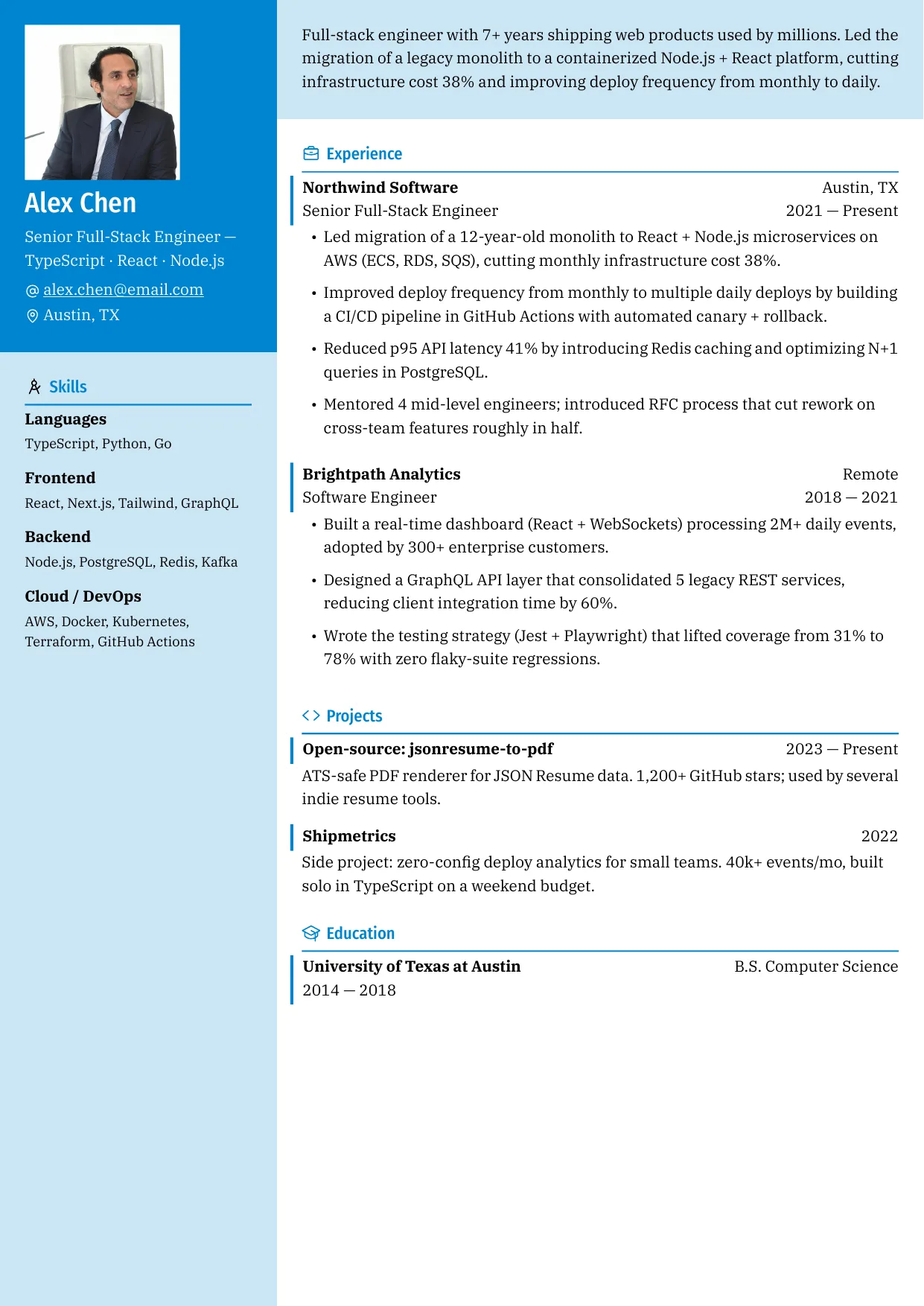
A one-page software engineer resume in this template: grouped stack block, impact-first experience bullets and a projects section with links. Switch layouts in the builder — the plain single-column layout is the safest for older portals — and export PDF or DOCX, free.
Showing 3 of 15 free templates — open the builder to browse every layout. All 15 are free.
Writing experience bullets that survive an engineer's read
- Name the system and the scale. “A real-time dashboard processing 2M+ daily events” tells the reader the size of the problem before the achievement.
- Lead with the change, not the task. Cut infrastructure cost, cut latency, increased deploy frequency, reduced on-call pages — the outcome is the sentence.
- Be precise about ownership. “Led”, “built”, “owned” and “contributed to” mean different things, and an interviewer will ask about whichever one you used.
- Show engineering judgement, not only delivery. Migrations, testing strategy, rollback design and incident work all demonstrate seniority when they are stated plainly.
- Leave out stacks you no longer want to work in. A resume listing everything invites interviews for the oldest thing on it.
The projects section: who needs one and what goes in it
Projects are essential for students, career changers and anyone whose day job does not show the stack they want to be hired for. For an experienced engineer they are optional but useful when a side project demonstrates something a job could not — a language you do not use at work, a system you designed end to end, or a maintained open-source tool. Each entry needs three things: what it does in one line, what you built in it, and a link. A project without a link, a demo or a repository reads as a claim rather than a project.
ATS notes for software engineer resumes
- Write technologies as text, not as logos or icons. A grid of framework logos is invisible to a parser and a screen reader.
- Spell terms the way postings do: “CI/CD”, “PostgreSQL”, “Kubernetes”, “REST”, “GraphQL”. If a posting writes “NodeJS”, matching that string costs nothing.
- Avoid tables and multi-column stacks of skills; the labels and values can separate when the text is extracted.
- Do not paste code or terminal screenshots into the resume — neither survives parsing and neither fits a page budget.
- Keep dates as month and year on every role, including contracts and internships.
Common mistakes on a software engineer resume
- Listing twenty languages and frameworks, which makes the three you would interview in impossible to find.
- Writing duties — “participated in code reviews”, “worked in an agile team” — instead of outcomes.
- Omitting the scale of a system, which is how a reader judges level.
- Leaving the links out, or linking a portfolio that no longer builds.
- Using a decorative two-column template for a large company's portal, where a single column extracts most reliably.
- Keeping an old, irrelevant stack at the top of the skills block because it was the first thing you learned.
Every layout in ShitResume renders the same underlying document, so the plain single-column option and the sidebar layouts carry the same stack block and the same project links — only the emphasis changes. The builder runs entirely in the browser, keeps the resume on your device and exports PDF or DOCX for free, with no account needed to start.
Skills and keywords for this role
Use the terms that genuinely describe your work — an interviewer will ask about anything you list.
- Languages: TypeScript, Python, Go, Java, C#, SQL — ordered by how you would interview in them
- Frameworks: React, Next.js, Node.js, Django, Spring, .NET
- Cloud and DevOps: AWS, GCP, Docker, Kubernetes, Terraform, GitHub Actions
- Data: PostgreSQL, MySQL, Redis, Kafka, DynamoDB, BigQuery
- Practices: CI/CD, testing (Jest, Playwright, pytest), code review, observability, incident response
- Impact language: users served, requests per day, latency, cost, deploy frequency, uptime
Frequently asked questions
What should a software engineer resume include?
A grouped stack block, experience bullets that name the system and the outcome, two or three projects with links, and a one-line education entry. The stack goes high on the page because recruiter screens match keywords there first; the outcomes matter to the engineer who reads it next.
Should a software engineer resume be one page or two?
One page for most engineers, two once you have a decade of relevant work or several leadership items worth describing. Depth beats breadth: three strong roles with measurable outcomes read better than six roles with two generic lines each.
Should I include side projects on my resume?
Yes when they show something your jobs cannot — a language you want to work in, a system you designed yourself, or a maintained open-source tool. Each needs a one-line description, what you built, and a working link. If a project has no repository, demo or write-up, it is a claim, not evidence.
How many programming languages should I list?
Only the ones you would accept an interview in, ordered by strength. A long list dilutes the signal and invites screening for your weakest entry. If you want to show breadth, put the two or three you use in the skills block and let projects demonstrate the rest.
Do I need a photo or a portfolio on a software resume?
A photo is unnecessary on a technical resume in most markets. Links are not optional: GitHub, a portfolio or a personal site should be in the header and working. If your portfolio is stale, either update it or leave it out — a broken link is worse than no link.
How do I make a software resume ATS-friendly?
Keep the stack as plain text rather than logos, avoid tables and icon grids, use month-and-year dates on every role, and choose a single-column layout when the employer's portal is older. Then check that the exact terms from the posting — CI/CD, Kubernetes, TypeScript — appear in the document where they are honest.