Student Resume: How to Write One With Little or No Experience
A student resume is not a short adult resume — it is a different document with a different logic. With little or no work history, the sections that prove you can do the job are education, projects, activities and part-time or volunteer work, in that order of usefulness. This guide shows what to include at every stage (high school, college, first job), full examples, and what to leave out.
Free forever. No account, no card, no catch — your data never leaves your device.
The trap every student resume falls into is apologising. A page that reads as “I know I have no experience, but…” loses before the first bullet. The fix is not padding or fake jobs — it is realising that employers hire students for capability and reliability, and both can be shown without a formal job title: a class project with real users, two seasons of retail hours, a tutoring side gig, organising an event that required 30 volunteers.
What replaces the experience section
- Projects. The single best substitute: a website, a lab report pipeline, a marketing plan, a game, a robotics build. Each gets a one-line description, the tools you used, and one outcome or deliverable.
- Paid work of any kind. Part-time, seasonal, food service, retail, tutoring — with outcomes where you can find them (“handled 150+ transactions per shift with a balanced drawer”).
- Activities and leadership. Clubs you led, teams you organised, competitions you entered. Leadership shows reliability; participation alone shows less.
- Volunteer work. Real responsibility counts the same as paid responsibility: shifts run, people coordinated, funds raised.
- Certifications and coursework. A completed certificate, a course with a graded project, a safety training — anything with a verifiable finish line.
Section order for a student resume
- High school students: header → objective → education (with coursework) → projects or activities → work (if any) → skills.
- College students, no internships yet: header → summary or objective → education → projects → work and activities → skills.
- College students with an internship: header → summary → education → experience (internship first) → projects → skills.
- Graduating within a year: move toward the standard professional order — experience leads as soon as it has anything relevant.
What every student resume should get right
- One page. Two years into a career is the earliest a second page can be justified; before that it reads as padding.
- An objective or summary. A two-line objective (“Computer science student targeting a summer backend internship”) briefly explains why the resume exists.
- Education near the top. While you are a student, it is your strongest credential and belongs above experience.
- Links that work. GitHub, a portfolio, a class project demo. Test every link from a different device.
- Skills that match the posting. Lead with the tools the job names — even if you learned them last semester. Group them: languages, tools, methods.
- Honesty about the humble jobs. Your cashier role is not a weakness if you describe it with numbers; what reads as weakness is leaving it off and having an empty page.
How to describe projects without overclaiming
- What it is, in one line. “A Django web app where students swap textbook notes.”
- What you did. “Built the backend (models, API, auth) and wrote the tests.”
- What happened, honestly. “Used by 60 classmates; 400+ uploads in the first month.” If it has no users, say what it does instead: “handles 10k rows of sample data in under two seconds.”
- Tools. The posting's words: Python, PostgreSQL, Git, Figma.
Student resume example
The example below is a college student with one summer job, a real project, and campus leadership — no internships yet. Notice how each section is doing the work an experience section normally would.
Example resume
A one-page student resume, ATS-safe and honest about its level. Export PDF or DOCX, no account needed.
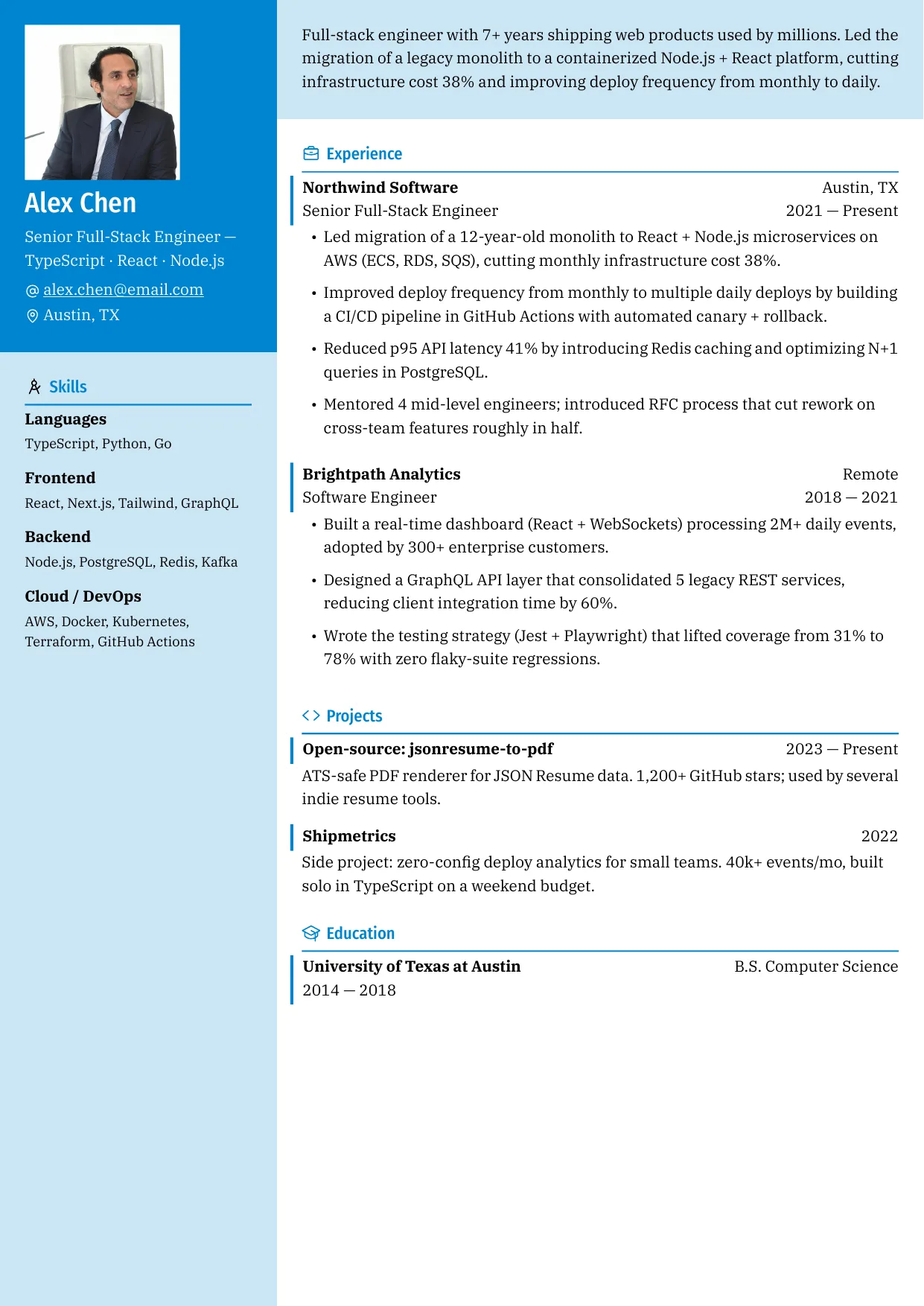
Showing 3 of 15 free templates — open the builder to browse every layout. All 15 are free.
Common student resume mistakes
- Listing coursework as skills. “Advanced mathematics” is not a skill; “SPSS regression” is. Translate courses into tools and methods.
- Including high school once you are past sophomore year of college. Unless it is the strongest credential you have, drop it and use the space for projects.
- Photos, birth dates, full addresses. Not wanted in the US, UK and most markets, and often harmful. Name, city, email, phone, links — that is the header.
- Objective statements that ask for things. “Seeking an internship where I can grow” is about you. “CS student targeting backend internships, available May–August” is about the employer's need.
- A list of every club ever joined. Two or three with real roles beat six membership lines.
- No numbers anywhere. Hours worked, events run, users served, grades improved, dollars raised — with no experience, these are the only proof you have.
A note on ATS for student resumes
- Use the same file discipline as everyone else: PDF or DOCX with selectable text, single column, standard headings.
- Mirror the posting's exact words for the tools you know. If it says “Microsoft Excel,” do not write “spreadsheets.”
- Keep the education block parseable: school name, degree, expected graduation date as plain text — not a stylised graphic.
- Internship and new-grad systems often screen by graduation date and degree field; make both unmissable in the first quarter of the page.
And a structural one: student resumes get mangled by over-designed templates more than any other kind — two-column layouts that scatter project links and dates. ShitResume uses one linear structure for every template, so a single-column student resume stays readable to software and humans alike.
Skills and keywords for this role
Use the terms that genuinely describe your work — an interviewer will ask about anything you list.
- Sections that work without experience: education, projects, activities, volunteer work, certifications, coursework
- Order: header → objective or summary → education → experience (if any) → projects → activities → skills
- Education detail: degree or diploma, school, expected graduation, relevant coursework, GPA if strong
- Projects: 2–4 with a one-line outcome, a tool list, and a link where possible
- Experience counts in any form: part-time, seasonal, babysitting, tutoring, volunteering, family responsibilities framed honestly
- Skills: the posting's tools and methods first — Excel, Canva, Python, Spanish, POS systems, social media
Frequently asked questions
How do you write a resume with no work experience?
Replace the experience section with the closest equivalents: class or personal projects with real users or outcomes, volunteering, campus leadership, part-time or seasonal work of any kind, and certifications. The structure stays the same as any resume — only the section order changes, putting education and projects where experience would normally sit.
What should a high school student put on a resume?
Education with relevant coursework, any paid or volunteer work (babysitting and yard work count when described with numbers), school activities with leadership roles, projects, and a skills list aimed at the job. No photo, no birth date, no full address. One page, always.
Should I include my GPA on a student resume?
Include it if it is strong (typically 3.5+ or the equivalent) and you are within a year or two of graduation; otherwise leave it off — a blank can be explained, a weak number invites doubt. Once you have real work experience in your field, GPA fades in importance and can go entirely.
Can I put class projects on a resume?
Yes — they are the strongest experience substitute a student has. Describe each with what it is, what you personally built, the tools, and any real outcome: users, adoption, performance numbers, a grade if notable. Two or three well-described projects beat ten titles.
How long should a student resume be?
One page, without exception until you have a few years of full-time work. If it does not fill a page, add projects and activities before you add margin or type size. If it overflows, cut coursework detail and the weakest early activities.
Do student resumes get screened by ATS?
Internship and new-grad postings at large companies very often do, and they frequently filter on graduation date and degree field. Keep those in plain text in your education line, mirror the posting's exact tool names, and use a single-column layout — student resumes are the ones most often broken by decorative two-column templates.