Resume Summary: What It Is and How to Write One
A resume summary is the two-to-four line paragraph under your name that tells the reader who you are, what you do best, and what you have achieved — before they read anything else. It is the single highest-leverage block on the page: recruiters read the top third first, and many decide there. This guide covers a formula that works, full examples for different situations, and the clichés that waste the space.
Free forever. No account, no card, no catch — your data never leaves your device.
The summary is not a formality and it is not an objective. It is your pitch, compressed to the length of a long text message, placed where the reader's eyes land first. The difference between a summary that works and one that gets skipped is almost always specificity: the winning versions name a role, a domain and a number.
What a resume summary should include
- Your professional identity: the title you are targeting plus your years or level. “Registered nurse with 6 years in medical-surgical and telemetry” beats “dedicated healthcare professional.”
- Your specialty or stack: the two or three things you are genuinely strongest at, worded the way the posting words them.
- One measurable outcome: the number that proves the claim. Reduced costs, raised retention, cut time — one is enough; two is plenty.
- The target, implicitly: the summary should make it obvious why this resume is on this desk. No need to write “seeking a position…” — just align the content with the posting.
Resume summary vs objective: which one do you need?
- Summary — answers “what do you bring?” with evidence. The default choice for anyone with relevant experience.
- Objective — answers “what do you want?” and is about the candidate's goals. It earns its place mainly for career changers, new graduates, and people re-entering work after a gap, where the reason for applying is not obvious from the history.
- Both in one — a career changer can write a summary whose fourth clause states the target: “...now focused on healthcare operations roles.” That is usually stronger than a standalone objective.
A formula you can fill in
[Role] with [X years] in [domain], strongest at [specialty A] and [specialty B]. [One measurable achievement]. [Optional: what you are targeting next].
- Example fill: “Warehouse operations lead with 7 years in high-volume fulfillment, strongest at shift planning and inventory accuracy. Cut mis-ship rate from 1.8% to 0.4% across a 120-person site.”
- Example fill: “Elementary teacher with 9 years in Title I schools, specializing in early literacy intervention. Raised grade-level reading proficiency 23 points over two years.”
- Example fill: “Career changer moving into UX research from 8 years in market research. Led 60+ moderated studies; completed a 9-month UX certification with two shipped case studies.”
Examples by situation
- Experienced professional: “Senior accountant with 10 years in manufacturing, specializing in cost accounting and audit readiness. Closed a $180M division's books three days faster by rebuilding the month-end checklist.”
- Career changer: “Customer support lead moving into people operations, bringing 6 years of frontline management and a SPHR certification in progress. Built the onboarding program that cut new-hire ramp time 30%.”
- New graduate: “Computer science graduate with two shipped side projects and a backend internship. Built a Django service handling 40k daily requests for a campus organization.”
- After a career break: “Marketing manager returning after a two-year caregiving break, previously owning email programs for a 400k-subscriber list. Averaged 38% open rate, 9 points above industry benchmark.”
- Executive: “VP of Operations with 18 years across logistics and manufacturing, leading orgs up to 300 people. Led two plant integrations that delivered $6M in cumulative savings.”
How long should a resume summary be?
Two to four lines — roughly 35 to 60 words. Shorter than a paragraph, longer than a tagline. At one line it cannot carry a number and a specialty; at five-plus lines it becomes a wall that delays the reader from reaching experience. Write it in third person implied (no “I” needed) with subject-verb fragments: terse, factual, scannable.
Mistakes that make recruiters skip the summary
- Adjectives instead of evidence. “Results-driven professional with excellent communication skills” describes everyone and therefore no one.
- Objective language in a summary. “Seeking a challenging role where I can grow” is about you, not the reader — and the posting already implies you are seeking it.
- No number. A summary without a single measurable claim reads as a template.
- Keyword stuffing. “Expert in SQL Python AWS Azure GCP React Node” is not a sentence; it wastes the block that should have made an argument.
- Copy-paste across applications. The summary is the easiest block to retarget per posting — that is its point.
- Redundancy with the headline. If the headline says “Senior Data Analyst” and the first clause repeats it verbatim, vary the second clause to add information instead.
Resume summary example
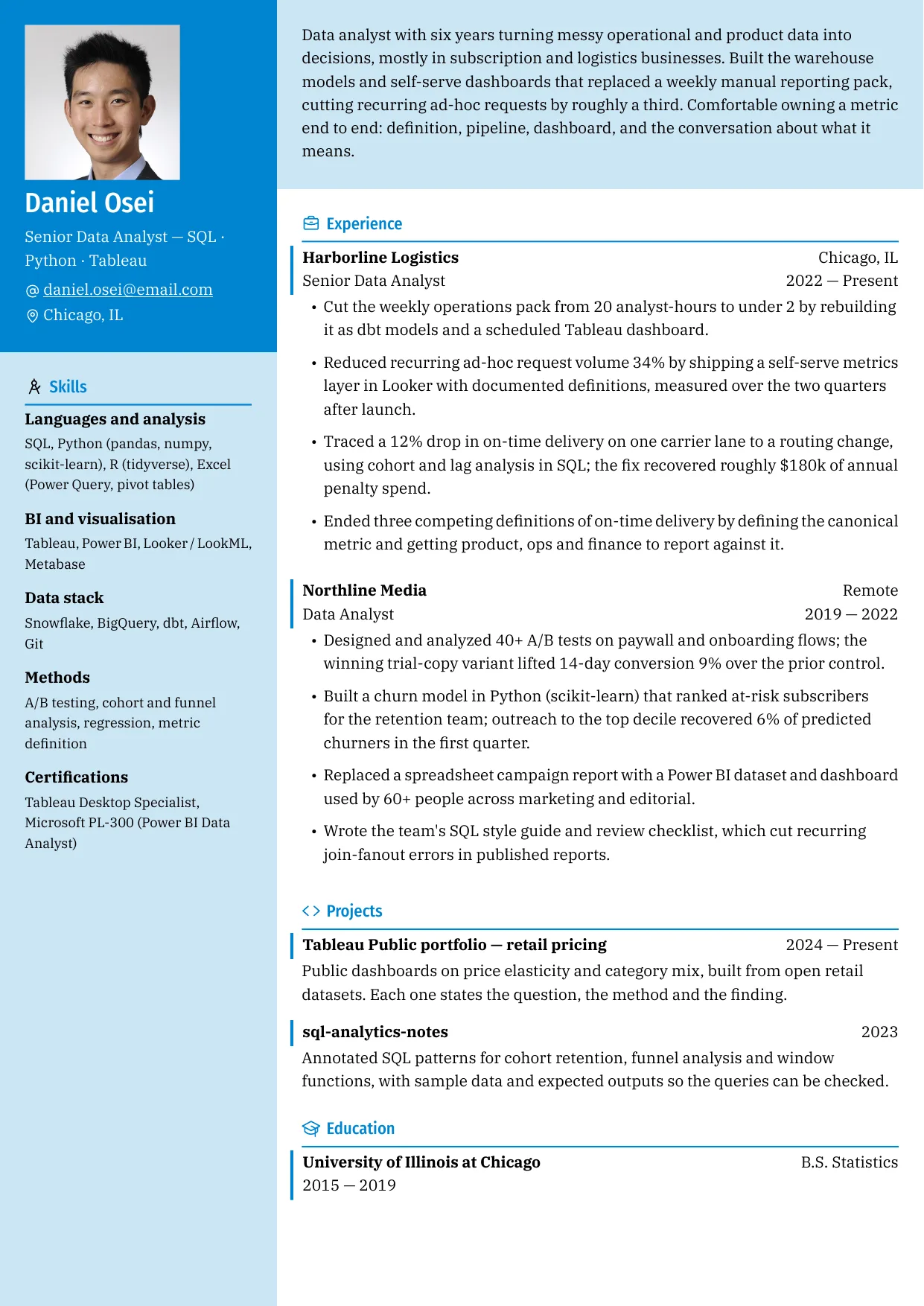
Below is a full resume built around a summary that does its job in three lines: identity, specialty, and a number a hiring manager can react to.
Example resume
A one-page, ATS-safe resume. The summary is the top third — the block our builder asks you to write first. Export PDF or DOCX, no account needed.
Showing 3 of 15 free templates — open the builder to browse every layout. All 15 are free.
How to test whether your summary works
- Cover the rest of the resume and read only the summary: can you tell what role the person wants and one thing they have achieved?
- Swap your summary onto a friend's resume in a different field — if it still “works,” it is too generic.
- Check that every claim in the summary is proven again somewhere below. The summary promises; the experience delivers.
- Read it in six seconds. That is the budget. If the number is buried in line three, move it up.
The summary is also where an ATS harvests its first keywords, so keep the posting's exact terms in it where they are honest. ShitResume renders your summary as plain selectable text at the top of the document — no header images, no text boxes — so the first thing both a parser and a human read is the thing you wrote.
Skills and keywords for this role
Use the terms that genuinely describe your work — an interviewer will ask about anything you list.
- Formula: [role + years] + [specialty/stack] + [one measurable outcome] + [what you are targeting]
- Length: 2–4 lines, 35–60 words, standalone — no first person pronouns needed
- Must include: your title, your domain, one number, and the role you are applying for
- Good proof: percentages, scale, dollar figures, headcount, time saved — pick the one that matches the posting
- Variants: career changer, new graduate, returning after a gap, internal promotion, senior executive
- Cut: “hardworking team player,” objective-style wishes, generic adjectives with no evidence
Frequently asked questions
What is a resume summary?
A 2–4 line paragraph at the top of a resume that states who you are professionally, what you specialize in, and one measurable achievement — written for the specific job you are applying to. Recruiters read it as the first substantive text on the page, and ATS software harvests its keywords.
How long should a resume summary be?
Two to four lines, about 35–60 words. Long enough to carry a role, a specialty and a number; short enough to read in six seconds. If it runs to five lines it is competing with your experience section instead of pointing to it.
Should I use a summary or an objective on my resume?
Use a summary when your background already points at the job. Use an objective (or a summary with an explicit target clause) when it does not — career changes, first jobs, returning after a break. Either way, keep it evidence-based; “seeking a challenging opportunity” tells the reader nothing.
Do I need a resume summary if I have no experience?
Yes, and for a student or new graduate it is often the second-most-read block after the headline. Lead with your degree or program, name your two strongest skills, and use any number you honestly have — projects shipped, users served, hours volunteered, grades if strong.
Can a resume summary hurt my application?
It can if it is generic, repeats the headline, or claims things the rest of the resume never proves. A vague summary signals a template and lowers the reader's expectations for everything below. A specific one raises them. If you cannot make it specific, a headline plus a strong first bullet is a better trade than a filler paragraph.
Does the summary matter for ATS screening?
Yes — the summary is scanned early and often carries the highest keyword weight because it sits in the document's opening text. Mirror the posting's exact job title and top two or three requirements there where they genuinely describe you, and keep the text plain selectable prose.