Types of Resumes: Chronological, Functional and Combination
There are three resume formats, and the right one depends on one question: does your work history already point at the job you want? If yes, reverse chronological is the default and almost always the winner. If no — a career change, a long gap, or a first job — the hybrid (combination) format usually beats both the chronological and the functional resume. This guide compares all three, shows the section order for each, and explains what ATS software does with them.
Free forever. No account, no card, no catch — your data never leaves your device.
The three formats differ in one structural decision: what comes first under the summary. Chronological puts experience first. Functional puts skill groups first and de-emphasizes or omits the timeline. Combination (also called hybrid) puts a substantial skills or projects block first but keeps the full dated history. That single difference changes who the resume is for — the same facts can read as “steady progression” or “something to hide,” depending on the format.
Reverse chronological format
- Structure: header, summary, experience (newest first, with dates), skills, education.
- Best for: anyone whose recent roles are in the same field as the target job. That includes most mid-career and senior applicants, and most internal moves.
- Strength: recruiters read it effortlessly, and ATS parsers — which extract dated roles from a recognised experience section — handle it most accurately.
- Weakness: it puts your timeline front and centre. Gaps, short tenures or an unrelated recent title are visible immediately, which is exactly what the other two formats try to soften.
Functional (skills-first) format
- Structure: header, summary, two to four skill-based groups (each with achievement bullets), then a compressed “Employment” list — sometimes titles and dates only.
- Best for: almost nobody, in 2026. It was designed to hide gaps and emphasize transferable skills, and recruiters have learned to read that intent.
- Weakness: the missing or minimized timeline is the problem the reader notices first, and achievement bullets detached from employers are hard to verify. Many ATS configurations also score the experience section poorly when it lacks dated entries.
- Verdict: if a functional resume seems attractive, use a combination format instead. It fixes the same first-impression problem without hiding the history.
Combination (hybrid) format
- Structure: header, summary, a substantial skills or projects block, then the full dated experience in reverse order, then education.
- Best for: career changers, people returning after a long gap, early-career candidates with strong projects but thin history, and anyone whose most relevant material is not their most recent job.
- Strength: nothing is hidden — the timeline is complete and dated — but the reader's first impression is the relevant material, not the mismatch.
- Weakness: it asks for careful curation. The lead block has to genuinely map to the target job, or it reads as padding and delays the experience section for no benefit.
Which format should you use? A three-question check
- Would a recruiter guess the job I want from my last two titles? Yes → chronological. No → combination.
- Do I have relevant material that is not employment? (Projects, certifications, coursework, volunteer work, military training.) If yes and it would not fit after experience on one page, lead with it in a combination format.
- Am I trying to hide something? If the honest answer is yes, stop — both recruiters and ATS software are built to detect it. Restructure for emphasis (combination), not concealment (functional).
What ATS software does with each format
- Chronological: parses cleanly when it uses standard headings and a single column. This is the layout parsers are built around.
- Combination: also fine, as long as the experience section keeps its own standard heading and full date ranges. The skills block above it does not confuse extraction.
- Functional: the riskiest. When a resume has no dated experience entries, parsers frequently produce an empty work history — which is what the recruiter then sees in the system.
- Any format: single column, no tables or text boxes, dates as real text, standard headings. Layout breaks parsing far more often than order does.
Combination format example
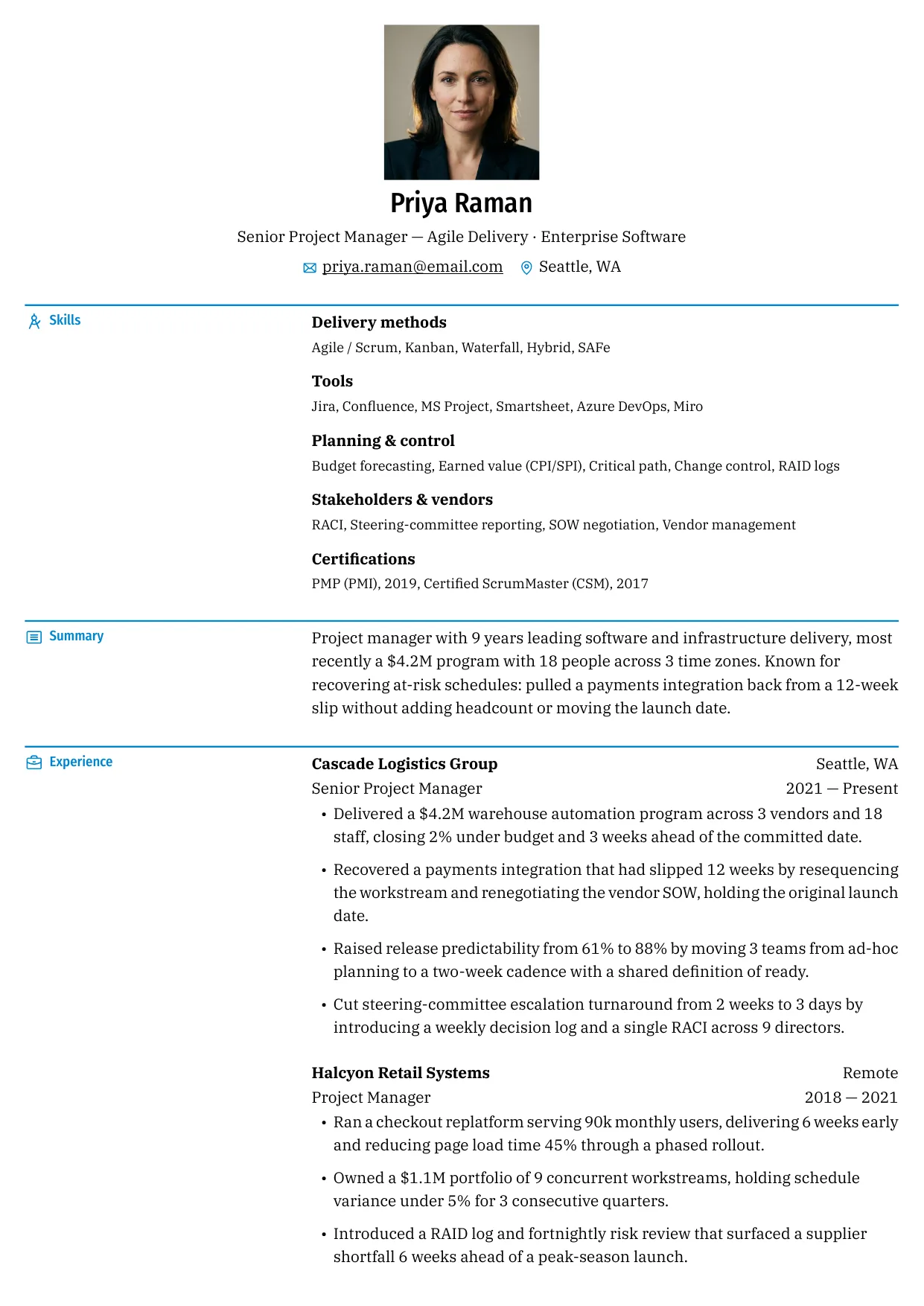
The example below is a combination resume: the skills and projects blocks come first because the person's target job (facilities management) is not what their most recent title says (military logistics), and the dated experience section below is complete and in reverse order — nothing is hidden, only re-ordered.
Example resume
A one-page combination resume. The same data in chronological order would bury the relevant material; here it leads. Export PDF or DOCX, no account needed.
Showing 3 of 15 free templates — open the builder to browse every layout. All 15 are free.
Formatting rules that apply to all three
- One consistent date style throughout: month + year, e.g. “Mar 2022 — Present.”
- Standard, boring section headings: “Experience,” “Skills,” “Education.” Parsers match on the familiar words.
- Skills as a plain labelled list — no rating bars, dots or percentages.
- Education as degree, school, year. Put it above experience only while you are still a student or a very recent graduate.
- One page for under ten years of experience; two when the second page is genuinely full.
Format decides what the reader sees first; structure decides whether the software sees anything at all. ShitResume keeps every template to a single linear document — so whichever of the three formats you choose, titles, companies and dates extract in the order you wrote them.
Skills and keywords for this role
Use the terms that genuinely describe your work — an interviewer will ask about anything you list.
- Chronological: experience first, newest to oldest — the default for ~90% of applications
- Functional (skills-first): skill groups up top, work history compressed or absent — high risk with recruiters and ATS
- Combination (hybrid): substantial skills/projects block above a fully dated experience section — the best fix for career changes
- Section order, chronological: header → summary → experience → skills → education
- Section order, combination: header → summary → skills/projects → experience → education
- ATS note: parsers expect dated experience; any format must keep titles, companies and dates as real text
Frequently asked questions
What are the three types of resumes?
Reverse chronological (experience first, newest to oldest), functional or skills-first (skill groups first, timeline compressed or omitted), and combination or hybrid (a substantial skills block above a complete, dated experience section). Chronological is the default for most applicants; combination is the standard fix for career changes and gaps; functional is the one to avoid.
Which resume format is best for ATS?
Reverse chronological, followed closely by combination. ATS parsers are built to extract dated roles from a standard experience section; formats that omit or bury the timeline tend to produce incomplete records. In every format, what matters most is the layout — single column, standard headings, dates as real text, no tables or text boxes.
Is a functional resume still a good idea?
Rarely. Functional resumes were designed to de-emphasize gaps and short tenures, and recruiters read that intent immediately — the missing timeline often becomes the first thing they notice. If you want the emphasis-on-skills effect, use a combination format: it leads with relevant material but keeps a full, dated work history that both readers and parsers can verify.
When should I use a combination resume?
Use it when your most relevant qualifications are not your most recent job: career changers, people returning after a long break, veterans translating military experience to civilian roles, and early-career candidates with strong projects but limited history. The combination format moves what matters to the top without hiding anything.
Can I mix formats on one resume?
You can, but the result usually reads inconsistently — skill groups between dated roles, or a projects block in the middle of the experience section, confuse both readers and parsers about the organising principle. Pick one primary format and let the other elements stay in clearly labelled sections.
How long should each format be?
Same rule for all three: one page under roughly ten years of experience, two pages when the second page carries real substance. Format changes emphasis, not length. A combination resume for a career changer should still fit one page in most cases.