Resume Skills: What to Put on a Resume
The skills section is the densest concentration of keywords in your whole resume — which is exactly why a vague list hurts more than it helps. This guide covers what counts as a skill, how many to list, how to group them for both ATS parsers and human readers, and the specific wording that matches how jobs are actually advertised.
Free forever. No account, no card, no catch — your data never leaves your device.
A resume's skills section is read twice: once by the applicant tracking system scoring your file against the job description, and once by a human deciding whether the list is credible. The same list has to satisfy both. That rules out two common approaches — a wall of soft-skill adjectives (“hardworking, detail-oriented, team player”) that parses as noise, and a technical dump nobody can verify.
What counts as a skill on a resume
- Tools and systems you can operate: Excel, Epic, Salesforce, AutoCAD, a point-of-sale system, a forklift.
- Technical methods you can perform: SQL queries, financial modeling, triage, weld inspection, lesson planning.
- Certifications and licenses with a verifiable issuer — these are skills with an expiry date, and employers screen for them first.
- Languages at a stated proficiency level.
- Soft skills backed by evidence. “Leadership” alone is a claim; “led a six-person team through a system migration” is a skill demonstrated in the experience section.
The test for every item: could an interviewer ask you to prove it? If not, it is decoration. Decoration costs space and dilutes the keywords that would have scored.
Hard skills vs soft skills: where each one belongs
- Hard skills (Excel modeling, Python, GA4, catheter care, forklift operation) belong in the skills section and should also appear in at least one experience bullet where you used them. They are what both ATS keyword matching and technical screens look for.
- Soft skills (communication, ownership, adaptability) rarely need their own line. The strongest resume proves them with an outcome: “negotiated a vendor contract that cut spend 18%” demonstrates negotiation better than the word does.
- Hybrid skills are the modern default — “stakeholder reporting (Power BI dashboards used by a 40-person org)” is a hard tool plus a soft capability in one line.
How many skills should a resume list?
Enough to cover the posting, not so many that none of them look real. In practice that is usually 4–6 groups with 4–8 items each — around 8–15 hard skills plus a handful of supported soft skills. A one-page resume for an early-career applicant sits at the lower end; a senior specialist with a deep stack can go wider.
- Too few (three generic items) fails keyword matching even when your experience is strong.
- Too many (30+ items in one paragraph) makes the list unscannable and signals you padded it.
- Irrelevant depth — five photo editors on a financial analyst resume — wastes a group slot that should have gone to modeling tools.
How to choose the right skills for a specific job
- Read the posting twice. Highlight every tool, method and credential it names. That list is the target.
- Mirror its exact wording. If the posting says “Power BI,” write “Power BI,” not “business intelligence tooling.” Parser matching is often literal.
- Keep only what you can defend. If you used Kubernetes once in 2021, it is interview bait you cannot survive — leave it out.
- Group by category so a human can scan. Languages / Frameworks / Cloud / Data beats one alphabetical blob, and it also helps a parser see context.
- Put the posting's top three requirements in the first group. Reading order is a signal.
How to list skills on a resume (three formats that parse)
- Grouped list — a “Skills” section with labelled categories. The default for ATS-heavy job markets and the easiest to scan. Use this when the job will be screened by software.
- Skill tags inside the summary — a one-line stack summary under your headline (“React · Node.js · PostgreSQL · AWS”). Best as a complement to a grouped list, not a replacement.
- Skills proven in bullets — every hard skill appears at least once inside an experience bullet with an outcome. This is what makes the list credible; the section itself only provides the keyword surface.
Skills for ATS: the formatting that survives a parser
- Use a standard “Skills” heading. Creative alternatives (“My Toolkit,” “Superpowers”) may not be recognized as a section at all.
- Write a plain comma-separated or bulleted list. Skill rating bars, dots, star ratings and percentage meters are graphics — parsers drop them and sometimes the whole line with them.
- Skip proficiency percentages (“Excel — 80%”). They are unfalsifiable; use levels only where the industry expects them (languages: basic, professional, fluent, native).
- Spell out an acronym once: “search engine optimization (SEO),” then use the acronym. Tokenizers differ in which form they index.
- Keep the section out of tables and text boxes. A two-column skills table can scramble the parse order of everything after it.
Skills by role: start from the posting, then calibrate
The fastest calibration is a worked example for a role close to yours. The guides in this cluster list the keywords hiring managers actually screen for, role by role — software engineer, registered nurse, teacher, marketing manager, data analyst — with the sections, outcomes and ATS notes for each.
Common skills-section mistakes
- Listing soft skills with no supporting bullet anywhere in the resume.
- Copying a “top 100 skills” list wholesale instead of matching the posting.
- Mixing unrelated skill levels — “Python (expert)” next to “French (basic)” invites the wrong comparison.
- Leaving off the credential that legally qualifies you (license number, certification, clearance). Many screeners filter on it before reading anything else.
- Letting the list go stale: a skills section still advertising tools you have not touched in three years reads as a resume that was never updated.
Resume skills example
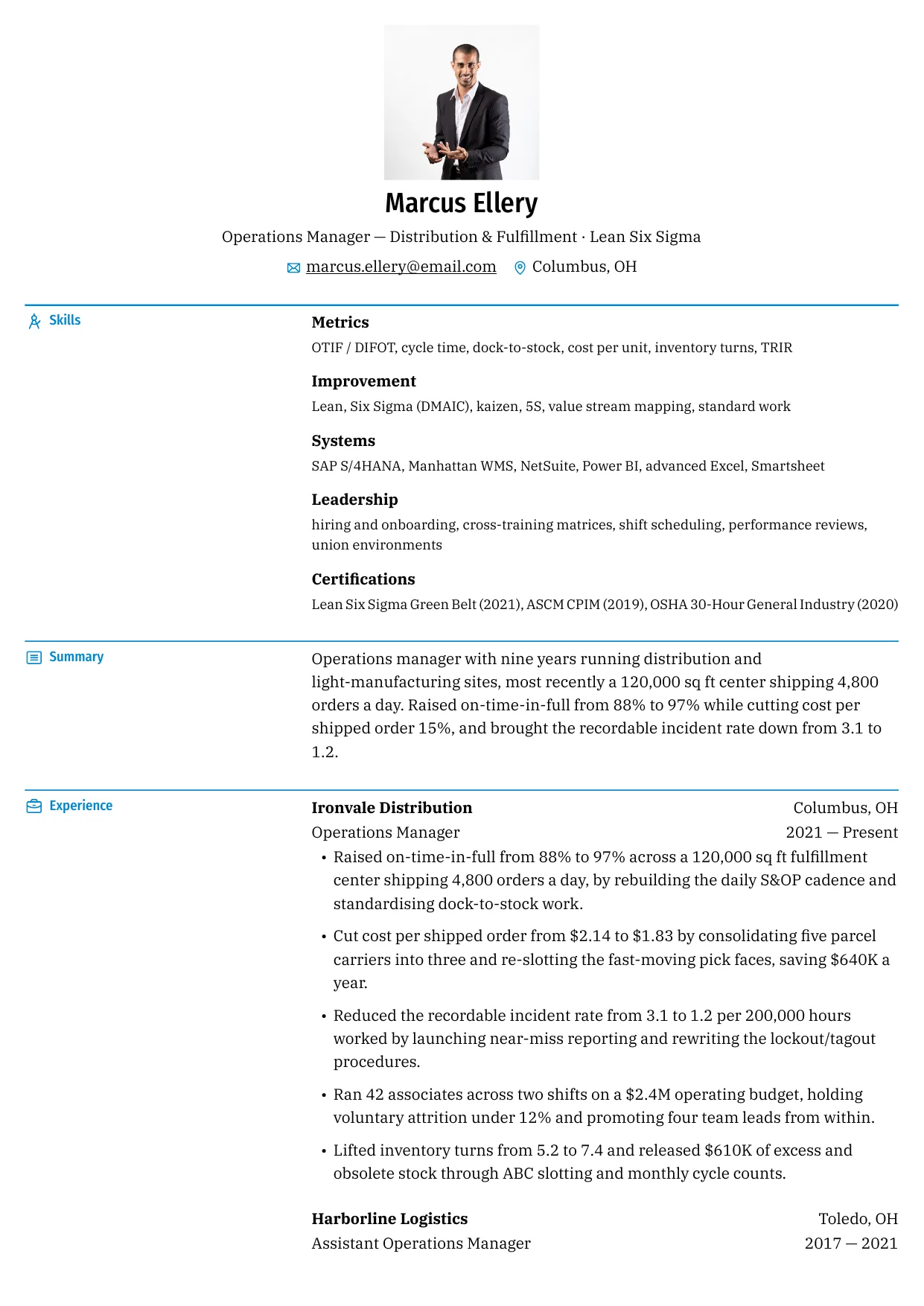
The example below shows the pattern: a headline that frames the specialty, a summary that names the stack, grouped skills that mirror how the role is advertised, and experience bullets where each skill shows up doing real work.
Example resume
A one-page, ATS-safe resume with a grouped skills section. This is the structure our builder produces — switch templates, export PDF or DOCX, no account needed.
Showing 3 of 15 free templates — open the builder to browse every layout. All 15 are free.
How to test your skills list before you send it
- Paste the job posting into a document and highlight every skill, tool and credential it names.
- Cross off each one you can genuinely claim — those are your keywords.
- Check that each remaining high-priority keyword appears in your resume at least twice: once in the skills section and once in an experience bullet or the summary.
- Read the list out loud. If any item makes you wince thinking about the interview, cut it.
One more reason to keep the format boring: an ATS reads structure before it reads meaning. ShitResume builds every resume from one linear document structure, so the skills section a human sees is the exact text a parser extracts — no tables, no columns, no lost lines.
Skills and keywords for this role
Use the terms that genuinely describe your work — an interviewer will ask about anything you list.
- Technical skills: SQL, Python, Excel (pivot tables, VLOOKUP, Power Query), Git, Google Analytics 4, Figma
- Tools by function: CRM (Salesforce, HubSpot), project management (Jira, Asana, Monday), design (Figma, Adobe Creative Cloud), BI (Tableau, Power BI, Looker)
- Soft skills with proof: cross-team coordination, stakeholder communication, mentoring, conflict resolution
- Industry credentials: RN licensure, CPA, PMP, CompTIA Security+, OSHA 30, CDL-A, ServSafe
- AI-era skills: prompt writing, AI-assisted drafting, reviewing and fact-checking model output, data quality control
- Transferable skills: budgeting, scheduling, customer de-escalation, inventory control, reporting
- Languages and communication: Spanish (professional working proficiency), technical writing, presentations
Frequently asked questions
What are good skills to put on a resume?
The good ones are specific, verifiable, and named in the job posting: tools you can operate (Excel, Epic, Salesforce), methods you can perform (financial modeling, triage, lesson planning), and credentials with an issuer. “Hardworking” and “team player” score nothing with either an ATS or a recruiter unless an experience bullet proves them.
How many skills should I list on my resume?
Most strong resumes list about 8–15 hard skills grouped into 4–6 labelled categories, plus a few soft skills that are backed elsewhere on the page. If the list runs past a third of the page it is crowding out experience, and if it has three vague items it is not doing its keyword job.
Do I need a separate skills section if my experience already shows the skills?
Yes, for two reasons. The ATS often scores a dedicated skills section separately from the body text, and a human recruiter scanning for one keyword can find it in a grouped list in seconds. Keep both: the section provides the keyword surface, the bullets provide the proof.
Should I list soft skills on a resume?
List at most a few, and only the ones your experience already demonstrates. The strongest pattern is naming the soft skill with its evidence — “conflict resolution (reduced escalated tickets 40%)” — or leaving the word out entirely and letting the bullet speak for itself.
What skills should a resume have with no work experience?
Lead with what you can prove: coursework and class projects, certifications in progress, tools you actually use, volunteer or campus roles with outcomes, and languages. Group them the same way (“Technical,” “Tools,” “Communication”) and give the two strongest projects their own section so the skills list has something to point at.
Can I use skill rating bars or percentages on my resume?
No. Rating bars, dots and percentages are graphics or unfalsifiable numbers: parsers usually drop them and recruiters cannot compare them. Use words — “advanced Excel (Power Query, macros)” — and reserve formal levels for languages where the industry expects them.