Accountant Resume
An accounting resume is screened twice: once by software looking for a credential and a systems match, and once by a controller who wants to know how fast you can close the books. This guide covers the sections that carry that answer, a complete worked example, and the wording that gets an accounting resume read.
Free forever. No account, no card, no catch — your data never leaves your device.
What an accountant resume must include
- The credential, stated plainly and early. Whether you hold a CPA, CMA or EA, or are still sitting the exams, that line is the first thing most screens look for.
- Close performance in numbers: days to close, how many entities or accounts you owned, how many recurring journal entries you produced.
- The systems by name. NetSuite, SAP, Oracle, Workday, Sage Intacct, BlackLine, FloQast — a generic “ERP experience” tells the reader nothing they can act on.
- Scope: how many legal entities, currencies or cost centers your close covered.
- Standards you have applied rather than only studied: ASC 606, ASC 842, SOX 404 walkthroughs, IFRS if you have worked inside a group reporting function.
- Evidence of audit support — PBC schedules, sample selections, tie-outs — and whether your audits closed without material adjustments.
Corporate accounting hiring runs on the close. A controller reading your resume is really asking one question: can you own a set of accounts and land the close on time without surprises? Every other line on the page exists to support that answer.
Accountant Resume Example
Example resume
A single-page, ATS-safe senior accountant resume. This is the structure our builder produces — switch templates, export PDF or DOCX, no account needed.
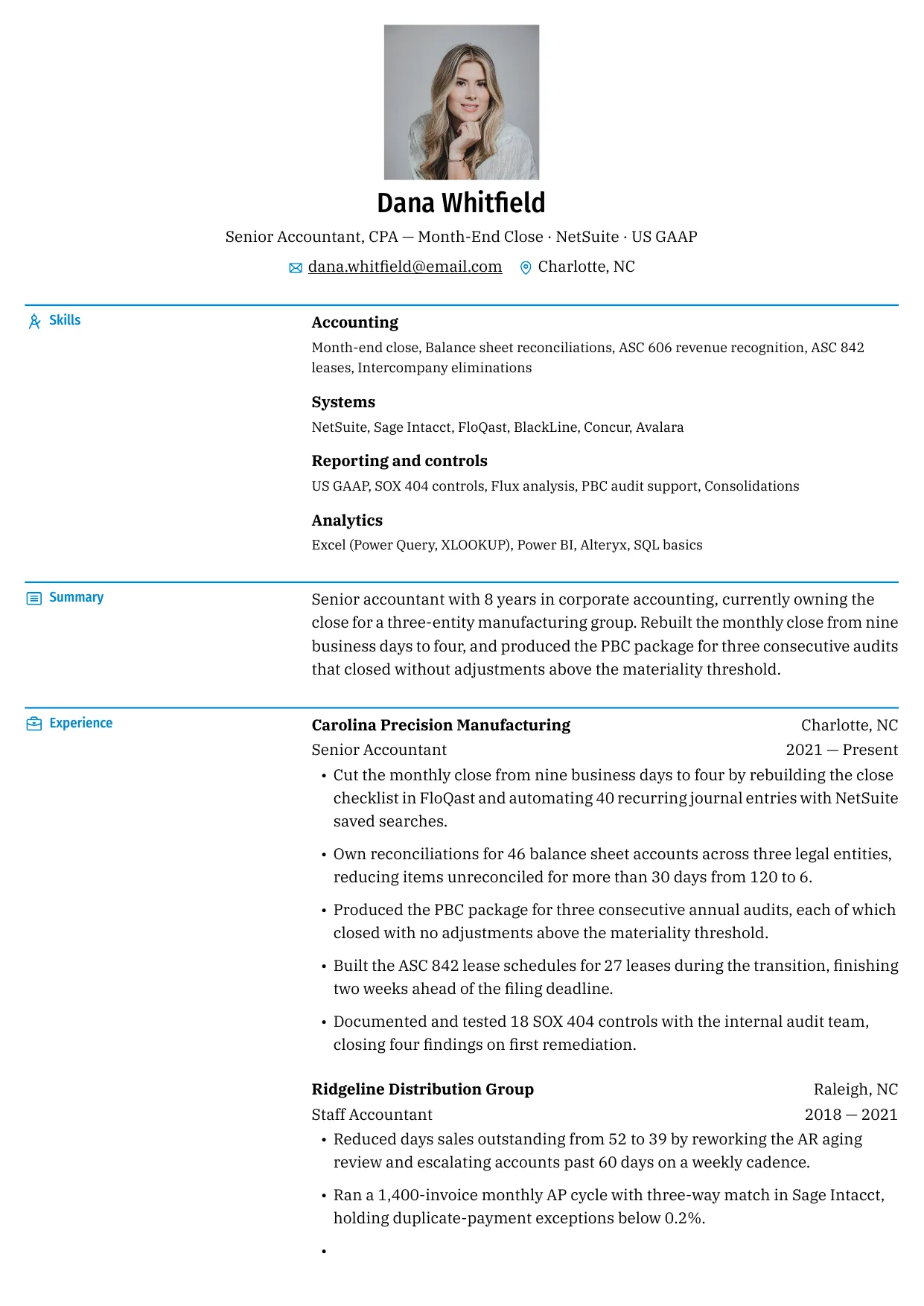
Showing 3 of 15 free templates — open the builder to browse every layout. All 15 are free.
Recommended sections for an accountant resume
- Header — name, city, and the credential after your name if you hold one, for example “Dana Whitfield, CPA.”
- Summary — years in the field, your track (general ledger, audit, tax, FP&A), and one close or audit outcome with a number in it.
- Certifications — credential, issuing body and status. If you are mid-exam, say which parts you have passed and when you expect to finish.
- Experience — reverse-chronological, each bullet leading with the outcome and then naming the system or method that produced it.
- Systems — the ERP, close management and reporting tools you would be comfortable being interviewed on.
- Education — degree, school, dates. Add the accounting concentration or credit hours that make you eligible to sit for the CPA exam when that is relevant to the role.
- Skills — grouped by area (close, reporting, controls, tax) rather than one flat list of every term you have heard.
Accountant skills and systems keywords
Accounting job postings are unusually literal. If the requisition says “ASC 606” and your resume says “revenue recognition,” a keyword-weighted screen may never connect the two, even though you have done the work. Where a posting names a standard, a system or a close tool, use that exact spelling.
- Close — month-end and year-end close, journal entries, accruals, prepaids, fixed assets, intercompany eliminations, multi-entity and multi-currency consolidation
- Reconciliations — bank, general ledger, sub-ledger, inventory, payroll clearing, AR and AP aging
- Standards — US GAAP, IFRS, ASC 606 revenue recognition, ASC 842 leases, ASC 350 intangibles
- Controls and audit — SOX 404, COSO, control walkthroughs, PBC schedules, internal and external audit support
- Order to cash — billing, cash application, collections, DSO reporting, deferred revenue
- Procure to pay — three-way match, vendor master maintenance, expense reporting, 1099 preparation
- Tax support — sales and use tax filings, property tax schedules, nexus tracking, transfer pricing data requests
- Reporting and analysis — financial statement preparation, flux and variance commentary, budget versus actual, Power BI dashboards
ATS notes for accounting roles
- Keep the credential line as plain text. If “CPA” sits inside a text box, a graphic or a table cell, many parsers drop it entirely and your resume reads as uncertified.
- Write dates in one format and use it everywhere — MM/YYYY or Mon YYYY. Mixed formats can split a single job into two entries.
- Use the standard section labels: Experience, Education, Certifications, Skills. A creative heading gets parsed as unrecognised text, and the lines underneath lose their meaning.
- Spell a system out once and abbreviate it once, so both forms are present: “Sage Intacct” and “Intacct.” Parsers tokenise differently, and you want either version to match.
- Do not paste an Excel table into the document to show a reconciliation or a schedule. The cells either vanish or arrive as a column of meaningless numbers.
- Put the tools that matter for the requisition in the experience bullets as well as the systems list. A tool mentioned once, in context, reads as used rather than merely known.
None of this is about making the document prettier. It is about getting the credential and the systems line through the parser intact, because those two fields decide whether a person ever reads the rest of the page.
Formatting advice is only worth what survives the upload, which is why ShitResume renders every template — including the ledger-style layouts accountants gravitate toward — from one linear document model. What you type about your month-end close, your NetSuite reconciliations or your ASC 842 schedules is exactly what the parser scans, and exactly what lands in the PDF or DOCX you hand over. Building it costs nothing and requires no account, so nothing stops you from restyling the page after the first draft.
ShitResume is completely free — every template, every export, and no billing step at any point. Nothing you enter is uploaded; the resume takes shape in your browser and stays there, with no account to create and no session to lose. The CPA credits, the PBC schedules and the close-day numbers stay between you and the file until you decide to send it.
Skills and keywords for this role
Use the terms that genuinely describe your work — an interviewer will ask about anything you list.
- Accounting: month-end close, balance sheet reconciliations, accruals, prepaids, fixed assets, intercompany eliminations
- Technical standards: US GAAP, IFRS, ASC 606, ASC 842, SOX 404, COSO
- ERP systems: NetSuite, SAP S/4HANA, Oracle Fusion, Workday Financials, Sage Intacct, QuickBooks
- Close and controls: FloQast, BlackLine, Workiva, Concur, Coupa, Avalara
- Reporting: financial statements, consolidations, flux analysis, audit support (PBC schedules)
- Analytics: Excel (Power Query, XLOOKUP, pivot tables), Power BI, Tableau, Alteryx, SQL
- Credentials: CPA, CMA, EA, CIA, CFE — requirements vary by state board and employer
Frequently asked questions
Do I need a CPA to get an accounting job?
It depends on the employer and the role, and the requirement is usually stated in the posting. Public accounting firms and many controller-track corporate roles list a CPA or active progress toward one. Staff and senior accountant roles in industry frequently accept equivalent experience instead. The license itself is issued by a state board and typically requires specific accounting credit hours, an exam and supervised experience, so check your own state's requirements before planning around it.
How do I show month-end close experience on a resume?
With the number of days it took and the scope you covered. “Closed the books in five business days for three entities” is far more useful to a controller than “responsible for month-end close.” Add how many recurring journal entries you own, how many balance sheet accounts you reconcile, and which close-management tool tracked the checklist.
Where should certifications go on an accountant resume?
Near the top, either after your name in the header or as its own short section directly under the summary. Give the credential, the issuing body, and your status. If you are still sitting exams, name which parts you have passed and when you expect to complete the rest — an in-progress CPA is worth stating, because it tells the reader you are on the same path.
Should I list every accounting system I have ever used?
No. List the ERP, close-management and reporting tools you would be comfortable being interviewed about, because each one invites a question. Group them so the list is scannable, and keep a long tail of legacy systems out unless a specific posting asks for one — then name it in the experience bullet where you used it.
How long should an accountant resume be?
One page if you have under roughly ten years of experience, two if you have more and the second page carries real content. Accounting is a detail-oriented field, so length is read as a signal: padding a one-page career to three pages suggests you cannot prioritize. Cut older roles that no longer resemble the job you are applying for.
Which metrics matter most on an accounting resume?
Days to close, the number of entities or accounts you own, days sales outstanding, and the volume of transactions or journal entries you process. Audit outcomes are useful too, as long as you describe them accurately — how many audits you supported and whether they closed with adjustments. Any metric you cannot explain in an interview should not be on the page.