Reverse Chronological Resume Format: What It Is and How to Use It
The reverse chronological resume lists your most recent job first and works backward. It is the format virtually every recruiter and applicant tracking system expects — which makes it the safest default, and also the format most applicants use slightly wrong. This guide covers the exact order, the rules that keep it ATS-safe, and the situations where a hybrid version beats the pure form.
Free forever. No account, no card, no catch — your data never leaves your device.
There are three common resume formats: reverse chronological, functional (skills-first), and hybrid (combination). The reverse chronological format accounts for the overwhelming majority of successful applications because it matches how the reader thinks. A hiring manager wants to know: where do you work now, how did you get there, and does the trajectory fit this job? Reverse order answers those three questions in reading order.
What a reverse chronological resume looks like
- Header — name, target title, city, phone, email, and one or two links (LinkedIn, portfolio, GitHub).
- Summary — 2–4 lines: role, specialty, and one measurable outcome, targeted at the posting.
- Skills — optional position here for keyword-heavy fields (nursing, IT, trades); many put it after experience instead.
- Experience — the current or most recent role first, each with title, company, location, dates, and outcome bullets.
- Education — degree, school, year. For recent graduates this can move above experience.
- Optional sections — projects, certifications, publications, languages, volunteer work, placed after the core blocks.
The one non-negotiable rule: dates run backward, and every entry shows its dates. A recruiter's first question about any role is “when,” and hiding dates (or formatting them inconsistently) is the fastest way to make a resume look evasive.
Why recruiters and ATS prefer reverse chronological
- It answers the recency question first. The top of the page is the most relevant present, not the least relevant past.
- It shows progression. Promotions and growing scope read as a trajectory when the same company appears twice in ascending order.
- It is what parsers are built for. ATS extraction rules assume a dated experience section in reverse order; unusual formats are where parse errors cluster.
- It is transparent. The reader can see gaps, moves and tenure without hunting — which, counterintuitively, is why it wins: readers trust a resume they can verify.
When a pure reverse chronological format works against you
- Career change. If your last two titles are from a different field, the reader's first impression is “wrong industry.” A hybrid format leads with a relevant skills block or projects section, then presents the history.
- Long employment gap. A chronological format puts the gap near the top of the page. A hybrid version leads with skills and projects, and a short summary line accounts for the gap.
- Early career, thin experience. With little relevant history, nothing is gained by putting three unrelated jobs at the top. Lead with projects and skills instead, then a compact work history.
- Very senior, heavily specialized roles. Still chronological — but the summary and skills do more work up top, and early roles compress to one line.
The hybrid (combination) format, briefly
A hybrid resume keeps the reverse chronological experience section but adds a substantial skills or projects block above it, where the chronological version would open with experience. Nothing is hidden — the history is all there, dated and in order — the emphasis is just moved forward. For career changers and returners, this is usually the strongest structure: it satisfies the parser (dated, ordered history) while fixing the first-impression problem (relevant material first).
Reverse chronological formatting rules for ATS
- One column. Two-column layouts are the most common cause of scrambled parsing — text order jumps between columns.
- Standard section headings: “Experience” or “Work Experience,” “Education,” “Skills.” Creative names risk not being recognized as sections.
- Dates as real text (“Mar 2022 — Present”), not in headers, footers or text boxes, which many parsers skip entirely.
- Consistent date format throughout. Mixed styles (3/2022, March '22, 2022.03) fragment the timeline extraction.
- No tables or columns for content. A table holding dates alongside titles often attaches the wrong dates to the wrong jobs.
- File as PDF or DOCX with selectable text. Never an image, a scan, or a PDF exported from a design tool that flattened the text.
Reverse chronological resume example
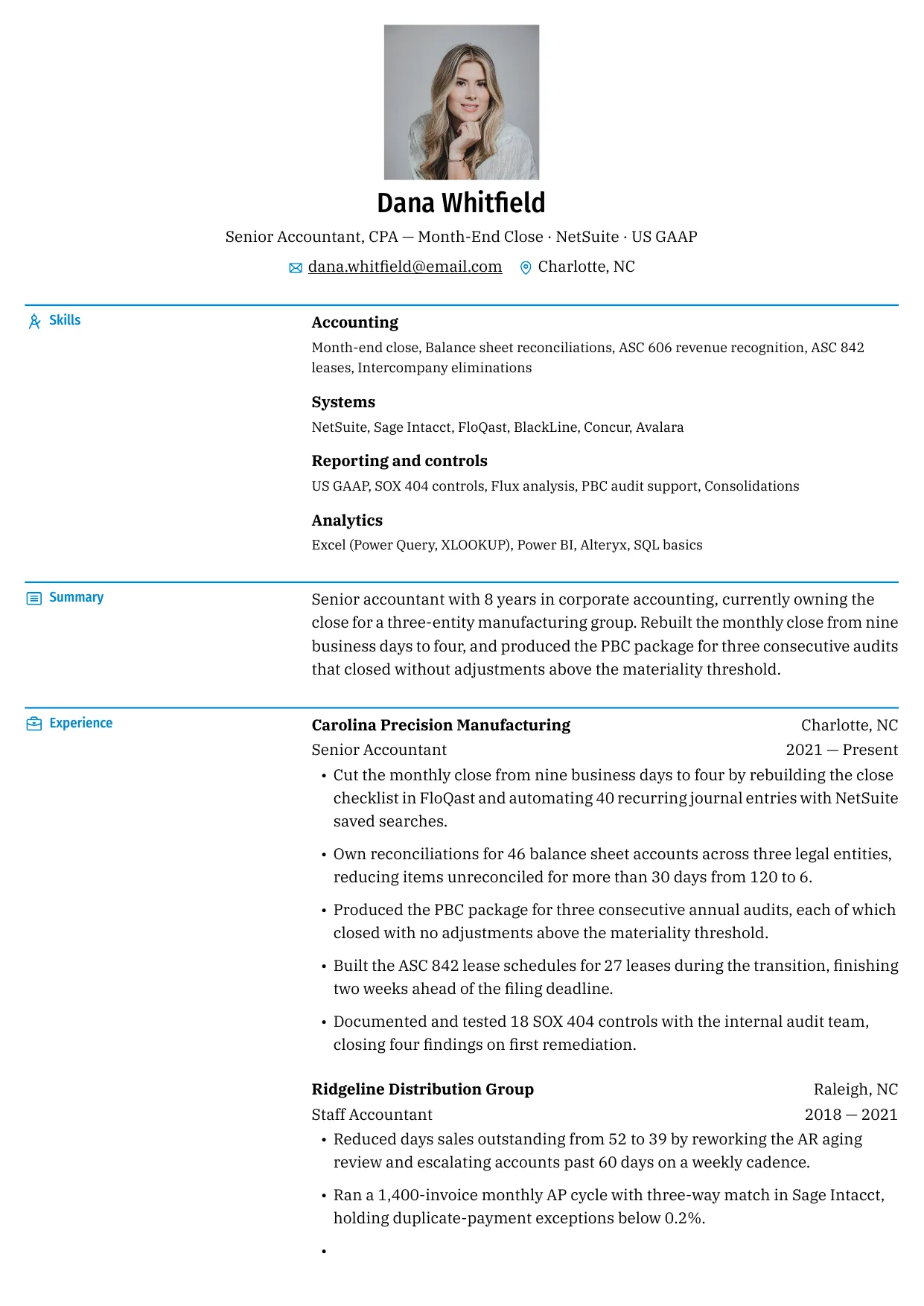
The example below follows the canonical order: header, summary, experience newest-first with dates, then skills and education. Notice the first role carries the most detail and each earlier role carries less — that gradient is what keeps a chronological resume from reading as a flat list.
Example resume
A one-page, ATS-safe resume in reverse chronological format — the default structure our builder produces. Export PDF or DOCX, no account needed.
Showing 3 of 15 free templates — open the builder to browse every layout. All 15 are free.
Common reverse chronological mistakes
- Burying the current role. Anything before it — a career objective, a wall of skills, an education block — delays the one thing the reader came for.
- Equal detail for every job. A 2009 internship does not need five bullets. Detail should decay with age and relevance.
- Decorative date columns. Right-aligned dates in a separate table column often break the title-date association in parsing.
- Unexplained gaps. If there is a gap the reader will notice, address it in the summary or with a truthful line item (caregiving, study, contract work) rather than letting the dates speak alone.
- Mixing formats mid-resume. Functional-style skill groups sandwiched between dated jobs confuse both the reader and the parser about what the page's organizing principle is.
Whichever variant you choose, keep one thing constant: a single linear document. ShitResume's templates share the same structure by design — what you see on screen is the exact order an ATS extracts, so a reverse chronological resume stays reverse chronological after parsing.
Skills and keywords for this role
Use the terms that genuinely describe your work — an interviewer will ask about anything you list.
- Section order: header → summary → experience (newest first) → skills → education
- Experience format: title, company, location, dates — most recent role always on top
- Date format: one style throughout, month + year (Mar 2022 — Present), aligned right or after the header
- Bullet rule: 3–5 outcome bullets for recent roles, 1–2 for older ones, past tense for past roles
- When to hybrid: career changes, gaps, and early-career candidates lead with projects or skills
- ATS rules: single column, standard headings, no tables, dates as real text, no images
Frequently asked questions
What is a reverse chronological resume?
A resume that lists work experience from most recent to oldest, with titles, companies and dates for each role. It is the default format for most applications because it answers the reader's first questions — where do you work now and how did you get here — in reading order, and it is the structure ATS parsers are built to extract.
Is reverse chronological better than functional?
For most candidates, yes. Functional resumes (organized by skill groups, often without dated roles) hide the timeline, which recruiters and ATS software both associate with gaps or padding. The hybrid format is the better escape hatch: keep dated, ordered experience but move a strong skills block above it when the history alone does not fit the target job.
How do I format dates on a chronological resume?
One consistent style throughout — “Mar 2022 — Present” is the safest. Put dates in plain text next to the title or company line, not in a separate column, table or text box. Right-aligned date columns look tidy but frequently break the date-to-job association when a parser reads the file.
Can I use a reverse chronological resume if I have a gap?
Yes — without lying about it. Keep the dated order, and address the gap once: a clause in the summary (“returning after a two-year caregiving break”) or a truthful line in the history. Gaps are common; unexplained gaps in a hidden timeline are what damage credibility. A hybrid format with projects at the top also shifts the first impression away from the gap.
Where does the skills section go in a chronological resume?
Either just below the summary or after experience — both work. Put it high when keywords carry formal weight (nursing credentials, IT stacks, trades certifications), and after experience when your roles are the stronger argument. What matters is that it is a plain labelled list, not a graphic or a table.
Do ATS systems require reverse chronological order?
They do not reject other orders outright, but they extract them worse. Parsing rules assume dated entries in a recognised experience section, which is exactly what the chronological format provides. When the parser misreads dates or scrambles order, the record it builds for the recruiter can be wrong — which is the failure that actually costs interviews.