Business Analyst Resume
A business analyst resume has to prove two things at once: that you can extract what stakeholders actually need, and that you can write it down precisely enough for a delivery team to build from. Below are the sections hiring managers look for, a full example, and the certifications worth naming.
Free forever. No account, no card, no catch — your data never leaves your device.
What a business analyst resume must include
- Summary — two or three lines naming your domains, your years in analysis, and one outcome you caused with a number attached.
- Experience — reverse-chronological, with the scale of each engagement (users, transactions, markets, headcount) and what changed because of it.
- Deliverables — the artifacts you produced: the BRD, functional specification, process redesign or traceability matrix. Owning that document is what a business analyst is hired for, so name the type rather than writing “requirements”.
- Skills — grouped into requirements, modeling, delivery and data, so a screener can match your stack against the posting in one pass.
- Certifications — CBAP, CCBA, PMI-PBA or Lean Six Sigma, with the awarding body and year.
- Education — degree and school; add relevant coursework only if you are early in your career.
Hiring managers read for scope and precision: how many stakeholders you kept aligned, how ambiguous the problem was, and whether your requirements survived contact with the build. A resume that lists methodologies without a single outcome reads as administrative, not analytical.
Business Analyst Resume Example
Example resume
An ATS-safe business analyst resume covering three roles across payments and insurance. This is the structure our builder produces — switch templates, export PDF or DOCX, no account needed.
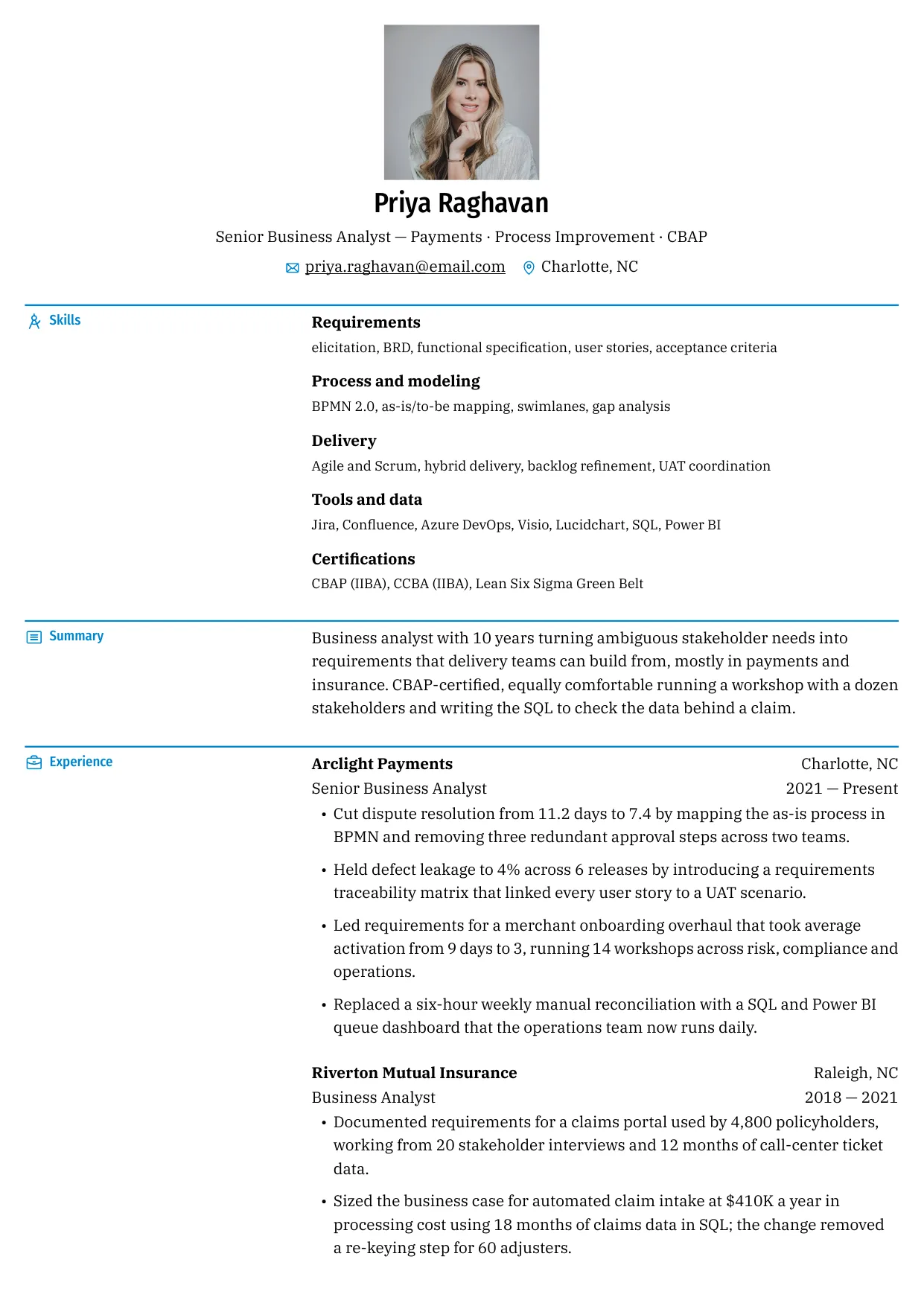
Showing 3 of 15 free templates — open the builder to browse every layout. All 15 are free.
How to write bullets that read as evidence
Business analysis is easy to describe in a way that sounds diligent and proves nothing. Name the change, the number and the mechanism: lead with the measurable result, then say what you did and with whom.
- Weak: “Responsible for gathering requirements from stakeholders and documenting them.” Better: “Ran 14 workshops across risk, compliance and operations to define onboarding requirements, closing 41 open questions before the build started.”
- Weak: “Worked on process improvement initiatives.” Better: “Cut dispute resolution from 11.2 to 7.4 days by mapping the as-is process in BPMN and removing three redundant approval steps.”
- Weak: “Analysed data to support business decisions.” Better: “Sized the business case for automated claim intake at $410K a year in processing cost, working from 18 months of claims data in SQL.”
Business analyst skills and keywords
Applicant tracking systems match your resume against the job description, so use the posting's exact terms wherever they are true of you. A BA description usually names a documentation artifact, a modeling approach, a delivery method and a reporting tool — cover all four.
- Requirements: elicitation, business requirements document, functional specification, user stories, acceptance criteria, requirements traceability matrix
- Process and modeling: BPMN 2.0, as-is and to-be mapping, swimlanes, use cases, data flow diagrams, gap analysis, root cause analysis
- Delivery: Agile, Scrum, waterfall, hybrid delivery, backlog refinement, UAT coordination, RACI, MoSCoW prioritisation
- Data and reporting: SQL, Excel with Power Query and pivot tables, Power BI, Tableau, data profiling
- Tools: Jira, Confluence, Azure DevOps, Visio, Lucidchart, Miro, ServiceNow
Certifications worth naming
Certification is one of the few parts of a BA resume that gets filtered mechanically, because many postings list CBAP or PMI-PBA as preferred. Name the credential, the awarding body and the year, and be accurate about status: “CCBA (IIBA), 2022” beats an unqualified “Certified Business Analyst”. Eligibility rules differ between bodies, so check the current requirements before you claim one.
- CBAP — IIBA's senior credential, aimed at analysts with years of documented business analysis work behind them.
- CCBA — IIBA's mid-level certification, for analysts past entry level who do not yet meet the senior thresholds.
- ECBA — IIBA's entry certificate, most useful when you are moving into analysis from another discipline.
- PMI-PBA — PMI's business analysis credential, common where the project office already runs on PMI certifications.
- Lean Six Sigma — Green or Black Belt, frequently requested for process-improvement and operations roles.
ATS notes for business analysts
- Keep the file to a single column. Two-column layouts and design-tool exports reorder text, so a parser can read your skills list before your job titles.
- Send a text-based PDF or DOCX. A scanned or image-only PDF gives the parser nothing to extract, however good it looks on screen.
- Spell an acronym out at first use, then use the short form — BPMN, BRD, UAT — because systems tokenise abbreviations inconsistently.
- Keep tables, text boxes and header or footer content for material that does not need parsing, such as a page number.
- Keep dates in one format and in reverse order. A parser that cannot follow your timeline may drop a role entirely.
ATS-friendly formatting only removes a way for a good resume to be lost. It does not turn a thin resume into a strong one, so put the effort into the outcomes first.
ShitResume was built around that last point: parsing should not be the variable. Every template uses one linear document structure, so the BPMN process maps, the BRD sections and the UAT traceability notes you write are identical content to the parser and to the PDF or DOCX you export. No fee is attached to creating it, and there is no sign-up step in the way.
No feature at ShitResume is locked: the templates, the exports and the PDF are all free to use. The document is assembled locally in the browser, so stakeholder names, workshop notes and business-case figures never leave the machine you are working on. No account means no profile to maintain between searches. The traceability matrix and the defect-leakage number are your evidence; the file just needs to preserve them.
Skills and keywords for this role
Use the terms that genuinely describe your work — an interviewer will ask about anything you list.
- Requirements: elicitation, BRD, functional specification, user stories, acceptance criteria
- Process and modeling: BPMN 2.0, as-is/to-be maps, swimlanes, gap analysis
- Delivery: Agile and hybrid methods, backlog refinement, UAT coordination, release readiness
- Data and reporting: SQL, Excel (Power Query, pivot tables), Power BI, Tableau
- Tools: Jira, Confluence, Azure DevOps, Visio, Lucidchart, ServiceNow
- Certifications: CBAP, CCBA, ECBA, PMI-PBA, Lean Six Sigma Green Belt
Frequently asked questions
What should a business analyst put at the top of a resume?
A summary naming your domain, your years in the role and one measurable outcome you caused. That line tells a screener what you know and what you changed, which is what they scan for first. Leave the methodology list for the skills section below.
Do I need a CBAP to get a business analyst job?
No. Most postings do not require a certification, though some list CBAP, CCBA or PMI-PBA as preferred and a few in regulated industries ask for one. Certification helps most when you are moving into analysis from another role, or where an employer screens on it mechanically.
How do I show business analysis experience if my job title was something else?
Describe the work rather than the title. Project coordinators, support leads, quality analysts and operations staff routinely gather requirements, map processes, write acceptance criteria and run UAT. Put those actions in your bullets with the artifact produced and what changed, and make the analysis work explicit in your summary.
How do I quantify impact when the delivery team owns the outcome?
Quantify the decisions you controlled rather than the revenue you did not. Requirements defects caught before build, open questions closed before a sprint started, days removed from a process and manual steps eliminated are all countable and all yours. Where a project saved money, credit the team and state your part.
Should a business analyst resume include SQL?
Include it if you can genuinely use it, because many postings expect an analyst to check the data behind a claim rather than wait for an extract. Be precise about the level: querying data for profiling and validation is a different claim from designing schemas.
Is one page enough for a business analyst resume?
Usually yes below about ten years of experience. Prioritise the roles where you owned requirements or process change, and compress early analyst work into a line or two each. If you have worked across very different domains such as banking and healthcare, a second page can earn its space — but only if it carries real detail.