Financial Analyst Resume
A financial analyst resume is read by people who check the numbers before they read anything else, so the first job is to show scale, ownership and accuracy. This page covers what to include, a complete worked example, the tools and certifications that carry weight, and how to keep an applicant tracking system from mangling a numbers-heavy layout.
Free forever. No account, no card, no catch — your data never leaves your device.
What a financial analyst resume must include
- A headline that names your lane — FP&A, corporate development, equity research, credit or treasury. “Financial Analyst” on its own is too broad to be useful.
- A summary that states the size you have owned (budget, revenue, portfolio or balance sheet) and one accuracy or savings result.
- Experience bullets that pair a number with the decision it drove, rather than describing the process you followed.
- A tools section that is specific: which ERP, which planning platform, and what you actually do in Excel or SQL.
- A certification line that shows where you are in the CFA or CPA program, not only the letters you already hold.
- Education with degree, institution and year. Add GPA only if you graduated recently.
Finance managers screen for two things at once: whether you have handled money at the scale of the open role, and whether your numbers can be trusted. A resume that lists responsibilities but never names an amount, a percentage or a deadline gives them nothing to verify.
Financial Analyst Resume Example
Example resume
A single-page, ATS-safe financial analyst resume. This is the exact structure our builder produces — switch templates, export PDF or DOCX, no account needed.
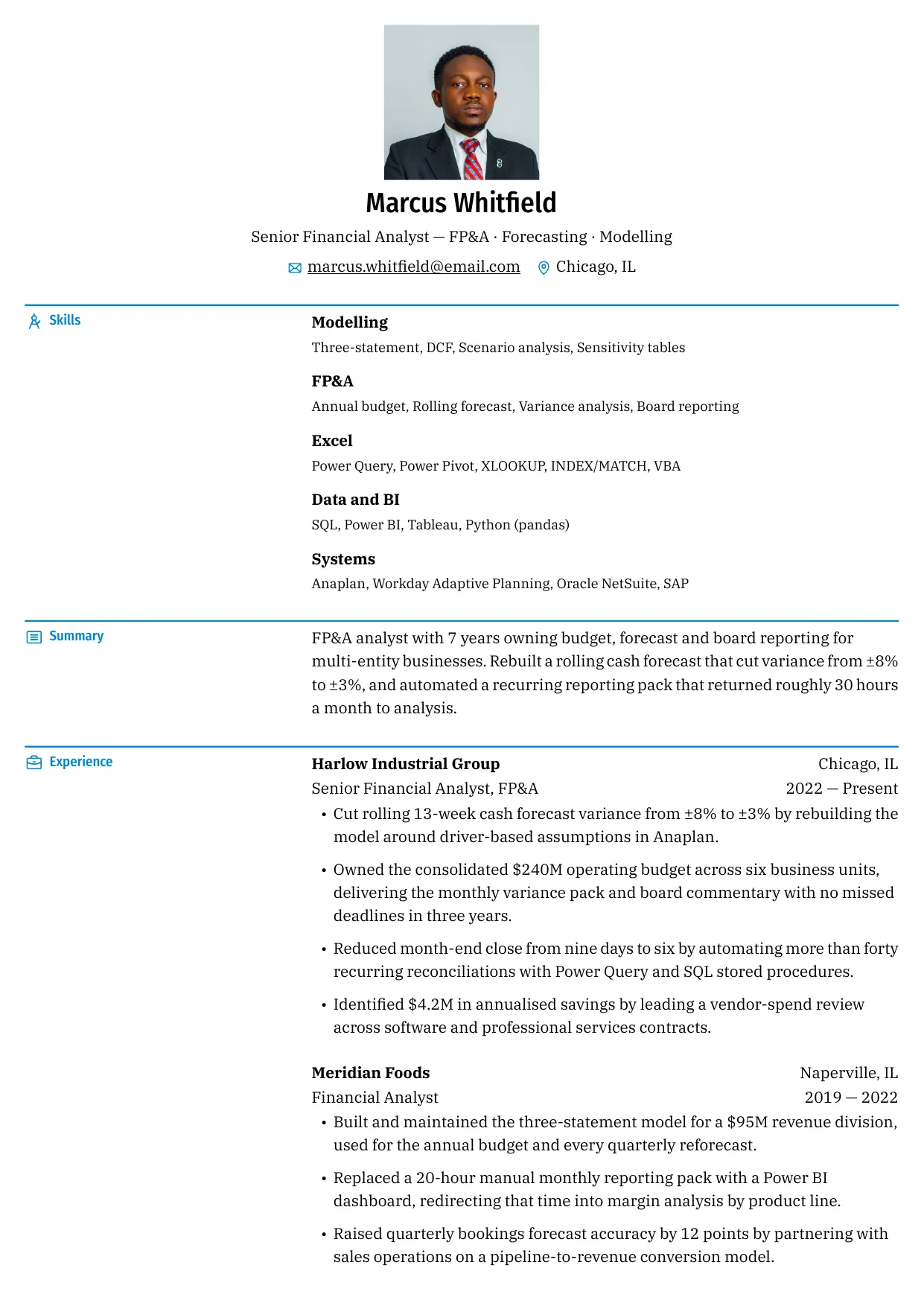
Showing 3 of 15 free templates — open the builder to browse every layout. All 15 are free.
Recommended sections for a financial analyst resume
- Summary — your function, the scale you own, and one quantified result.
- Experience — reverse-chronological, one number per bullet wherever you can manage it.
- Technical toolkit — ERP and planning systems, BI tools, and your genuine Excel and SQL level. Finance is one of the few fields where this earns its own block rather than a footnote.
- Certifications — levels passed and the sitting you are registered for, plus FPAC or CPA status where relevant.
- Education — degree, institution, year, and honours or relevant coursework if you are early in your career.
- Deal or portfolio exposure — only when targeting corporate development, investment banking or equity research, where transaction history is the first screen.
How to write the numbers
- Weak: “Responsible for monthly variance analysis.” Strong: “Cut monthly variance reporting from five days to two by rebuilding the pack in Power Query.”
- Weak: “Helped with the annual budget.” Strong: “Built the $120M annual budget for three cost centers across nine departments.”
- Weak: “Improved forecast accuracy.” Strong: “Lifted quarterly revenue forecast accuracy from 82% to 94% by adding a pipeline-conversion driver.”
- Weak: “Advanced Excel user.” Strong: “Automated twelve recurring reports with Power Query and XLOOKUP, removing around thirty hours of manual work a month.”
- Keep one headline number per bullet. Two competing figures dilute each other, and the reader stops at the first one.
Financial analyst skills and tools
Match the tooling in the job description wherever it is genuinely yours. Enterprise finance stacks vary widely between employers, so naming systems you have actually used beats a long list of categories.
- Modelling: three-statement models, DCF, WACC, comparable company analysis, scenario and sensitivity analysis, break-even, unit economics
- FP&A: annual budget, rolling forecasts, variance analysis, month-end close, working capital, capex planning, KPI reporting
- Excel: XLOOKUP, INDEX/MATCH, Power Query, Power Pivot, pivot tables, data validation, VBA
- Data and BI: SQL, Power BI, Tableau, Python (pandas) for larger datasets
- Systems: Anaplan, Workday Adaptive Planning, Oracle NetSuite, SAP, Hyperion, Planful
- Reporting: board packs, investor updates, management commentary, MD&A support, covenant reporting
Which finance role are you actually targeting?
These titles share a toolkit but hire on different evidence, and a resume written for one reads as unfocused to the others. Pick your lane and lead with its proof.
- FP&A — budget size owned, forecast accuracy, close-cycle improvements, and how often you present to leadership.
- Corporate development — deals screened and closed, pipeline value, integration or synergy tracking, and modeling under a deadline.
- Equity research — coverage universe, published estimates, earnings models, and any record of changing a rating before the market moved.
- Credit and risk — portfolio size, delinquency or loss trends, underwriting volume, and regulatory reporting you owned.
- Treasury — cash positioning, liquidity forecasting, hedging or banking relationships, and the balances under your control.
Certifications that carry weight
- CFA — three levels. State the levels passed and the one you are registered for, for example “CFA Level III candidate.”
- FPAC — the AFP credential aimed specifically at financial planning and analysis roles.
- CPA — strongest for accounting-adjacent finance roles. Licensure rules vary by state and country.
- FMVA and similar certificates — a useful signal of modeling training early on, with less weight once you have real budget or transaction experience.
- Check current eligibility, experience and continuing-education requirements with the awarding body: they change, and a stale claim is easy to spot in an interview.
ATS notes for finance resumes
- Finance teams lean on large applicant tracking systems, so keep the layout single-column and linear. The polished two-column consulting template is the most common way a strong finance resume gets scrambled.
- Keep numbers in plain sentences rather than tables or charts. Parsers frequently drop table content or flatten it into unusable order, and a figure the system cannot read may as well be absent.
- Currency symbols and percentages survive parsing inside a sentence. A standalone column of figures usually does not.
- Use the conventional headings — Experience, Education, Skills, Certifications. Expressive alternatives such as “Where I Have Made an Impact” often land in the wrong field.
- Write dates in one consistent format throughout, and place them in their own column rather than inside a sentence.
- Spell certifications out at first mention with the acronym in brackets — Chartered Financial Analyst (CFA) — because tokenisation differs between systems.
- Leave off photos, date of birth and marital status. They create bias risk in many markets and give a parser nothing to score.
ATS-safe formatting will not rescue a thin resume. Its only job is to stop a good one from being lost before a person reads it.
Variance analysis, three-statement models and forecast accuracy figures have to land as readable text before a hiring manager weighs them. ShitResume puts every template on one linear structure, so a numbers-heavy page parses in the order you built it and the PDF or DOCX export arrives the same way. Neither an account nor a card stands between your model and the exported file.
ShitResume is free to use: every template and every export, including the DOCX a corporate portal demands, costs nothing. The document runs in your browser, so budget figures and company names never leave the machine, and no account gets in the way. The model that lifted accuracy from 82% to 94% deserves a page that states it plainly.
Skills and keywords for this role
Use the terms that genuinely describe your work — an interviewer will ask about anything you list.
- Modelling: three-statement models, DCF, WACC, comparable company analysis, scenario and sensitivity analysis
- FP&A: annual budget, rolling forecasts, variance analysis, month-end close, capex planning, board reporting
- Excel: XLOOKUP, INDEX/MATCH, Power Query, Power Pivot, pivot tables, VBA
- Data and BI: SQL, Power BI, Tableau, Python (pandas)
- Systems: Anaplan, Workday Adaptive Planning, Oracle NetSuite, SAP, Hyperion, Planful
- Credentials: CFA candidate, FPAC, CPA, FMVA
Frequently asked questions
How long should a financial analyst resume be?
One page is the norm for most financial analysts, and two is fine only when the second page is genuinely full of relevant transaction, modeling or leadership detail. Finance reviewers are used to dense one-pagers, so length is not a substitute for specificity.
Should I list Excel skills on a finance resume?
Yes, and be precise rather than writing “advanced.” Name what you build with: XLOOKUP, INDEX/MATCH, Power Query, Power Pivot, pivot tables, VBA. Interviewers routinely ask you to demonstrate these live, so claim only what you can use under pressure.
Do I need the CFA to get a financial analyst job?
No. Many FP&A, credit and corporate finance roles hire on modeling ability and business partnership and never ask for it. The CFA carries the most weight in equity research and asset management; elsewhere it is a differentiator rather than a requirement.
How do I show forecast accuracy on a resume?
Name the metric you moved and the period: “raised quarterly forecast accuracy from 82% to 94%” or “held variance under 3% for twelve consecutive quarters.” If your employer does not track it, describe the consequence instead — a reforecast that changed a hiring plan, or a budget that held without a mid-year cut.
Do I need SQL or Python as a financial analyst?
Increasingly useful, not universally required. Larger employers with big datasets value SQL for pulling your own data, and Python helps with automation and large models. Smaller finance teams still run almost entirely on Excel and a planning platform, so prioritize those unless the job description says otherwise.
What if I am moving into finance from another field?
Lead with the transferable numbers you already owned: the budget you managed, the analysis you ran, the system you implemented. A modeling certificate can give you a visible signal, and the easiest entry point is usually a team whose business you already understand — operations experience is an advantage in FP&A supporting operations.
Should I include a photo or my date of birth?
No. In most markets these invite bias, and some employers are obliged to strip them from applications. They also give an applicant tracking system nothing to read, so they only consume space you could use for a result.