Combination Resume Template
A combination resume leads with skills and follows with a dated work history: the competency block answers “what can this person do?” in the first screen, and the experience section answers “where did they do it, and when?” underneath. It is the honest answer to a career change, a gap or a set of skills that were spread across several jobs — and unlike a purely functional resume, it keeps the dates a recruiter and a parser both need.
Free forever. No account, no card, no catch — your data never leaves your device.
Most format advice splits into two camps — reverse-chronological or functional — and the combination format exists because both have a failure mode. A strictly chronological resume buries a career changer's relevant skills under years of other work; a functional resume hides the dates, which reads as concealment to most recruiters and often parses badly. The combination format keeps the skills up top and the dated history below, so nothing is hidden and the relevance is visible first.
What a combination resume template needs to hold
- Summary: two to three lines that name the target role and the two or three strengths that transfer into it.
- Core competencies: the skills block, grouped into three or four labelled sets and limited to terms you can defend.
- Experience with dates: reverse-chronological, every role with month and year, and bullets that prove the competencies above.
- Education and certifications: degrees, licences and courses with dates, kept in a standard section.
- A gap note where one is needed: a single line — caregiving, study, relocation, contract work — is better than a silent hole.
Section order for a combination resume
- Header: name, target title, city and state, phone, email, portfolio or LinkedIn.
- Summary: the pitch, retargeted to the posting, with one measurable result.
- Core competencies: the grouped skills block — the section that defines the format.
- Experience: dated roles, most recent first, with the bullets that support each competency.
- Education and certifications: degree, school, year, then any certification that maps to the role.
Combination resume example
Example resume
A combination resume for a candidate moving from warehouse operations into supply-chain coordination: competency block first, dated history below. Switch layouts in the builder and export PDF or DOCX — free, no account.
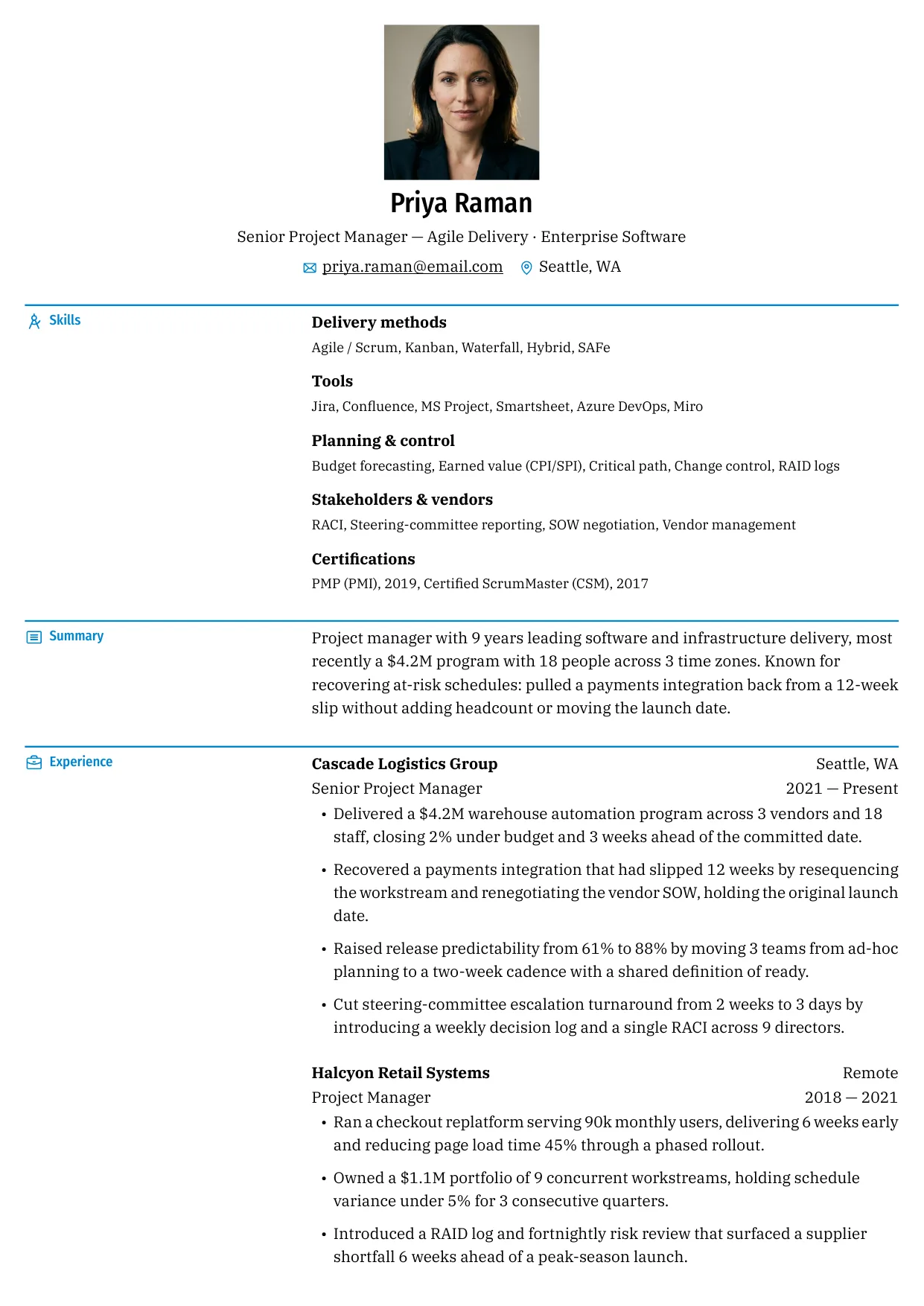
Showing 3 of 15 free templates — open the builder to browse every layout. All 15 are free.
How to build the core competencies block
- Harvest the terms from postings, not from memory. Collect five to ten postings for the role you want and keep the skills they repeat — those are the terms a filter is looking for.
- Group them by function, not alphabetically. “Operations”, “Systems” and “People” read as a profile; a flat A–Z list reads as keyword stuffing.
- Cap it at about twelve items. Beyond that the block competes with the experience section instead of introducing it.
- Prove each competency below. If a skill appears in the block, at least one dated bullet must show it in use — otherwise delete it from both places.
- Write the target title into the summary. A combination resume only works when the reader understands what it is combining toward.
When to use a combination format — and when not to
Use it when your skills are stronger than your chronology: a career change, a gap of a year or more, years of contract and agency work, or a move between industries where the vocabulary changes but the work does not. Do not use it when your history is linear and in the same field as the job — a straight chronological resume is shorter, more familiar to recruiters and easier to screen. If you are unsure, read the posting: employers that ask for a “traditional format” or a “chronological resume” have said which one they want.
ATS notes for a combination resume
- Keep the competencies as plain text groups — no icon grids, no star ratings and no skill bars, none of which carry a value a parser can read.
- Keep the date column in the main text flow so each role keeps its start and end dates after extraction.
- Do not use the functional shortcut of dropping dates entirely; a parser that cannot find tenure often ranks the resume lower.
- Use standard headings — Summary, Skills, Experience, Education — even though the layout puts skills before experience.
- Export a PDF with selectable text, and check that the competency block did not turn into a table during design.
Common mistakes on a combination resume
- Filling the competencies block with skills that appear nowhere in the experience section.
- Turning it into a functional resume by removing dates “to keep it clean”.
- Repeating the summary word for word in the competencies block.
- Leaving an employment gap unexplained when one honest line would remove the question.
- Listing generic traits — “team player”, “detail-oriented” — instead of tools, methods and verifiable skills.
- Using a two-column layout where the competency block and the experience dates sit in separate columns that extract out of order.
The layouts above are built from the templates ShitResume ships, and each one keeps the competency block and the dated history in the same reading order for people and for software. Because the builder runs in the browser, experimenting with the structure costs nothing: try a layout, export the PDF, and switch again if the emphasis does not land. Every template and export is free, with no account required.
Skills and keywords for this role
Use the terms that genuinely describe your work — an interviewer will ask about anything you list.
- Structure: summary → core competencies → experience (dated) → education → certifications
- Competency block: 8–12 items in 3 groups, each one traceable to a bullet in the experience section
- Dates: month and year on every role — a combination format never hides chronology
- Best used for: career changes, employment gaps, contractors with many short roles, skills spread across industries
- Keep chronological when: your history is linear and in the same field as the job
- ATS check: skills as plain text groups, not icons, ratings or skill bars
Frequently asked questions
What is a combination resume?
A combination resume puts a grouped skills or core-competencies block near the top, above a reverse-chronological experience section with full dates. It shows what you can do before where you did it, without hiding your employment history the way a functional resume does.
When should I use a combination resume?
Use it when your skills matter more than your timeline: a career change, a gap of a year or more, contract and agency work, or experience spread across industries. If your history is linear and in the same field as the job, a standard chronological resume is the simpler and safer choice.
Is a combination resume ATS-friendly?
Yes, when the skills block is plain text and the experience section keeps its dates. It fails when the competencies are rendered as icons, ratings or skill bars, or when the layout splits the dates into a separate column that extracts out of order. The layouts on this page keep both in the main text flow.
What is the difference between a combination and a functional resume?
A functional resume organises everything by skill and often leaves dates out of the work history, which reads as concealment. A combination resume organises the skills first but still lists every role with month and year, so the reader can verify tenure and progression immediately.
How long should a combination resume be?
One page for under roughly ten years of experience, two pages when the history genuinely needs it. The competency block usually adds a few lines compared with a chronological resume, so trim older roles to their employer and dates to keep the total within a page.
How do I explain a career gap on a combination resume?
Add one line in the experience section with the dates and a plain description — caregiving, study, relocation, contract work — and then list what you did that is relevant: a certificate completed, a project, volunteering. A named gap is a fact; an unexplained one is a question the reader has to answer for you.