One Page Resume Template
A one-page resume is not a shorter version of the same document — it is an editing decision with a budget attached. One page forces every line to earn its place: a summary that says something, bullets that lead with outcomes, skills grouped instead of scattered, and no section that exists only because a template had room for it. This page shows a one-page template in three layouts and the section-by-section budget that keeps you inside the page without shrinking the type.
Free forever. No account, no card, no catch — your data never leaves your device.
Recruiters read the first page in detail and the second only when the first earned it — which is why a tight single page outperforms a padded two-page document for most applicants. The trap is not length itself; it is what people do to reach it. Shrinking the font to 9pt, deleting spacing between sections or cutting the dates off old roles all damage the document to satisfy a page count. A template with a fixed structure makes the trade-offs visible before they become formatting problems.
What a one-page template has to do differently
- Set a bullet budget. One page holds roughly 12–16 experience bullets in total. Allocate them before writing: current role 3–4, previous role 2–3, everything older 1–2.
- Group skills instead of listing them. Four labelled groups of four items fit in a few lines; a 30-item keyword wall eats a third of the page and reads as padding.
- Keep the summary to two lines. On a one-page resume the summary is a signpost, not a paragraph — identity, specialty, one outcome.
- Compress old history. Roles older than about ten years can share a single “Earlier experience” line unless they are directly relevant.
- Use the same date format everywhere. Month and year is the most compact honest option and it keeps the page break predictable.
Section order for a one-page resume
- Header: name, target title or credential, city and state, phone, email, one relevant link.
- Summary: two lines — role, years, specialty, one measurable result.
- Experience: reverse-chronological, with the most relevant role first and the rest compressed as you go back.
- Skills: three or four groups of the terms the posting uses, kept after experience unless you are changing fields.
- Education: degree, school, year — one line if the degree was long ago, more detail if you are early in your career.
One-page resume example
Example resume
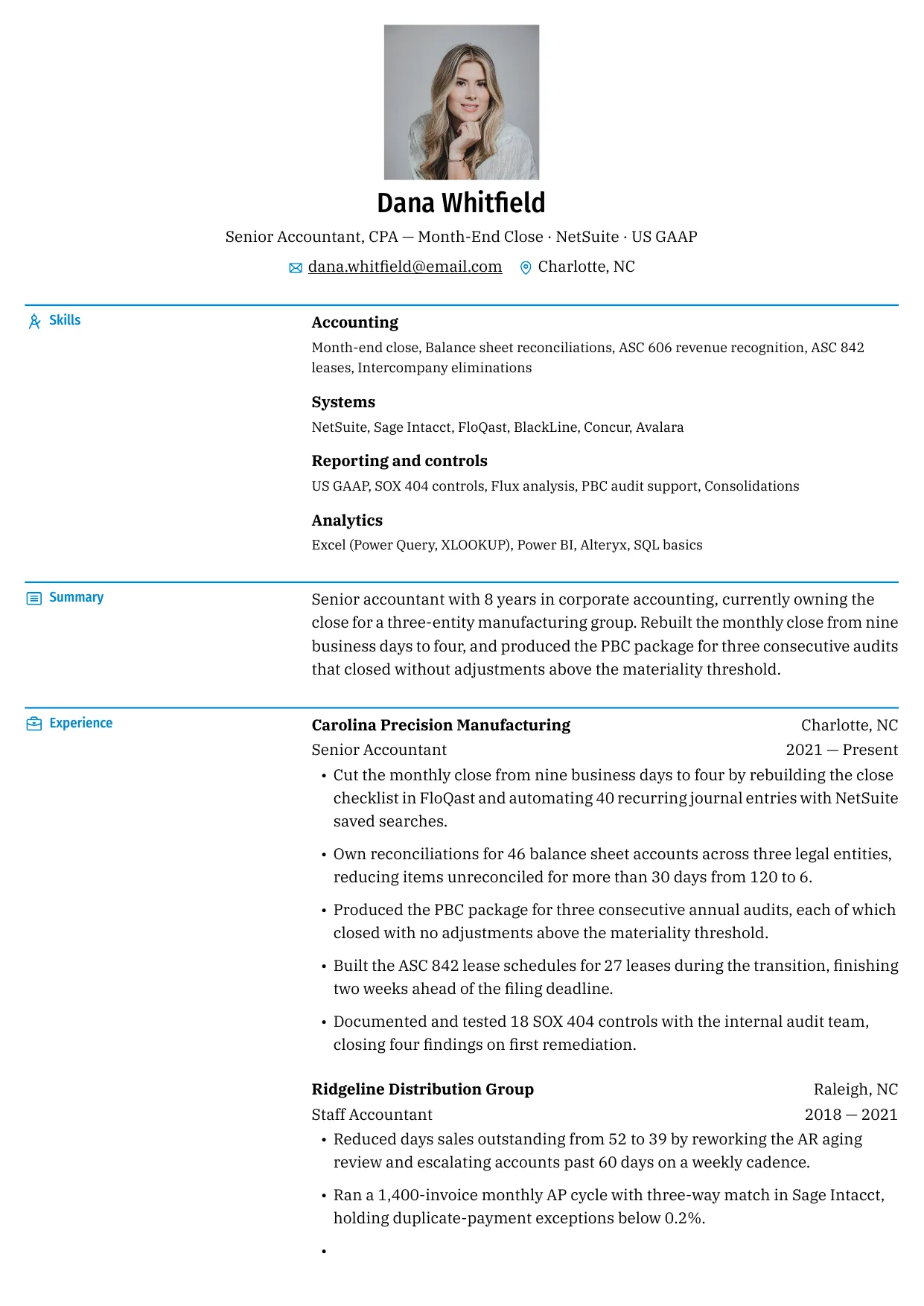
A complete one-page resume in this template: two-line summary, a 3/2/1 bullet split across roles, grouped skills and a single-line education entry. Switch layouts in the builder and export PDF or DOCX — free, no account.
Showing 3 of 15 free templates — open the builder to browse every layout. All 15 are free.
What to cut first when you are over the page
- References and “available on request”. They are assumed; a separate reference sheet is the right place for the details.
- Hobbies, interests and personal statements. Unless a hobby is a professional qualification, it is not evidence.
- Duties that repeat across roles. If two jobs involved the same tasks, describe them once where the work mattered most.
- Old, irrelevant roles. Keep the employer and dates on one line, and drop the bullets entirely.
- Object-stuffing in the skills list. Tools you used once in 2014 are not skills; the interview question they invite is a risk, not an asset.
- Wide margins and headline blocks. You do not need a banner. Reclaiming two lines from the header is free space for a bullet that proves something.
When two pages is the better answer
One page is a guideline, not a rule. Two pages are reasonable when the relevant history genuinely does not fit — ten or more years in the same field with promotions, a senior specialist carrying certifications and publications, or a manager with a record of measurable scale. The test is whether page two contains experience that changes what you can be hired for. If it contains a summary repeated with different adjectives, you have a one-page resume with a spare sheet of paper attached.
ATS notes for one-page resumes
- Keep body text at 10.5pt or larger — small type is the most common reason an older parser misreads a line.
- Never shrink the page by putting content in a header, footer or text box; those regions are dropped before parsing.
- Use one column for the main history and keep sidebars for skills, so a reflow cannot reorder your roles.
- Check that the contact line is plain text in the body of the page, not part of a design element.
- Export as PDF with selectable text: if you can highlight a sentence in the file, a parser can read it too.
Common one-page mistakes
- Reducing the font and margins instead of cutting content.
- Rewriting bullets into one long paragraph to save lines, which makes the page harder to scan.
- Cramming three jobs from a decade ago into full detail while the current role gets two bullets.
- Deleting dates to make the layout fit, which leaves a parser unable to calculate tenure.
- Using a layout with a large photo or banner that consumes space without carrying information.
- Cutting the education line for an early-career applicant, where it is still the strongest credential.
The layouts on this page are three of the templates ShitResume ships, and all of them hold a one-page document without a banner or a page-break surprise. Because the builder runs in the browser and stores the resume on your device, trimming a role, moving a section or reverting an edit costs nothing — and the PDF or DOCX export stays free, with no account required.
Skills and keywords for this role
Use the terms that genuinely describe your work — an interviewer will ask about anything you list.
- Format: single page, reverse-chronological, most recent role first
- Bullet budget: 3–4 for the current role, 2–3 for the previous, 1–2 for older roles
- Sections that stay: header, summary, experience, skills, education
- Sections that go: references, hobbies, “interests”, full mailing address, photo
- Spacing that survives editing: body text 10.5–12pt, margins 0.5–1 inch, consistent paragraph spacing
- Check before export: no orphan line on page two, no clipped date, PDF opens with selectable text
Frequently asked questions
Is a one-page resume still the standard?
For most applicants under about ten years of experience, yes. One page keeps the reader on the page that decides the interview and forces every bullet to carry evidence. Past ten years, or with promotions and certifications that change what you can be hired for, a second page is reasonable.
How many bullets fit on a one-page resume?
Roughly 12–16 experience bullets in total at 10.5–12pt with normal margins. A workable split is 3–4 for the current role, 2–3 for the previous one and 1–2 for older roles, with four labelled skill groups and a two-line summary. If you are over, cut duties that repeat between roles.
Can I use a two-column template for a one-page resume?
Yes, as long as the main history stays in one column. A sidebar for skills is fine and keeps the page airy; what breaks parsing is spreading dates and role titles across two columns, because extracted text can reorder them. Three layouts on this page handle that split correctly.
What should I remove from my resume to get it down to one page?
References, hobbies, personal statements, duties that repeat across roles, older roles without bullets, and skills you no longer use. What you should not remove is dates, the education line for early-career applicants, or any bullet with a number in it — those are the lines doing the work.
Does a one-page resume hurt experienced applicants?
Only if it drops history that matters. If the last ten years hold the relevant, promoted experience, one page can carry it. If the earlier roles or certifications are part of why you are being hired, use two pages and make sure the second page contains experience rather than a repeated summary.
How do I shrink a resume without making it unreadable?
Cut content before you cut type. Keep the body at 10.5pt or larger, margins at half an inch minimum, and consistent spacing between sections. If it still does not fit, remove the least relevant older role's bullets, compress the skills groups, and shorten the summary to two lines.