Project Manager Resume
A project manager resume is judged on scale and control: what you delivered, how large the budget and the team were, and what happened when the plan slipped. This page gives you a complete, ATS-safe example, the sections hiring managers look for, and the keywords and certifications that belong on it.
Free forever. No account, no card, no catch — your data never leaves your device.
What a project manager resume must include
- A headline that names your delivery method and domain — “Senior Project Manager, Agile software delivery” beats “Project Manager.”
- Scale in the top third: the largest budget you have owned, the team size, and how many workstreams or vendors ran at once.
- Bullets that pair an outcome with the constraint you were managing. “Delivered 14 releases on a $4.2M budget with no unplanned scope” says far more than “managed the project plan.”
- A selected-projects section if your job title understates the work, because a PM career is really a list of deliveries.
- Certifications placed where a screener will find them, with the issuing body and the year.
- Tools named concretely (Jira, MS Project, Smartsheet) instead of the phrase “project management software.”
Hiring managers read a PM resume looking for evidence of control rather than activity. Anyone can Chair a weekly status call. What matters is what happened to the schedule, the budget and the risk register while you were the one accountable for them.
Project Manager Resume Example
Example resume
A single-page, ATS-safe project manager resume with budget, team size and delivery method up front. It is the structure our builder produces — switch templates, export to PDF or DOCX, no account needed.
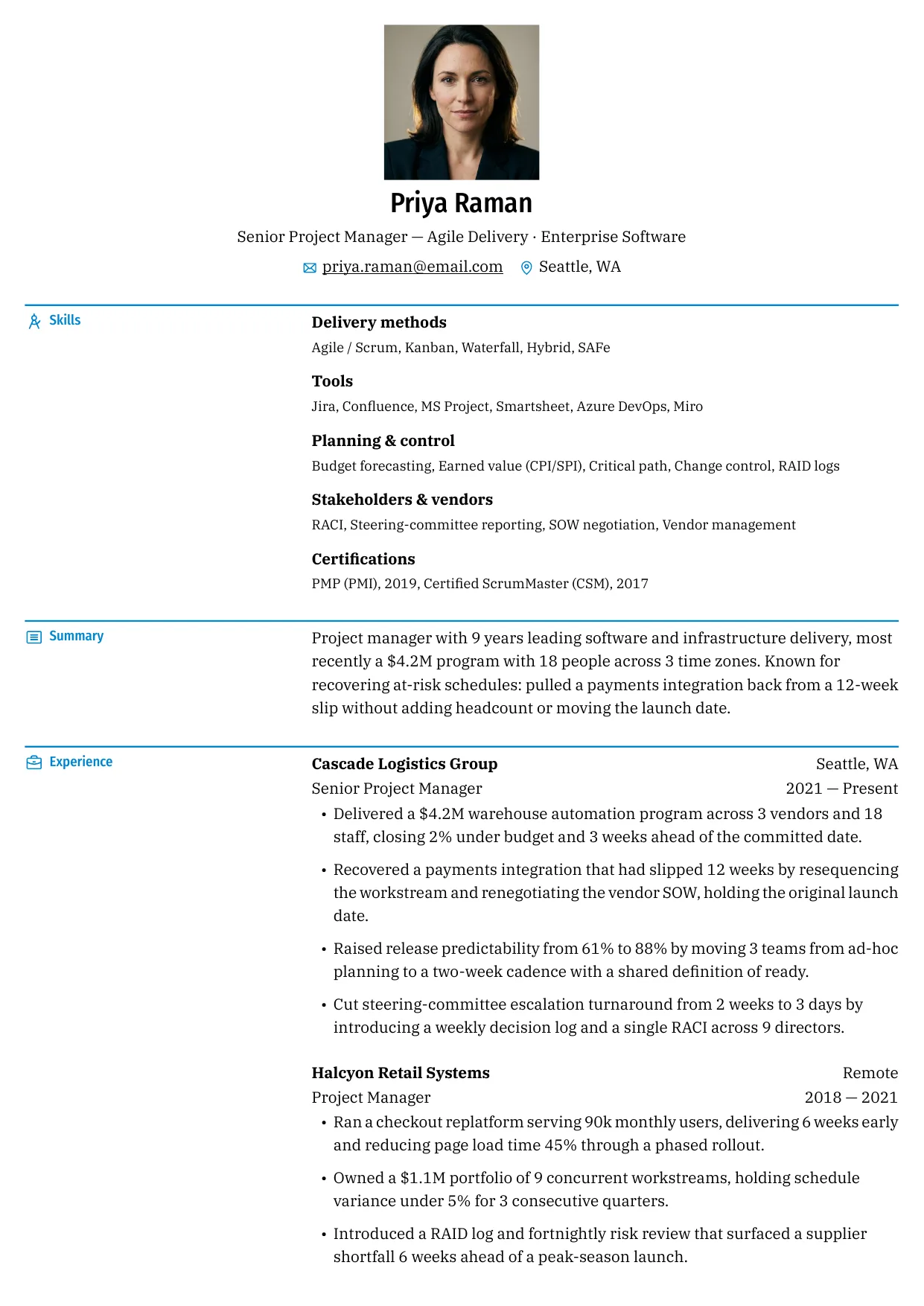
Showing 3 of 15 free templates — open the builder to browse every layout. All 15 are free.
Recommended sections for a project manager
- Summary — delivery method, domain, years of experience, and one scale number (budget or team size).
- Experience — reverse-chronological, three to five bullets for recent roles.
- Selected projects — three or four entries with budget, team size and outcome. Use it when a single employer does not convey the range of what you ran.
- Certifications — PMP, CAPM, CSM or PRINCE2 with issuer and year. Nothing you have not actually earned.
- Skills — separate methods from tools, because one posting screens for Agile and the next screens for Jira.
- Education — degree and year. Drop the coursework line once you have real delivery history behind you.
How to write bullets that hold up in an interview
The strongest PM bullet has three parts: the outcome, the constraint you were working against, and the mechanism you used to get there. Leave out the weekly rituals — standups and status reports are assumed to exist. Show the decisions instead.
- Weak: “Managed a website replatform project.” Stronger: “Replatformed checkout for 90k monthly users, landing 6 weeks early by resequencing the payments workstream.”
- Weak: “Responsible for budget.” Stronger: “Owned a $4.2M capital budget across 6 vendor contracts, closing 2% under forecast.”
- Weak: “Communicated with stakeholders.” Stronger: “Ran a steering committee of 9 directors and cut escalation turnaround from 2 weeks to 3 days with a weekly decision log.”
- Weak: “Managed risks.” Stronger: “Surfaced a supplier shortfall in the risk register 6 weeks ahead, reordered procurement and protected the peak-season launch.”
- Weak: “Led an Agile team.” Stronger: “Coached 3 teams from ad-hoc boards to a stable two-week cadence, lifting release predictability from 61% to 88%.”
Your numbers do not need to be enormous. Predictability, variance and cycle time matter as much as the size of a budget, and modest figures you can explain clearly survive an interview better than round ones you cannot.
Project management skills and keywords (2026)
Screening software matches your resume against the wording of the job posting. Mirror the terms you genuinely work with, and keep methods separate from tools so a keyword match finds both.
- Methods: Agile, Scrum, Kanban, Waterfall, hybrid, SAFe, critical path, work breakdown structure
- Scope and schedule: requirements traceability, change control board, dependency mapping, milestone planning
- Cost: budget forecasting, earned value management (CPI, SPI), vendor and SOW management, purchase orders
- Risk and quality: RAID logs, risk registers, contingency planning, acceptance criteria, UAT coordination
- Tools: Jira, Confluence, MS Project, Smartsheet, Asana, Monday.com, Azure DevOps, Miro
- Stakeholders: RACI, steering-committee reporting, communications planning, executive status dashboards
Certifications: what to list and how
- PMP (Project Management Professional), issued by PMI — the most widely requested PM credential. It requires documented project experience in addition to the exam.
- CAPM — the entry-level PMI credential, a reasonable step before you have the hours a PMP asks for.
- CSM or PSM I — Certified ScrumMaster or Professional Scrum Master, relevant when you lead Agile delivery rather than only coordinating it.
- PRINCE2 — frequently requested for public-sector and UK or EU delivery roles.
- PMI-ACP or SAFe — worth adding when your teams run Agile beyond a single squad.
Give each credential its acronym, its issuing body and the year, because employers do verify them. Requirements and even names differ between countries and industries, so confirm the current standard with the awarding body before you write a claim — and never present something you are still studying for as if you already hold it.
ATS tips for project managers
- Keep the file single-column. PM resumes attract table-heavy templates, and parsers read tables cell by cell, which scrambles your job titles and dates.
- Put budget and team size in the running text rather than in a chart or metric graphic, since graphics are invisible to a parser.
- Write job titles in their conventional market form. An internal label like “Delivery Lead II” is clearer alongside the standard title it maps to.
- Send a PDF or DOCX with selectable text. An image-only or scanned export leaves the system nothing to read.
- Keep the certifications block in the main body. A sidebar is often parsed after everything else, so qualifications can land in the wrong place.
ShitResume gives every template the same linear spine, so job titles, delivery dates and PMP or PRINCE2 credentials hold their sequence through the parse. There is no trial to sit through and no fee to reach the export — the schedule chart stays out of the file and the text does the work.
Formatting fixes do not turn a thin delivery record into a strong one. They only remove the mistakes that lose a solid PM resume before a person reads it.
ShitResume is free across every template and every export, keeps program budgets and stakeholder details in the browser, and never asks for a login. One file can support a PMP-track application and an Agile delivery role without a rebuild from scratch.
Skills and keywords for this role
Use the terms that genuinely describe your work — an interviewer will ask about anything you list.
- Certifications: PMP, CAPM, PMI-ACP, PRINCE2, Certified ScrumMaster (CSM)
- Delivery methods: Agile/Scrum, Kanban, Waterfall, hybrid, SAFe
- Tools: Jira, Confluence, MS Project, Smartsheet, Asana, Azure DevOps, Miro
- Core skills: scope management, schedule planning, budget forecasting, risk management, stakeholder communication
- Controls: RAID logs, change control board, earned value (CPI/SPI), RACI, vendor and SOW management
- Domains: software delivery, infrastructure, marketing campaigns, construction, healthcare
Frequently asked questions
How long should a project manager resume be?
Two pages is normal once you have more than about eight years of delivery experience, because a projects list takes space. Earlier on, one page forces you to keep only the work that shows control of scope, schedule or budget. Length is not the goal; scale and outcome are.
Should I put PMP at the top of my resume or at the bottom?
Near the top, either in its own short block or in the summary line, and again wherever the posting names it. Screeners frequently search for “PMP” as a literal string, so make it easy to find. Include the acronym, the issuing body and the year you earned it, and leave off anything you have not completed.
Do I need a PMP to get a project manager job?
No, though it helps in larger organizations, government work and industries with formal governance. Many employers list it as preferred rather than required, and documented delivery experience with a different credential can meet the same bar. Requirements vary by employer, sector and country, so read each posting rather than assuming a rule.
How do I show project scale on a resume?
Give three numbers in context: the budget you owned, the team size, and how many workstreams, vendors or sites were involved. “Led an 18-person team across 3 time zones on a $4.2M program” tells a hiring manager what level you operate at. Approximate figures are fine if you can explain them.
What is the difference between a project manager and a program manager on a resume?
Scope and horizon. A project manager delivers one defined outcome inside a fixed budget and date, while a program manager coordinates several related projects toward a business benefit and manages the dependencies between them. If you have done both, describe the program work in its own role entry instead of blurring the two titles together.
How do I explain a project that failed or got cancelled?
Describe your role, the constraint that changed, and what you did with it. “Escalated a 12-week vendor slip within a week, renegotiated the SOW and recovered the launch date” is stronger than a silent gap in the timeline. Hiring managers care more about how you handle a plan going wrong than about a project that ran perfectly.
Which is better to put on a resume, Agile or Waterfall?
Whichever you actually used, and for most project managers the honest answer is both. Name the method where it suits the role: Agile or Scrum for product delivery, Waterfall or hybrid for regulated, hardware and construction work. Claiming Agile for a fixed-scope project is easy to expose in an interview.