Product Manager Resume
A product manager resume is judged on the outcomes you produced, not the process you used to reach them. Below is a complete example, the metrics hiring managers scan for, and how to write discovery and delivery work so it reads as impact rather than activity.
Free forever. No account, no card, no catch — your data never leaves your device.
What a product manager resume must include
- A headline naming your product area and seniority — “Senior PM, payments and risk” tells a recruiter far more than “Product Manager.”
- A summary stating the products you owned, who used them, and one measurable outcome.
- Experience bullets that pair a business metric with the decision behind it: activation, retention, revenue, or cost.
- Evidence of discovery — interviews, experiments, or research — because hiring managers want proof you decide with evidence, not only that you shipped.
- The scale you operated at: users, revenue, transaction volume, team size, or number of markets.
- A skills block that separates product craft from the analytics and tooling stack you actually use.
The most common failure is a resume that describes a roadmap instead of a result. “Owned the checkout roadmap” says nothing about whether checkout improved. A hiring manager reads your resume to predict whether you can find the right problem and move a number, so every bullet should end somewhere measurable.
Product Manager Resume Example
Example resume
A one-page product manager resume using the outcome-first bullet shape described here. It is the kind of document the free builder produces — no account needed.
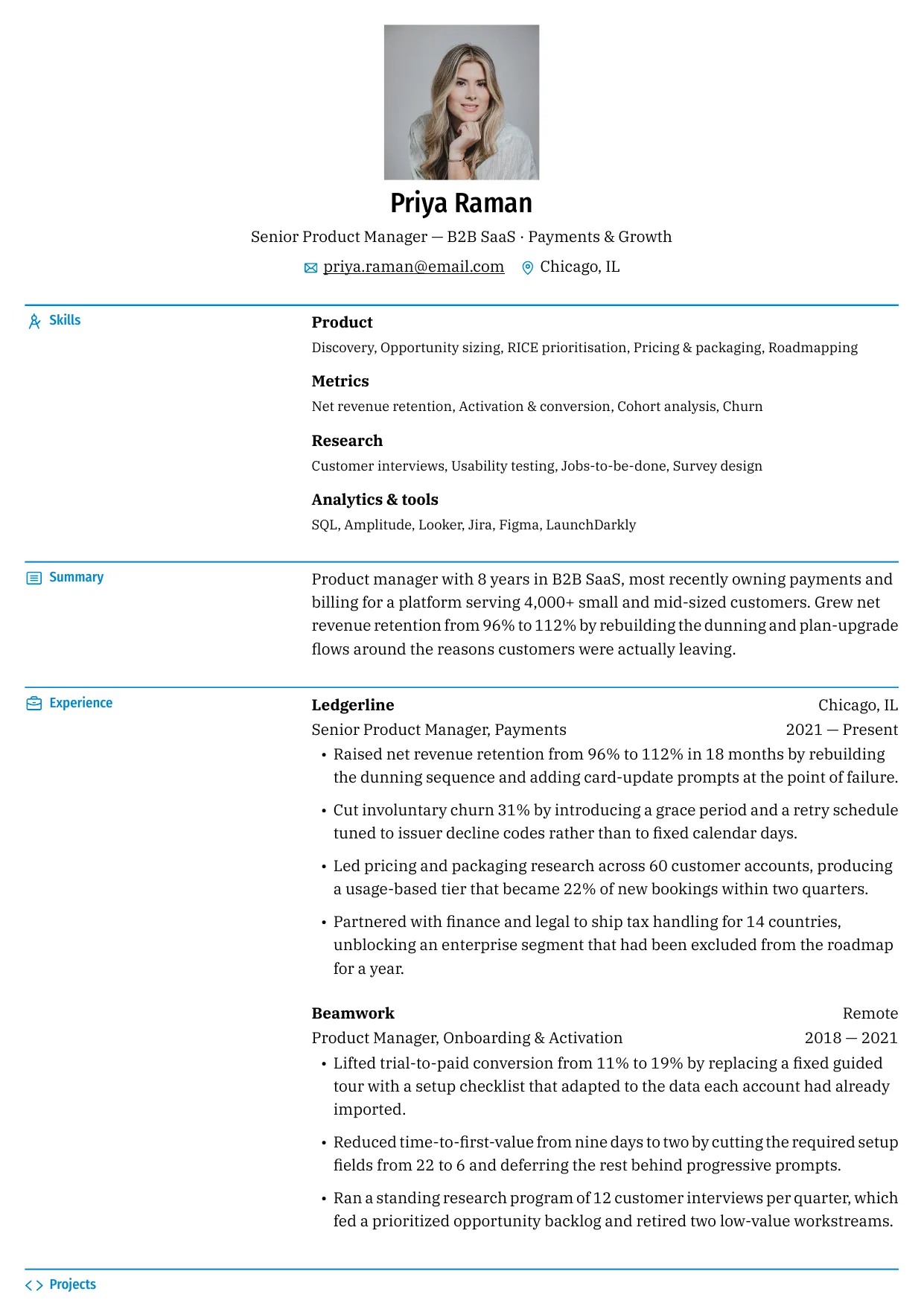
Showing 3 of 15 free templates — open the builder to browse every layout. All 15 are free.
Recommended sections for a product manager resume
- Summary — the product surface you know, your seniority, and your strongest number.
- Experience — reverse chronological, with the business metric first and the decision behind it second.
- Selected launches — two or three products or features, each with the outcome rather than a feature list.
- Skills — split into product craft, analytics, research, and tools.
- Education and certifications — degree, plus any product qualification named accurately.
- Portfolio or writing — one or two case studies, if the shipped work sits behind a login.
How to write product manager bullets that hold up
Use the same shape for every bullet: the outcome, then the decision behind it, then the scale it applied to. When you cannot attach a number, attach a concrete change of state — a flow that got faster, a churn segment that stopped leaving, a launch that unblocked a partner. Vague verbs like “drove,” “owned,” and “helped” are the tell of a resume that gets skimmed and forgotten.
- Flat: “Responsible for the onboarding experience.” Stronger: “Raised week-one activation from 34% to 51% by cutting the setup flow from nine steps to three.”
- Flat: “Worked with engineering on the payments roadmap.” Stronger: “Reordered the payments roadmap around failed-payment recovery, recovering an estimated $1.2M in annualised revenue.”
- Flat: “Ran user research.” Stronger: “Interviewed 40 churned accounts to find pricing confusion, then rewrote the plan-comparison page and cut billing support tickets 27%.”
- Flat: “Launched a mobile app.” Stronger: “Took the Android app from beta to 180k monthly active users in two quarters by sequencing offline mode ahead of social features.”
- Flat: “Managed stakeholders.” Stronger: “Aligned support, sales and legal on one data-retention policy, ending a three-quarter escalation loop and halving deal-review time.”
Product manager skills keywords (2026)
Job descriptions are written by teams with their own vocabulary. Read the posting and reuse its nouns where they honestly describe your work — “activation” and “onboarding” may mean the same thing, but a parser matches the word the posting used.
- Product craft: discovery, opportunity sizing, prioritisation (RICE, weighted scoring), roadmapping, product requirements, pricing and packaging
- Metrics: activation, retention and churn, net revenue retention, ARPU, LTV/CAC, conversion funnels, cohort analysis, North Star metrics
- Research: customer interviews, usability testing, surveys, jobs-to-be-done, competitive analysis
- Analytics and experimentation: SQL, Amplitude, Mixpanel, Looker, GA4, A/B testing, feature flags such as LaunchDarkly
- Delivery: agile and scrum, sprint planning, backlog prioritisation, cross-functional leadership, go-to-market coordination
- Tools: Jira, Linear, Confluence, Notion, Figma, Productboard, Pendo
ATS notes for product managers
- Give both forms of a term the posting uses — “A/B testing” beside “experimentation,” “KPIs” beside “key performance indicators” — because parsers tokenise differently.
- Keep metrics as text, not as an infographic. A growth chart is invisible to a parser, and it disappears from a plain-text export a recruiter may be reading.
- Avoid two-column layouts. They frequently interleave the columns and reverse your job titles and dates.
- Use standard section headings — Experience, Skills, Education. A creative heading like “Where I've Made an Impact” may not be recognized as experience at all.
- Put the product area and the metric in the bullet text, not only in a portfolio link that sits behind a login.
- Submit PDF or DOCX with selectable text. A scanned or flattened PDF cannot be parsed, so the content effectively does not exist.
ShitResume keeps every template to one linear document, so activation numbers, discovery methods and tool names such as Amplitude or Linear are read in the order you set them. It is completely free and takes no card, so cutting a tailored version per application carries no extra charge.
None of this replaces judgement about what to cut. A product manager resume is a one-page argument that you can find the right problem and move it, so anything that does not support that argument is spending space you need for the parts that do.
Every template on ShitResume is free, as is every export, and the product metrics you type stay in the browser with no account attached. A roadmap story for a fintech role and a growth story for a marketplace role can both be ready before the week's applications close.
Skills and keywords for this role
Use the terms that genuinely describe your work — an interviewer will ask about anything you list.
- Product craft: discovery, opportunity sizing, prioritisation (RICE), roadmapping, pricing and packaging
- Metrics: activation, retention, churn, net revenue retention, ARPU, conversion funnels, cohort analysis
- Research: customer interviews, usability testing, jobs-to-be-done, survey design, competitive analysis
- Analytics & experimentation: SQL, Amplitude, Mixpanel, Looker, GA4, A/B testing, feature flags
- Delivery: agile, sprint planning, backlog prioritisation, cross-functional leadership, go-to-market
- Tools: Jira, Linear, Notion, Figma, Productboard, Pendo, LaunchDarkly
Frequently asked questions
Should a product manager resume include a portfolio?
It helps when a link answers something a bullet cannot — how you framed a decision, what you considered, and what you rejected. Keep it to one or two specific case studies with the research, the options and the outcome. Leave it out when the work is confidential, and never point at a document the reader has to request access to.
How do I show product impact when I cannot share revenue numbers?
Use the strongest metric you are allowed to discuss: activation, retention by cohort, time-to-value, support-ticket volume, error rates, or the amount of manual work removed. If every number is confidential, describe the change of state in words — what was broken, what you changed, what got measurably better — rather than falling back on a list of responsibilities.
Do I need a product management certification?
Product management has no license or mandatory certification the way nursing or accounting does, and no course substitutes for evidence that you shipped something and moved a metric. Structured programs such as Pragmatic Institute or Reforge can help career switchers pick up vocabulary quickly, so list one if you finished it, and place it beside work that shows you applying it.
What is the difference between a product manager resume and a project manager resume?
They are different jobs that employers filter with overlapping keywords. A product manager resume should show ownership of what gets built and why — discovery, prioritisation, and the metric that moved. A project manager resume shows delivery against a fixed scope: schedule, budget, dependencies and risk. If you have done both, let the title on each role match the work it describes, because a keyword you cannot defend in the interview does more harm than the match does good.
How long should a product manager resume be?
One page up to roughly ten years of experience, two if your recent roles are dense and the second page is genuinely full. Senior candidates usually want more space than they get, so compress early roles to a line each and spend the room on the products and outcomes that match the job you are applying to.
How do I move into product management from engineering, design, or consulting?
Lead with product work you have already done, even when it was not your job title: a migration you scoped, a research project you ran, a pricing decision you influenced. Make the switch legible in the summary by naming the domain you know and the kind of product you want to own. Internal transfers are the most common route, so if you are applying externally, show that someone already trusted you with a product decision.