Operations Manager Resume
An operations manager resume has to answer one question quickly: what did your operation produce, at what cost, and with how many people? Scope, throughput and safety figures are the shorthand a hiring manager reads first, so they belong near the top of every role. Below is a worked example, the metrics that carry weight in 2026, and the formatting that stops an applicant tracking system from garbling your numbers.
Free forever. No account, no card, no catch — your data never leaves your device.
What an operations manager resume must include
- A scope line in every role: headcount, shifts, sites, SKUs, volume and budget. “Ran 42 associates across two shifts and a $2.4M operating budget” places you faster than any collection of adjectives.
- Flow numbers rather than activity. State what the operation produced per day or week and how long an order took to move from receipt to ship.
- Cost per unit or per shipped order, and what moved it. A cost line shows you own a slice of the P&L, not just the floor.
- Safety stated plainly — the rate you inherited, where it ended, and the mechanism that changed it. Operations leaders are judged on safety before anything else.
- Improvement work with a figure attached: kaizen events led, annualised savings delivered, and the metric that moved as a result.
- A dedicated Certifications block, because Lean Six Sigma belts, APICS/ASCM credentials and OSHA 30 are often screened as qualifying fields.
Operations resumes tend to fail in one of two directions: a list of responsibilities with no numbers, or a wall of numbers with no context. The fix is a repeatable bullet shape — the outcome first, then the action and the scale that produced it. Whoever is reading is comparing your figures against the size of the job they are filling, so make the league you played in obvious.
Operations Manager Resume Example
Example resume
A two-page, single-column operations manager resume. Every figure is written as real text, so both the parser and the human reader see the same numbers.
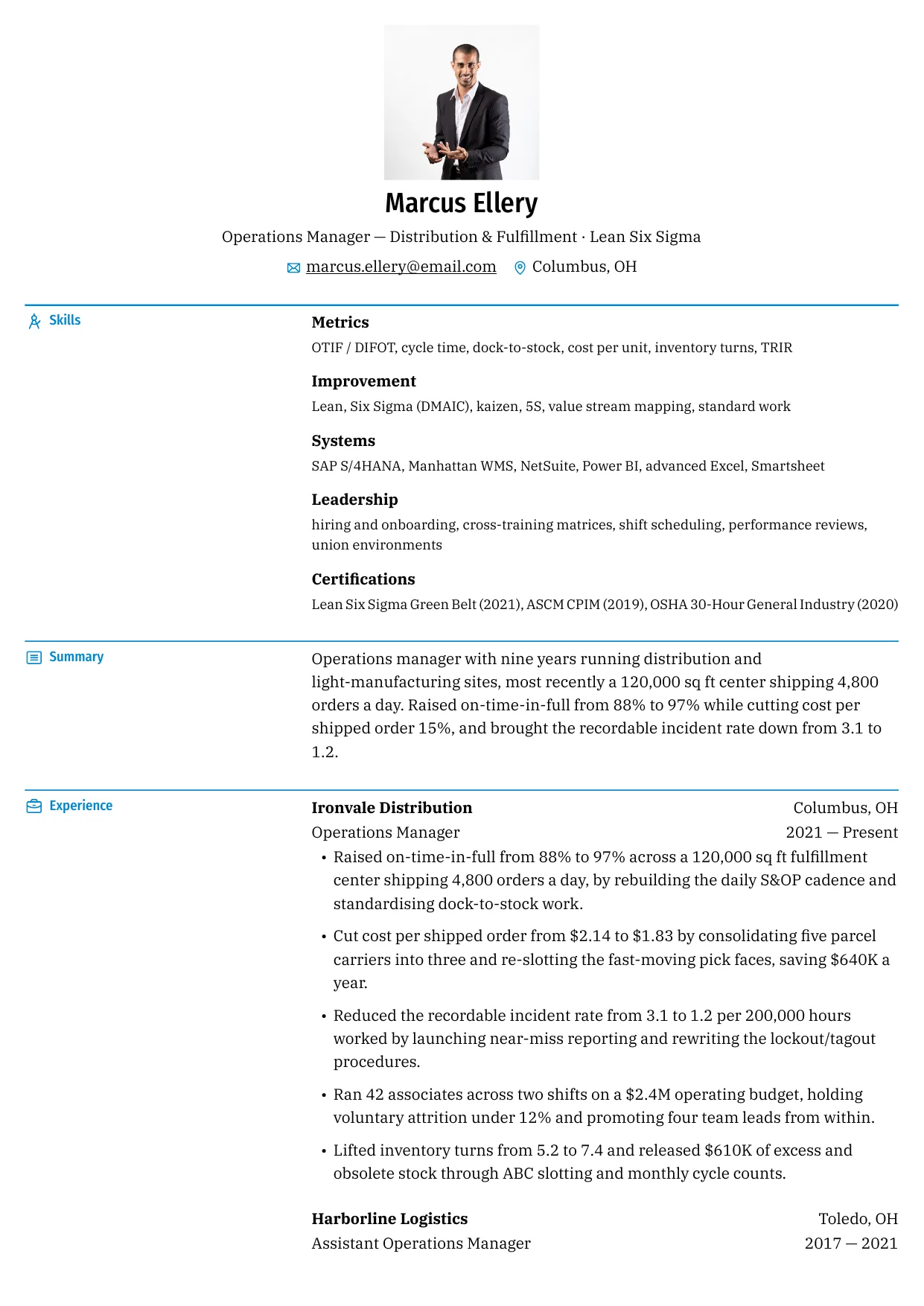
Showing 3 of 15 free templates — open the builder to browse every layout. All 15 are free.
How to write operations bullets that survive a skim
- Instead of: “Responsible for daily warehouse operations.” Write: “Ran a 120,000 sq ft distribution center shipping 4,800 orders a day with 42 associates across two shifts.”
- Instead of: “Improved on-time delivery.” Write: “Raised on-time-in-full from 88% to 97% in nine months by rebuilding the daily S&OP cadence and standardising dock-to-stock work.”
- Instead of: “Reduced costs.” Write: “Cut cost per shipped order from $2.14 to $1.83 by consolidating five parcel carriers into three and re-slotting the fast-moving pick faces.”
- Instead of: “Focused on safety.” Write: “Cut the recordable incident rate from 3.1 to 1.2 per 200,000 hours by launching near-miss reporting and rewriting lockout/tagout procedures.”
- Instead of: “Managed inventory.” Write: “Lifted inventory turns from 5.2 to 7.4 while releasing $610K of excess and obsolete stock through ABC slotting and monthly cycle counts.”
Recommended sections for an operations manager resume
- Summary — three lines: years in operations, the environments you have run (distribution, manufacturing, food, service), and one headline figure.
- Experience — reverse-chronological, each role opening with a scope line followed by three to five outcome bullets.
- Certifications — belt level, APICS/ASCM credential, OSHA 30, ISO auditor training. Place this above Education.
- Systems — ERP, WMS and reporting tools you can operate unaided. Name the modules when the posting names them.
- Improvement projects — two or three named projects with the metric and the saving attached; this is where a kaizen-heavy candidate separates from the field.
- Education — degree, school and year at the bottom, unless the posting makes a specific degree a requirement.
Operations metrics and keywords that matter
Most operations postings are screened against a short vocabulary of metrics, and the same terms recur across distribution, manufacturing and service operations. Mirror the posting's exact wording wherever it is genuinely true of your work — if the advert says “SIOP” and you ran an S&OP cycle, use each term once so both spellings are present.
- Flow: throughput, takt time, cycle time, dock-to-stock, order-to-ship, WIP, capacity planning, line balancing
- Cost: cost per unit, cost per shipped order, units per labor hour, overtime ratio, freight per shipment, cost of poor quality
- Inventory: inventory turns, days on hand, ABC and XYZ classification, cycle counting, shrinkage, excess and obsolete stock, fill rate
- Improvement: Lean, Six Sigma, DMAIC, kaizen, 5S, value stream mapping, standard work, root cause analysis, Gemba walks
- Safety and quality: TRIR, DART, near-miss rate, OSHA 300 log, first-pass yield, ISO 9001, ISO 45001, HACCP
- Planning: S&OP and SIOP, demand forecasting, forecast accuracy, supply planning, carrier and vendor management
ATS notes for operations resumes
- Spell each acronym out once, then use the short form: “on-time-in-full (OTIF)”, “total recordable incident rate (TRIR)”. Parsers tokenise inconsistently, and a human decoding jargon will skim past the figure.
- Keep metrics as real text in a single-column layout. Tables, text boxes and pasted spreadsheets are the usual reason an operations resume reaches a recruiter with its numbers missing.
- Use standard headings — Experience, Certifications, Education. Inventive labels can drop an entire section out of the parsed record.
- Write dates identically throughout and give every role a month and a year. A role the parser cannot place in time may be reported with the wrong tenure.
- Give certifications their own block instead of a line in a skills list. Many postings filter on a belt or an APICS/ASCM credential as a qualifying field, and that is the heading those filters read.
- Export a PDF or DOCX containing selectable text. A scanned or image-based copy makes every figure unreachable to the parser and to anyone using a screen reader.
With ShitResume, one linear layout holds the whole document, so OTIF percentages, TRIR figures and S&OP cadence lines arrive in the same order the parser reads them, with no hidden columns and no figures stranded in a sidebar. There is no card request and no trial timer, so testing a layout costs nothing but a click.
None of that needs columns, icons or a photograph. A single linear document with ordinary headings carries the same information and keeps every figure legible, which is what the free builder here produces — and you can export it without creating an account.
Nothing in ShitResume is paywalled — every template, every export is open — and the document is edited in the browser and stored nowhere else, with registration never entering the process. TRIR figures, OTIF trends and Lean Six Sigma credentials can be re-cut for a distribution role or a plant role in a single sitting.
Skills and keywords for this role
Use the terms that genuinely describe your work — an interviewer will ask about anything you list.
- Core metrics: OTIF/DIFOT, throughput, cycle time, dock-to-stock, cost per unit, inventory turns, TRIR
- Process improvement: Lean, Six Sigma (DMAIC), kaizen, 5S, value stream mapping, standard work, root cause analysis
- Systems: SAP S/4HANA, NetSuite, Manhattan WMS, Tableau, Power BI, advanced Excel, Smartsheet
- Supply chain: S&OP/SIOP, demand forecasting, vendor negotiation, inventory control, carrier management, E&O reduction
- People leadership: hiring and onboarding, cross-training matrices, shift scheduling, performance reviews, union environments
- Compliance and safety: OSHA recordkeeping, ISO 9001, ISO 45001, SOP authorship, audit readiness, GMP and HACCP familiarity
Frequently asked questions
What numbers should an operations manager put on a resume?
Three kinds, in this order: scope (headcount, shifts, sites, SKUs, budget), flow (throughput, cycle time, on-time-in-full), and money (cost per unit, savings delivered). Safety belongs alongside them, because operations leaders are measured on it first. If you can only find two figures for an older role, use scope plus one hard outcome.
How do I show I managed people without writing a job description?
Fold the team into a scope line at the top of each role — headcount, shifts, and whether you hired, trained or scheduled them — then spend the bullets on what that team produced. One line such as “42 associates across two shifts, including hiring and scheduling” communicates span of control without a paragraph of duties.
Should I list Lean Six Sigma certifications on an operations resume?
Yes, in their own block, with the belt level and the year awarded. Many postings screen a belt or an APICS/ASCM credential as a qualifying field. State it exactly as awarded, since requirements and accreditation vary by program and employer — a Green Belt from one course is not a Black Belt, and an inflated claim does not survive the first interview.
How long should an operations manager resume be?
Two pages is normal once you have run a team or a site, because scope lines and outcome bullets take room. One page is enough when you are stepping into a first supervisory role. Keep the most recent decade detailed and compress anything earlier to a line or two per employer.
How do I write about safety without drawing attention to incidents?
Report the rate and the direction of travel rather than a narrative: the recordable rate you inherited, where it finished, and the mechanism that moved it — a near-miss program, better guarding, or rewritten standard work. Omitting safety altogether is the weaker choice, because a gap on an operations resume invites the reader to assume the worst.
Can this format work if I am moving into operations from another field?
Usually yes, provided you translate your experience into operations language. Military logistics, restaurant management, retail, nursing rosters and field service all generate scope, flow and cost figures; describe them with the vocabulary above. Open with a summary naming the operation you ran and its size, and move any transferable certification above your education.
Which metrics matter most for manufacturing versus distribution roles?
Manufacturing leans on throughput, first-pass yield, OEE and cost per unit; distribution leans on orders per hour, dock-to-stock, fill rate and cost per shipped order. Safety and inventory turns apply to both. Mirror the posting's own vocabulary so a filter looking for its configured terms finds them in your text.