Marketing Manager Resume
A marketing manager resume is judged on numbers before it is read: which channels you owned, what they cost, and what they returned. Below is a full ATS-safe example, the sections hiring managers actually look for, and the platform and metric vocabulary that carries weight in 2026.
Free forever. No account, no card, no catch — your data never leaves your device.
What a marketing manager resume must include
- A headline naming your lane — demand generation, lifecycle, brand or growth — rather than the bare job title.
- A summary that ties your years of experience to the channels you own and one number you moved.
- Experience bullets that pair a metric with the lever you pulled, instead of a list of responsibilities.
- The platforms you can operate on day one: CRM, marketing automation, analytics, and the ad networks you have spent in.
- A budget line: spend managed, channel count, and the agencies or reports you oversaw.
“Marketing manager” covers a wide range of jobs: a lifecycle marketer at a software company and a brand marketer in consumer goods share almost no vocabulary. Mirror the wording of the posting for your lane instead of listing every channel you have touched. A resume claiming paid search, events and PR at once reads as unfocused.
Marketing Manager Resume Example
Example resume
A demand-generation resume with channel-level results, the martech stack spelled out, and a budget figure in the summary. This is the structure the builder produces — change the template, or export PDF and DOCX, whenever you like.
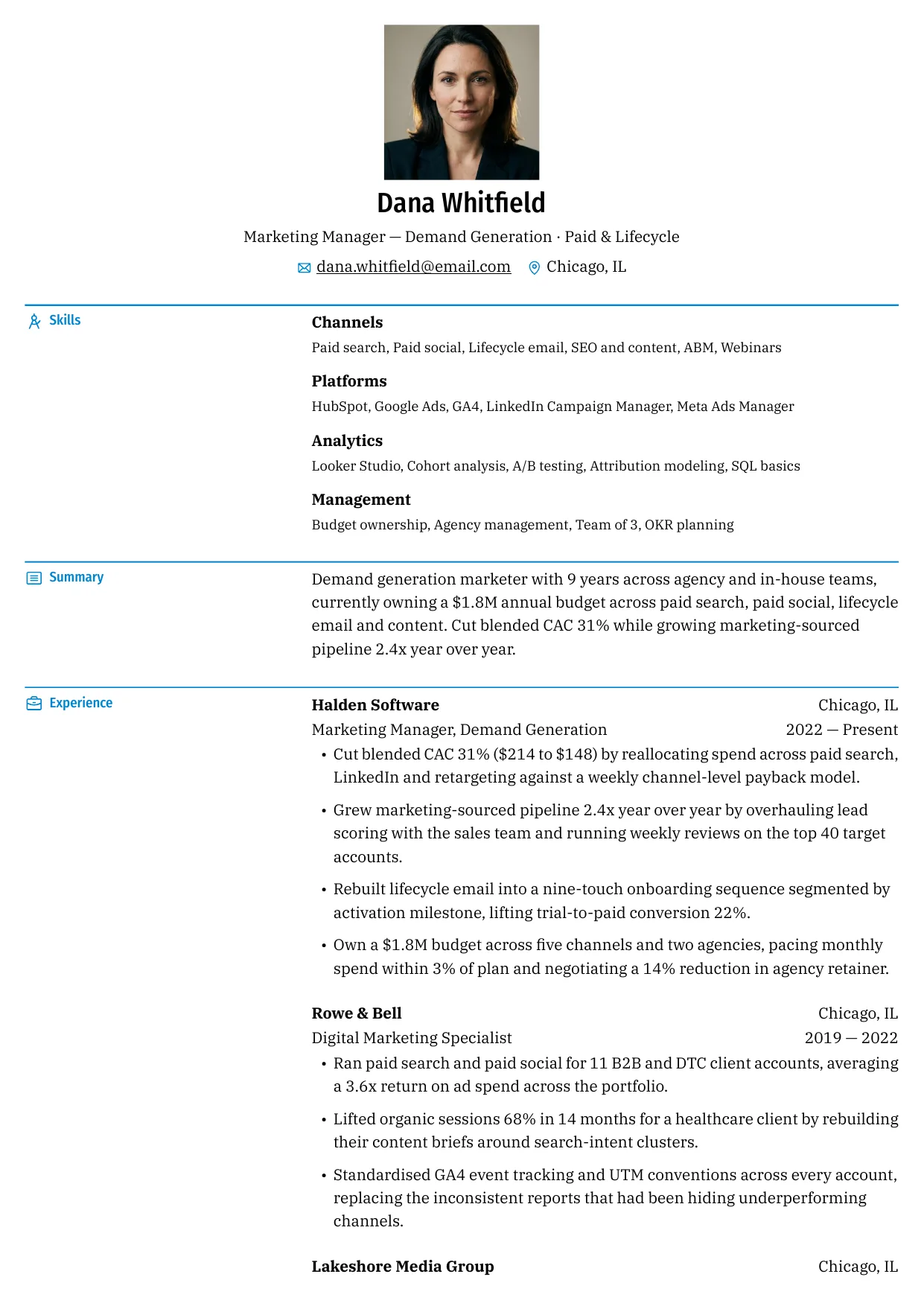
Showing 3 of 15 free templates — open the builder to browse every layout. All 15 are free.
Writing bullets that survive a skim
Give each role three to five bullets, and make each answer one question: what changed because you were there? Name the metric, how far it moved, and the action you took. Responsibility-style lines can be rewritten once you know the shape:
- “Managed paid social.” becomes “Cut blended CAC 28% by moving 40% of paid social budget into retargeting seeded from a lookalike of closed-won accounts.”
- “Owned email marketing.” becomes “Grew lifecycle email revenue 3.1x by rebuilding onboarding into a nine-touch sequence segmented by activation milestone.”
- “Worked with sales.” becomes “Raised MQL-to-SQL conversion from 18% to 31% by rewriting lead scoring with the sales team and removing low-intent form fills.”
- “Ran the website.” becomes “Lifted organic sessions 68% in 14 months by rebuilding content briefs around search-intent clusters rather than individual keywords.”
Sections most marketing resumes get wrong
- Tools: list the platforms you have genuinely run campaigns in. HubSpot and Marketo are not interchangeable to a reviewer who uses one daily.
- Metrics: define your acronyms once. CAC, ROAS, LTV to CAC and pipeline influenced are measured differently at different companies.
- Certifications: Google Ads, GA4 and HubSpot Academy credentials each deserve a line, but employers weigh them differently and some treat them as optional.
- Management: state the team size you led and the budget you owned. “Managed a team” without a number is not a management credential.
- Education: one line is enough once you have experience.
Keywords marketing managers should include
Applicant tracking systems match your file against the posting, so use its own terms wherever they honestly describe your work. “Results-driven marketer” matches nothing; a named platform or metric does.
- Channel ownership: paid search, paid social, programmatic, lifecycle email, SEO and content, ABM, webinars, partner marketing
- Measurement: customer acquisition cost, return on ad spend, marketing-qualified leads, sales-qualified leads, pipeline influenced, payback period
- Platforms: HubSpot, Marketo, Salesforce, Google Ads, GA4, LinkedIn Campaign Manager, Klaviyo, Braze
- Analytics: Looker Studio, attribution modeling, cohort analysis, A/B and multivariate testing, SQL basics
- Operations: budget management, agency management, vendor negotiation, marketing operations, OKR planning
ATS notes for marketing resumes
- Keep one column. Marketing resumes often borrow infographic layouts with side panels, and those parse as scrambled fragments.
- Export a text-based PDF or DOCX. Portfolio files exported from a design tool are often flattened images, and no text means no match.
- Never put a metric in an image or chart. If the number is not selectable text, the system never sees it.
- Drop the skill-rating scales. “Photoshop: 80%” means nothing to a parser.
- Use standard headings: Summary, Experience, Skills, Education. “Where I've Made an Impact” may not be recognized as the experience section.
ShitResume gives every template one flat column of real text, so campaign metrics, martech names and budget lines land in the same order the parser reads them. Using it is free and no card is requested, which helps when the same resume has to be re-cut for a demand-gen role and then for lifecycle.
Every template and every export on ShitResume is free, the work happens inside the browser so your numbers never travel to a server, and no account stands between you and the download. Two versions of the page — one built for demand generation, one for lifecycle — cost nothing but an evening.
Skills and keywords for this role
Use the terms that genuinely describe your work — an interviewer will ask about anything you list.
- Channels: paid search, paid social, lifecycle email, SEO and content, ABM, webinars
- Metrics: CAC, ROAS, LTV to CAC ratio, MQL and SQL counts, pipeline influenced, payback period
- Platforms and analytics: HubSpot, Marketo, Salesforce, Google Ads, GA4, Looker Studio, attribution modeling, A/B testing
- Operations: budget ownership, agency management, vendor negotiation, marketing operations, OKR planning
Frequently asked questions
Should a marketing manager resume include a portfolio or campaign samples?
Yes, if the work is yours to share. Link to a brief case-study page or one-page PDF covering two or three campaigns, and state your role on each. Do not link to live ad accounts or internal dashboards, and never upload client-confidential data. For NDA work, describe the campaign and result in the resume instead.
How do I show marketing results when I cannot share confidential numbers?
Use relative change and the scale you worked at rather than absolute figures: “cut cost per lead 34%,” “grew qualified pipeline 2.4x,” “a $1.8M budget across five channels.” You can also index against a baseline, such as “1.6x the account average.” Reviewers want evidence you measured your work, not your former employer's P&L.
Which marketing metrics matter most on a resume?
The ones closest to revenue that you personally influenced. Demand generation usually leads with customer acquisition cost, MQL-to-SQL conversion, and pipeline sourced. Brand and content roles can lead with branded search growth, engagement quality or content-attributed pipeline. Pick two or three and use them consistently across every role.
Is a marketing manager resume different from a marketing specialist resume?
Yes, mostly in what you claim to own. A specialist resume shows craft: the campaigns you built and the channels you ran. A manager resume shows leverage: the budget you directed, the team and agencies you managed, and the results others delivered under your plan. Applying up a level starts with leading on the scope you already hold.
Do HubSpot, Google Ads or AMA certifications help on a marketing resume?
They help a little, chiefly as a signal that you can use the platform. Employers weigh them differently: an agency may expect the platform certifications while an in-house team may care only about results, and some hiring managers treat them as optional when experience is strong.
How should I list agency or freelance marketing work?
Treat each engagement that ran long enough to produce results as its own role: client name, dates, your title, and bullets with metrics. If you handled many short projects, group them under one entry with the total spend or number of accounts managed, and name the two or three most relevant clients. Concurrent work should read as a portfolio with dates, not a gap.