Resume Objective: Examples and When to Use One
Objectives have a bad reputation because most of them deserve it — “seeking a challenging position where I can grow” says nothing about what you bring. But in the right situation, a targeted objective is the strongest opening a resume can have: it explains a career change, a first job, or a return to work before the reader has to guess. This guide shows when to use one, what makes it work, and full examples.
Free forever. No account, no card, no catch — your data never leaves your device.
The objective dates back to an era of generic resumes sent to many employers at once, which is why it earned its reputation. Modern hiring inverts that: resumes are targeted, and the question an objective answers — why is this person applying for this role, and why should the reader believe it? — still needs an answer whenever the resume alone does not give one.
Resume objective vs resume summary: the difference
- Summary: “here is what I have done and what I am strong at.” Backward-looking, evidence-first. The default for experienced candidates in the same field.
- Objective: “here is the role I am targeting and why I am positioned for it.” Forward-looking, intent-first. The right tool when the history does not obviously point at the target.
- The test: if a stranger reading only your job titles would understand why you applied, use a summary. If they would ask “but why this job?”, use an objective.
When an objective helps
- Career change. Your last title is from a different field; the objective bridges the gap by naming the target and the transferable proof in one move.
- First job or new graduate. There is no history to summarize; the objective states the direction and points at projects, coursework or internships.
- Returning after a break. A short line that names the target role turns a gap from a question into a given.
- Internal applications. A promotion or lateral move inside a company benefits from a line stating exactly which role and why this background fits it.
- Highly specialized roles. When applying for a niche position (clinical research coordinator, grants manager), the objective proves you are not mass-applying.
The formula
[Target role] candidate with [background/transferable strength]. [Most relevant proof, ideally with a number]. [Optional: commitment to the field or reason for the move].
- Keep it to two or three lines — shorter than a summary, because it is setting direction, not summarizing a career.
- Name the exact role from the posting. “Operations analyst” beats “a growth-oriented organization.”
- Every claim in the objective must be proven again below it, or it reads as wishful.
Objective examples that work
- Career change (retail → HR): “HR coordinator candidate bringing 6 years of retail team leadership, including scheduling and onboarding for a 45-person store. Completed CIPD Level 3 with a project on structured onboarding.”
- New graduate (CS): “Backend developer seeking a first full-time role after a CS degree and two internships. Built a Go service that still handles 40k daily requests for a campus organization.”
- Return after a gap (marketing): “Email marketing manager returning to full-time work after a two-year caregiving break. Previously ran a 400k-subscriber program averaging a 38% open rate.”
- Internal move (support → QA): “QA engineer candidate moving from three years in customer support, where the reproducible bug reports I filed led to 60+ confirmed fixes.”
- New grad (nursing): “New graduate RN seeking a medical-surgical residency. 480 supervised clinical hours across med-surg and telemetry; BLS certified, NCLEX passed.”
Objective mistakes that date a resume
- Wishes instead of facts. “Seeking a challenging role where I can utilize my skills” is about the applicant's needs; no reader has ever hired for that.
- The old clichés. “Hardworking self-starter,” “team player,” “excellent communication skills” without evidence — these signal a template.
- One objective, many applications. The block exists to show targeting; a generic version defeats its own purpose. Retarget the role name and top proof per posting.
- Using one when a summary would do. If you have 10 years of relevant experience, an objective can make you look like a career changer when you are not one.
- Length creep. An objective that becomes a five-line paragraph is just a summary with the wrong name. Keep it to three lines.
Resume objective example
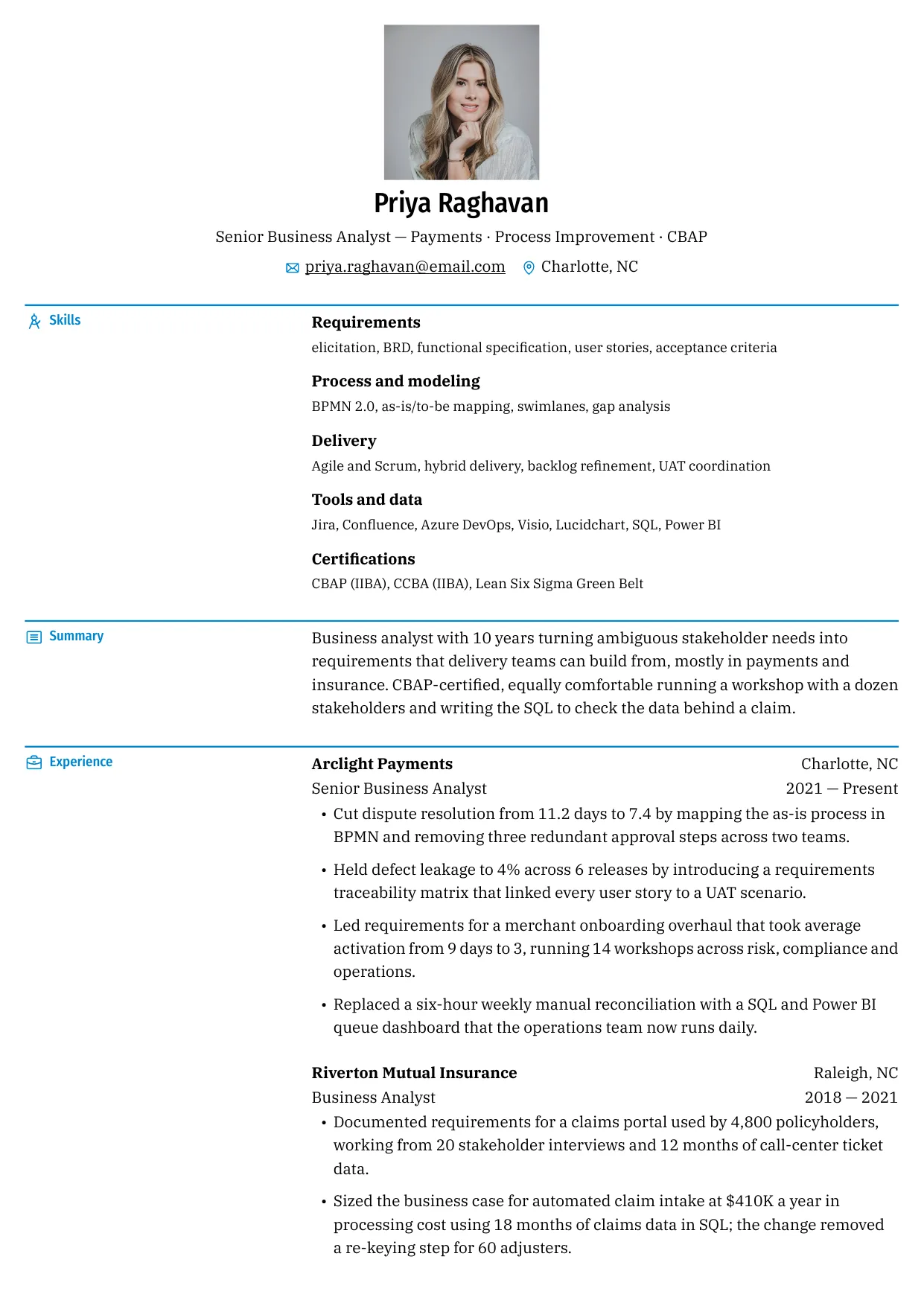
The example below is a career change done right: the objective names the target role, and every claim in it — the transferable numbers, the certification, the shipped projects — is proven again in the sections beneath.
Example resume
A one-page, ATS-safe resume for a career change. Export PDF or DOCX with the same structure, no account needed.
Showing 3 of 15 free templates — open the builder to browse every layout. All 15 are free.
How the objective interacts with the ATS
- Put the posting's exact job title in the first clause: if the role is “Operations Analyst,” write “Operations Analyst candidate,” not “aspiring operations professional.”
- Keep the objective as plain text at the top of the document — no text boxes or sidebars, which parsers skip or misread.
- Repeat the job title again in the headline and once in the experience or projects section if honest; opening text carries the most keyword weight.
- Do not stuff: an objective that lists ten unrelated tools parses as spam and reads worse.
One structural note: an objective works only if the resume beneath it is organized to prove it. ShitResume keeps every section in a single linear column, so the narrative runs from objective to evidence in exactly the order the reader sees.
Skills and keywords for this role
Use the terms that genuinely describe your work — an interviewer will ask about anything you list.
- Use when: career change, first job, return after a gap, or a highly specific target role
- Formula: [target role] + [most relevant proof] + [why this direction]
- Length: 2–3 lines, 25–45 words — shorter than a summary
- Career change: lead with transferable outcomes, not the old job title
- New grad: lead with degree, strongest project, and one number from it
- Skip when: your experience already points at the job — use a summary instead
Frequently asked questions
Is a resume objective still relevant in 2026?
Yes — in the situations it was built for. Career changers, new graduates, people returning after a gap and internal applicants all benefit from stating the target role and why their background fits. For experienced candidates in the same field, a summary is the stronger choice.
What is the difference between a resume objective and a summary?
A summary looks backward: what you have done and what you are strong at. An objective looks forward: which role you are targeting and why you are positioned for it. The test is simple — if your job titles already explain why you applied, use a summary; if they do not, use an objective.
How long should a resume objective be?
Two to three lines, about 25–45 words. It is shorter than a summary because it sets direction rather than summarizing a career. If it grows past three lines it has stopped being an objective and is just a summary with a different label.
What should I avoid in a resume objective?
Wishes instead of facts (“seeking a challenging opportunity”), clichés without evidence (“hardworking team player”), the same objective for every application, and any claim the rest of the resume does not prove. An objective that could sit unchanged on a thousand other resumes is doing harm, not good.
Can a career changer use an objective instead of experience?
No — the objective opens the door, the evidence underneath has to carry the application. After the objective, lead with a projects section and transferable outcomes, then the work history in compressed form. The objective's only job is telling the reader why a former restaurant manager is applying for an operations analyst role.
Should a new graduate use an objective or a summary?
An objective usually wins for new graduates, because there is no career to summarize yet. State the target role, the degree or program, and the strongest project with a number. Then make the projects section do the heavy lifting — it is your experience section until you have one.