Teacher Resume
Teaching is a licensed profession, so a teacher resume has to clear a bar most resumes never face: prove you are eligible for the job before it convinces anyone you are good at it. Below is a complete example, the credential details districts check first, and how to show classroom results without crossing a privacy line.
Free forever. No account, no card, no catch — your data never leaves your device.
What a teacher resume must include
- Your license near the top — credential type, issuing authority, and status. Districts screen on eligibility before they read anything else.
- Grade band and subject endorsements, written as they appear on the certificate.
- Classroom results in aggregate: the growth, the proficiency level, and the assessment that measured it.
- Experience entries naming the grade level, subject, school type, and class size or caseload.
- Student teaching while you are early in your career — it is your only classroom evidence so far.
A hiring committee is usually a principal plus a department lead or instructional coach. They read for fit with one vacancy: the right grade band, the right endorsement, and evidence you have moved outcomes with the population that school serves.
Teacher Resume Example
Example resume
An ATS-safe elementary teaching resume. Licensure and endorsements sit above the experience, results are reported as aggregates, and every bullet names the measure behind the number.
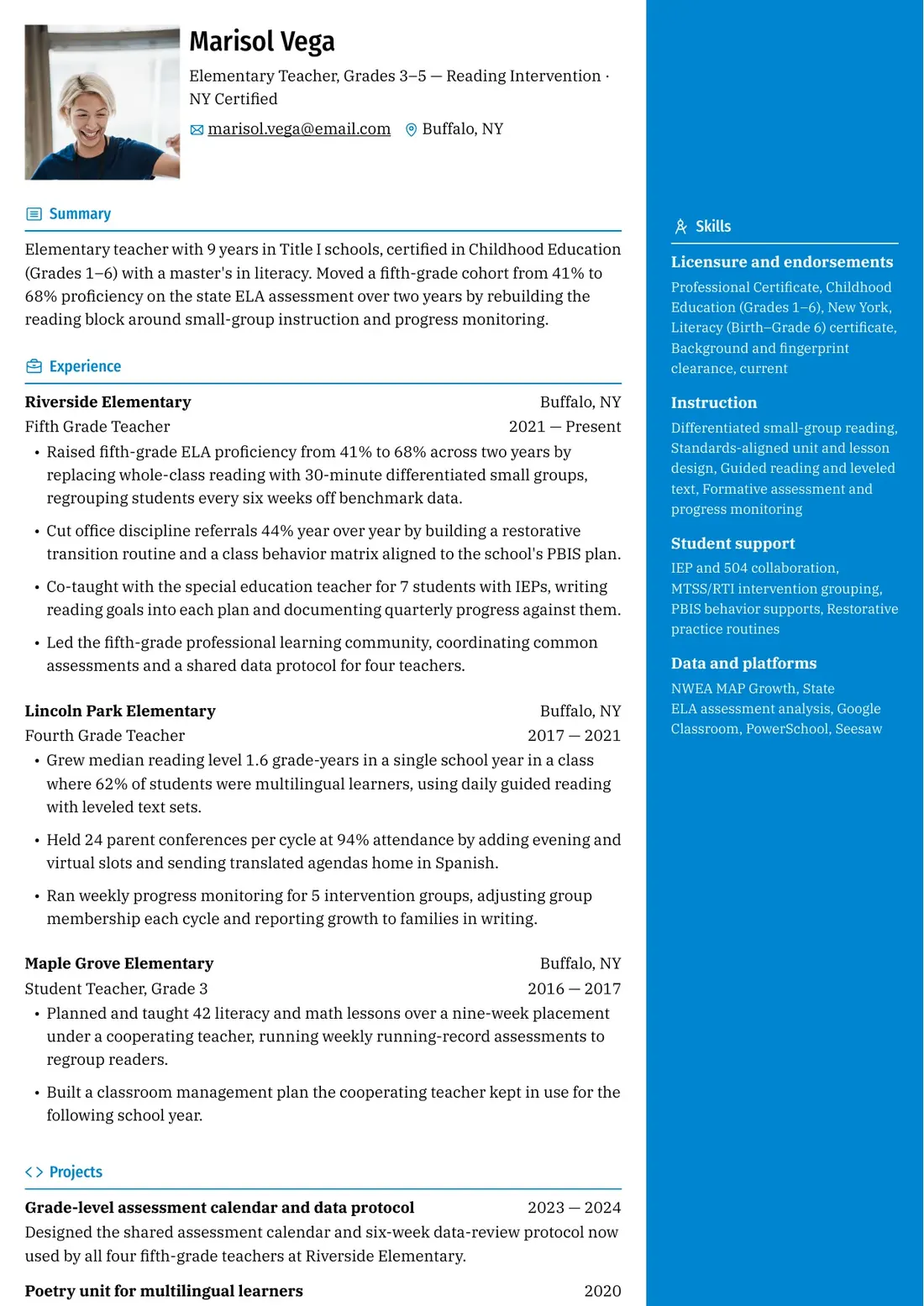
Showing 3 of 15 free templates — open the builder to browse every layout. All 15 are free.
The certification block belongs near the top
Without a current certificate you cannot generally be appointed, so the license is eligibility rather than a footnote. Put it under your summary and use the official credential name, because districts verify it against state records. Credential names, grade bands and renewal cycles differ by state and country.
- Credential name — the official title, such as “Professional Educator License”, not “teaching cert”.
- Issuing authority and state — the department of education or board that granted it.
- Grade band and subject endorsements — as printed on the certificate, plus endorsement codes if the posting asks.
- Status and expiry — active, provisional or emergency, with the renewal date. Naming a provisional credential early beats being screened out for it.
- Additional credentials — ESL/ELL, special education, bilingual or reading endorsements, and National Board Certification.
- Clearances — say background and fingerprint checks are current and available on request rather than printing reference numbers.
How to write classroom results without breaking student privacy
Teaching is one of the few fields where your strongest evidence is also the most restricted. Student education records are protected, so report aggregates and never individuals. “Grew median reading level by 1.6 grade years” is a result. A named student's score is a records disclosure.
- Report percentages and percentiles, not names, initials or identifiable case studies.
- Name the measure: a state assessment, a district benchmark, or a normed screening tool.
- Say what you changed, not only what moved, so a principal knows the result is repeatable.
- Include the starting point. A class moving from 41% to 68% proficiency reads differently from a bare “68% proficient”.
- Name the population when it matters — multilingual learners, students with IEPs, a high-poverty school.
- Skip anything you could not explain in an interview; inflated outcomes are easy to spot.
Teacher skills keywords
Education postings are written in the vocabulary of the district's frameworks. Mirror the terms that genuinely describe your practice, and leave out the ones you would not want to be interviewed about.
- Instruction: differentiated instruction, small-group intervention, standards-aligned unit design, formative assessment
- Student support: IEP and 504 collaboration, MTSS/RTI, PBIS, restorative practices
- Assessment and data: NWEA MAP Growth, student growth percentiles, standards-based grading, progress monitoring
- Multilingual learners: sheltered instruction, WIDA proficiency levels, language objectives
- Platforms: Google Classroom, Canvas, PowerSchool, Infinite Campus, Seesaw, Nearpod, IXL
- Families and colleagues: parent-teacher conferences, progress reporting, professional learning communities
ATS tips for teaching jobs
Large districts and state-wide application systems parse every submission. The usual formatting rules apply, with two that matter more in education.
- Keep one column; tables, columns and text boxes scramble reading order — which is where your license line sits.
- Export a text-based PDF or DOCX. A scan of your certificate is an image; type the credential details instead.
- Use the standard headings — Licensure, Experience, Education, Skills — rather than creative ones.
- Spell out acronyms once, because parsing varies: “Individualized Education Program (IEP)”.
- Include the issuing state next to the credential; a district cannot act on “certified” alone.
- Repeat your endorsements in the skills section, so they survive a keyword screen.
District portals and state application systems read the same way: license first, endorsements next, classroom evidence after. ShitResume keeps every template on one linear structure, so the credential name and grade band stay in the order the hiring committee and the parser both expect. It is completely free, which matters when the same resume goes to a dozen districts in a month.
ShitResume costs nothing, from the first template to the submitted PDF, and it never asks for an account — nor does it upload your license number or student aggregates anywhere. Everything stays in the browser. Build one clean resume once, then export whatever format each district portal wants instead of rebuilding it for every application.
Skills and keywords for this role
Use the terms that genuinely describe your work — an interviewer will ask about anything you list.
- Licensure: state teaching certificate, grade-band and subject endorsements, ESL/ELL endorsement, special education endorsement
- Instruction: differentiated instruction, small-group intervention, standards-aligned unit design, formative assessment, guided reading
- Student support: IEP and 504 collaboration, MTSS/RTI, PBIS, restorative practices, behavior intervention plans
- Assessment and data: NWEA MAP Growth, student growth percentiles, standards-based grading, progress monitoring
- Platforms: Google Classroom, Canvas, PowerSchool, Infinite Campus, Seesaw, Nearpod, IXL
- Families and colleagues: parent-teacher conferences, progress reporting, professional learning communities
Frequently asked questions
Do I have to put my teaching license on my resume?
A district has to confirm you are eligible before it can offer you a classroom, so a license line near the top saves everyone time. Give the official credential name, the issuing state, the grade band, and whether it is active or provisional.
What if my teaching license is from another state?
List the credential you hold and say plainly that it is out of state. Many states have reciprocity agreements or a transfer pathway, but requirements and timelines differ everywhere, so do not claim eligibility in a state you have not applied to. “Transfer application in progress” is honest and useful.
How do I describe student results without breaking privacy rules?
Describe aggregates, never individuals. Percentages, percentiles and class-level growth are fine; a named student's score is a protected education record and does not belong on a document you email to strangers. Name the assessment so the number is interpretable, and give the starting level as well as the endpoint.
Does student teaching belong on a teacher resume?
Yes, and it should stay for roughly your first three to five years. It is the only place a new teacher can show planning, instruction and assessment in a real classroom. List the grade level, the placement length, and two results, such as lessons taught or a unit the school kept using.
Should coaching, clubs or committee work go on a teacher resume?
Yes, in a short section below your classroom experience. It shows you contribute beyond your own room, and in small districts it is often how several roles get filled at once. Keep it to the commitment, the duration and any outcome worth naming.
How do I handle a long-term substitute or emergency-credential stretch?
Show it as teaching experience rather than as a gap. A full year in one classroom under a long-term assignment is real teaching: name the grade, subject and length. Being direct about a provisional credential beats having a district discover it during verification.