Teacher Resume Template
A teaching application is checked against a licence before anything else is read: the certificate, the grade bands it covers and the endorsements attached to it decide whether the rest of the page gets attention. This teacher resume template puts that block where a district reviewer looks for it, then gives the experience entries a structure that carries evidence — class size, growth data, intervention work and family contact. It is the same layout the builder opens when you pick this template, so what you see here is what you edit.
Free forever. No account, no card, no catch — your data never leaves your device.
A district screens teaching applications in a set order. First the certificate and endorsements, because a candidate who cannot be placed in the advertised classroom is not a candidate. Then the recent grade level and subject, because principals hire for a specific opening rather than for teaching in general. Only after those two checks does a hiring committee read the evidence of what changed for students — and that evidence is where most resumes in this field are thin.
What a teacher resume template needs to hold
- Certificate and endorsements. The state, the certificate type, the grade bands and every subject endorsement, written the way the district posts them.
- The grade levels you have actually taught. A third-grade placement and a ninth-grade placement are different jobs; name the levels and the subjects for each role.
- Student growth evidence. Benchmark movement, proficiency rates, reading-level gains — stated plainly with the measure and the period attached.
- Class context. Class size, multilingual learner share, IEP caseload, Title I setting. Context is what makes a growth number mean something.
- Intervention and support work. Small-group instruction, co-teaching, MTSS groupings and behaviour routines, because those are the duties the posting usually names.
- Clearances and training. Background check, fingerprint clearance, mandated reporter training and any district-required certificates, with their currency noted.
Section order for a teaching resume
- Header: name, certification line, city and state, phone, email and one professional link.
- Licensure and endorsements: certificate, grade bands, subject areas and clearance status, kept in the first block so it is never hunted for.
- Summary: two or three lines naming the grade levels, the settings you have worked in and one result you can support with data.
- Experience: reverse-chronological, with the school, grade, subject and class context on each entry.
- Student growth and leadership: assessment results, intervention groups, committee work and mentoring, either inside the roles or as a short block of its own.
- Education and professional development: degrees and certifications first, then only the training that changes what you can teach.
Teacher resume example
Example resume
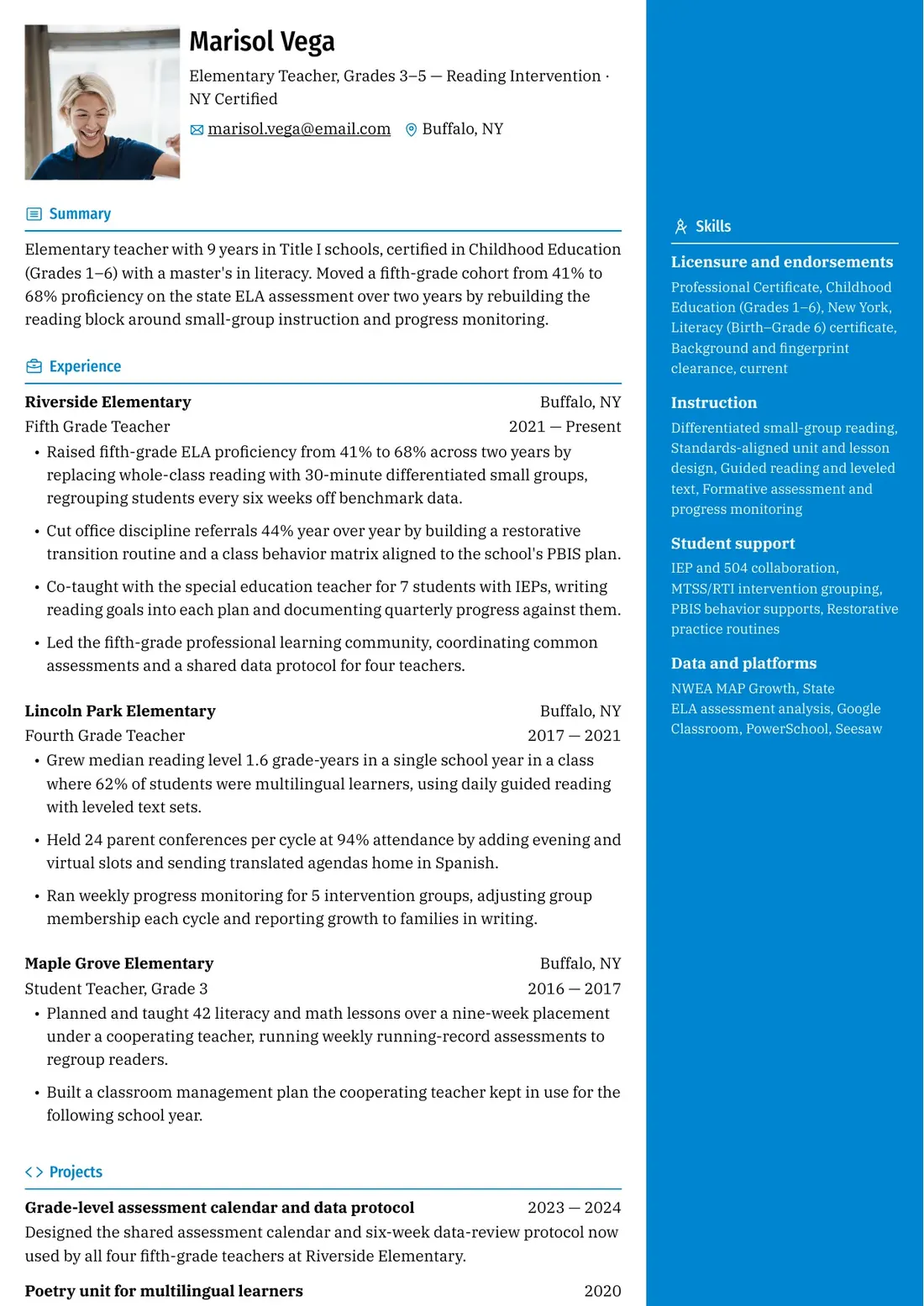
A full teaching resume in this template: certificate and endorsement details in the sidebar, growth measures inside every role, and a projects block for the assessment calendar and unit work. Switch layouts in the builder and export PDF or DOCX — no account needed.
Showing 3 of 15 free templates — open the builder to browse every layout. All 15 are free.
How to write the experience bullets
- Name the measure and the movement. “Moved a fifth-grade cohort from 41% to 68% proficiency on the state ELA assessment over two years” tells a principal what changed; “improved student outcomes” tells them nothing.
- Describe the teaching change, not just the result. A result with no method attached reads as luck. Name the practice you introduced — differentiated small groups, a data protocol, a behaviour routine — and how often it ran.
- Put the class context in the open. Multilingual learner share, IEP caseload and class size belong in the role, because they change how an evaluator reads the number next to them.
- Show the work beyond the classroom. Committees, curriculum writing, mentoring a student teacher and leading a professional learning community are promotion evidence in a district.
- Keep the vocabulary of the building. MTSS, RTI, IEP, PBIS, PLC, benchmark assessment — the terms a district uses in its own postings.
Certificates, endorsements and clearances
Write the licence as a compact block: certificate, state, grade bands and endorsements, with the renewal or expiry date. Name every endorsement you hold, even the ones that are not in the posting — an endorsement is what lets a principal move you between openings without refiling the hire. Clearances belong next to the certificate rather than at the bottom of the page; a district cannot appoint anyone whose background check is missing or expired, so that line is read as a gate, not as scenery.
ATS notes for teaching resumes
- Keep the certification block in the main text flow — a certificate placed in a page header, a footer or a text box is often skipped by the parser.
- Write the grade bands and subjects exactly as the district does: “Childhood Education (Grades 1–6)” and “Elementary, Grades 3–5” are not the same string to a filter.
- Use standard section names — Licensure, Experience, Education, Skills — so the extraction maps your history onto the application fields.
- Date every role in month and year; districts compute years of service and a year-only range leaves the calculation to a human.
- Keep the file single-column if the district portal is an older system, and check that the exported PDF lets you highlight a line of text.
Common mistakes on teacher resumes
- Listing the degree but not the certificate, which is the one credential a district verifies first.
- Writing about teaching philosophy instead of classroom evidence; the essay belongs in a cover letter, not in the experience section.
- Reporting growth without the measure, so the reader cannot tell whether the number comes from a state test or an internal quiz.
- Describing a grade level as “elementary students” when the posting names a specific year group.
- Filling the page with workshop attendance instead of the training that added an endorsement or a certification.
- Leaving out substitute, long-term or summer-school roles — they are often the newest classroom evidence an applicant has.
The layout on this page is one of the templates ShitResume ships, and the document behind it keeps licence details, roles and student growth in a single linear order. ShitResume runs in the browser and saves the resume on your device, so a file carrying your certificate numbers and employment history is never uploaded anywhere. No layout is locked: every one of them and the exported PDF or DOCX stays free, with nothing held back behind a sign-up step.
Skills and keywords for this role
Use the terms that genuinely describe your work — an interviewer will ask about anything you list.
- Licensure: state teaching certificate, grade bands, subject endorsements, renewal date
- Instruction: standards-aligned unit design, differentiated small groups, guided reading, formative assessment
- Student support: IEP and 504 collaboration, MTSS/RTI grouping, PBIS routines, restorative practice
- Data: benchmark and state assessment analysis, progress monitoring, gradebook and reporting platforms
- Family communication: conference scheduling, translated updates, behaviour follow-up, newsletters
- Platforms: Google Classroom, PowerSchool, Canvas, Seesaw, NWEA MAP Growth
Frequently asked questions
What should a teacher resume template include?
The certificate with its grade bands and endorsements, the grade levels and subjects you have taught, evidence of student growth with the measure named, class context such as size and multilingual learner share, clearances, and the training that changed what you can teach. The credential block belongs at the top of the page.
How long should a teaching resume be?
Two pages are normal in education, and a third is acceptable for a candidate with a long district record, coaching duties and curriculum work. One page is right for a first-year applicant. Wherever the history lands, keep the certificate block on page one and make sure every role carries at least one line of evidence.
Do I need a different resume for substitute or long-term positions?
Adjust the emphasis rather than the structure. A substitute or long-term application should lead with availability, the buildings you have already worked in and the grade levels you can cover, then keep the certificate and the growth evidence in their usual places so the same document still works for a permanent opening.
Should I list every professional development workshop I have attended?
No. Keep the workshops that produced an endorsement, a certification or a program you now run, and group the rest as one line naming the topics. A page of one-day session titles pushes the classroom evidence down without telling a principal anything about what you can be assigned.
What keywords do school districts screen for?
Differentiated instruction, small-group reading, MTSS or RTI, IEP and 504 collaboration, PBIS, formative assessment, data-driven instruction, parent communication and the exact grade bands and subject names from the posting. Mirror the posting's wording where it is true of your work.
Can one teacher resume cover several grade levels or subjects?
Yes, as long as each role names the level it belongs to. The summary can state the range you are licensed for, the certificate block lists every endorsement, and the experience entries carry the specific grade and subject. That gives a principal a reason to consider you for more than one opening.