Registered Nurse Resume
A nursing resume is read by two audiences at once: software that has to extract your license, unit type and certifications, and a nurse manager deciding in ten seconds whether you can take a patient assignment on their floor. Here is a complete example and the wording that satisfies both.
Free forever. No account, no card, no catch — your data never leaves your device.
What a registered nurse resume must include
- Licensure near the top: the credential, the state board that issued it, and the expiry. A manager cannot schedule you without it.
- Unit type and patient population, not just the hospital. “Medical-surgical” and “med-surg/telemetry at 1:5” describe different jobs.
- Your degree (BSN or ADN), plus any program you are enrolled in and its completion date.
- Certifications with expiry: BLS, ACLS, PALS, NRP, CCRN, CEN, CMSRN, TNCC.
- The EMR systems you have charted in, because orienting a nurse on Epic or Cerner costs a hospital real time.
One detail trips up almost every new graduate: clinical rotations are not professional experience. Give them their own “Clinical Experience” heading — unit, patient population, hours, skills performed under supervision — but never present them as a staff role. A precepted rotation where you carried a full assignment is worth several lines; an observation day is not.
Registered Nurse Resume Example
Example resume
A one-page, ATS-safe registered nurse resume with a licensure line, unit ratios and measured outcomes. This is the structure our builder produces — switch templates, export PDF or DOCX, no account needed.
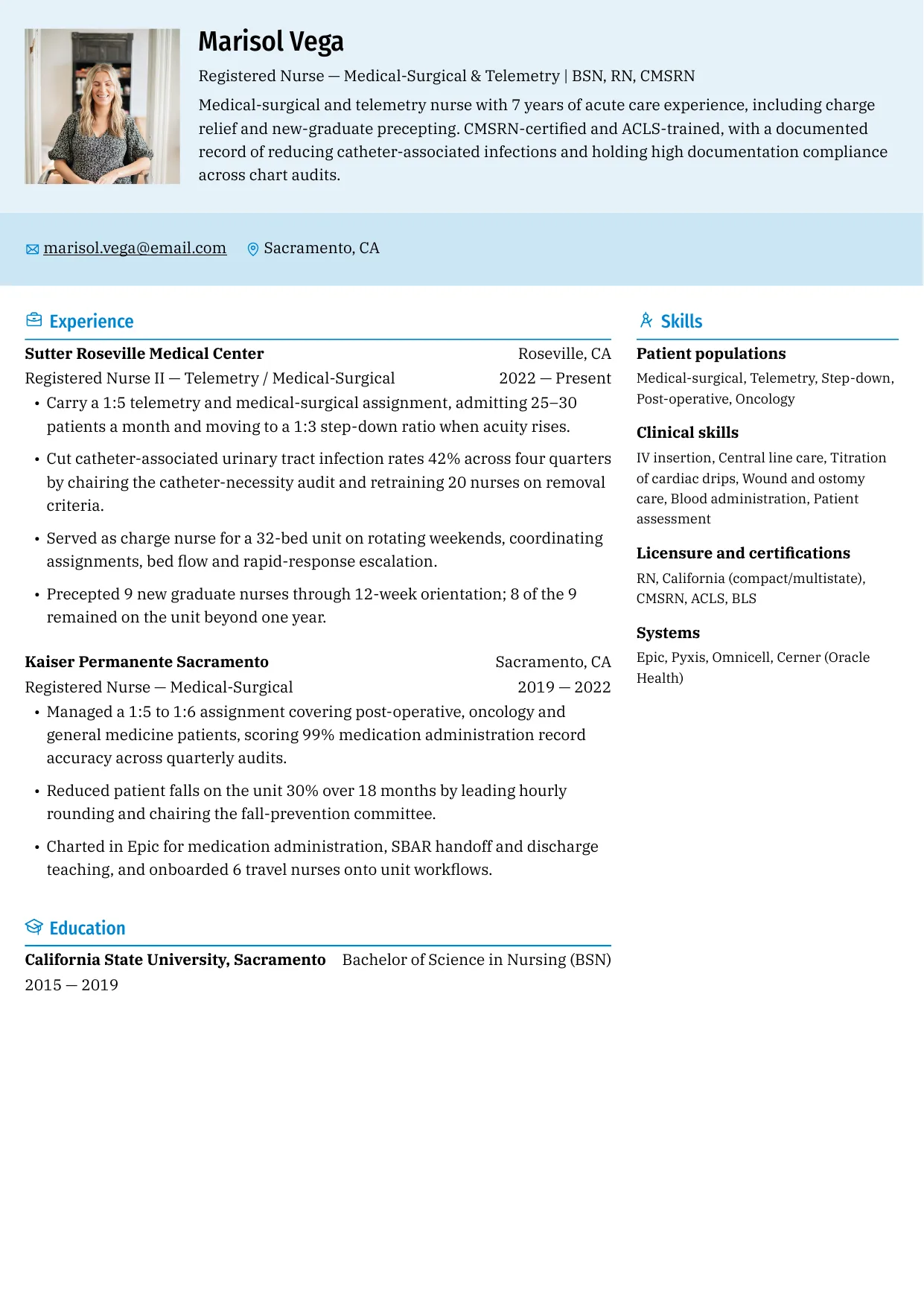
Showing 3 of 15 free templates — open the builder to browse every layout. All 15 are free.
Licenses and certifications: what to state
Credentialing staff verify every one of these, so precision matters more here than anywhere else. Requirements also differ by state board and by employer — a certification expected in one intensive care unit is optional in another — so list what you hold and when it expires.
- RN license: the issuing state board, the expiry, and whether it is a compact (multistate) license under the Nurse Licensure Compact — that decides whether you can be floated across state lines.
- BLS: required almost everywhere; issued by the American Heart Association or the Red Cross.
- ACLS: expected in ICU, emergency, PACU and telemetry; often not required on a general medical floor.
- PALS and NRP: paediatrics and emergency departments for PALS; labor, delivery and the newborn nursery for NRP.
- Specialty certification: CCRN, CEN, CMSRN, OCN or RNC-OB, each from its own board, carrying weight for charge and preceptor roles.
How to write nursing bullets that get past a skim
A manager skimming your experience is answering three questions: what ratio can you handle, what acuity have you seen, and did you improve the unit? Lead with the outcome, then the action, then the scale.
- Instead of “Responsible for patient care on a busy unit” → write “Managed a 1:5 medical-surgical assignment with 30 admissions a month and a 98% documentation compliance rate across chart audits.”
- Instead of “Helped reduce infections” → write “Cut CAUTI rates 42% over four quarters by chairing the catheter-necessity audit and retraining 20 nurses on removal criteria.”
- Instead of “Worked with new nurses” → write “Precepted 9 new graduates through 12-week orientation; 8 of the 9 stayed on the unit beyond one year.”
- Instead of “Cared for high-acuity patients” → write “Carried a 1:2 assignment in a 24-bed surgical ICU, managing ventilated patients and titrating vasoactive drips.”
Registered nurse skills keywords
Open the posting and mirror its vocabulary wherever it is true of you. Nursing is full of legitimate near-synonyms — emergency department and ED, telemetry and step-down — and matching the posting's wording costs you nothing.
- Populations: medical-surgical, telemetry, step-down, critical care, emergency, labor and delivery, NICU, paediatrics, oncology, PACU
- Clinical skills: IV insertion, central line care, tracheostomy care, wound and ostomy care, blood administration, ventilator management
- Systems: Epic, Cerner (Oracle Health), Meditech, Pyxis, Omnicell
- Quality and safety: fall prevention, CAUTI and CLABSI reduction, medication reconciliation, chart audits
ATS notes for nursing resumes
Hospitals and agency recruiters lean on applicant tracking systems heavily, because credentialing data has to be read accurately. A file that parses badly can lose your license information before a human opens it.
- Keep license and certifications as plain, selectable text. A scanned license image contributes nothing to a parser.
- Give the credential in full, then the acronym: “Advanced Cardiovascular Life Support (ACLS)”. Acronym-only lists parse inconsistently.
- Write every date the same way, as month and year; “Summers 2021” cannot be read as tenure.
- Stick to conventional headings — Licensure, Certifications, Experience, Education, Skills. A creative heading is invisible to keyword extraction.
- State the ratio and the unit explicitly: “1:5 med-surg” is the exact phrase a parser and a manager both look for.
None of this is about gaming a system — it is about not losing accurate information on the way in. A nurse with a compact license and five years of telemetry should never be filtered out because the license was an image.
Credentialing systems read fast and forgive nothing, which is why license lines and ratios deserve plain, selectable text. ShitResume builds every template on one linear skeleton, so the license, unit type and certification dates you type are the ones the parser extracts and the ones that appear in the export. It is completely free to use, and no account stands between a night shift and a finished PDF.
ShitResume charges nothing for any template or export, and it works local-first: the resume is built in your browser and stored nowhere else. No account, no card, no countdown. Finish it after a shift, save the PDF, and spend the drive home thinking about the interview rather than the formatting.
Skills and keywords for this role
Use the terms that genuinely describe your work — an interviewer will ask about anything you list.
- Care areas: medical-surgical, telemetry, step-down, critical care, emergency, labor and delivery, paediatrics, oncology
- Clinical skills: IV insertion, central line care, tracheostomy care, wound and ostomy care, ventilator management, titration of vasoactive drips
- Systems: Epic, Cerner (Oracle Health), Meditech, Pyxis, Omnicell, SBAR handoff
- Certifications: RN licensure, BLS, ACLS, PALS, NRP, CCRN, CEN, CMSRN, TNCC
- Care coordination: charge nurse, precepting, discharge teaching, care planning
- Quality and safety: fall prevention, CAUTI and CLABSI reduction, medication reconciliation, chart audits
Frequently asked questions
Do I need a BSN to get hired as a registered nurse?
It depends on the employer. Many hospitals, particularly Magnet-designated ones, prefer or require a BSN and give ADN nurses a deadline to complete one; clinics and long-term care settings frequently hire ADNs. If you hold an ADN, state it plainly and add your BSN completion date.
How do I list clinical rotations as a new graduate nurse?
Give them their own Clinical Experience section and treat each rotation like a job: unit type, patient population, skills performed and hours. Be accurate about your role — precepted student, not staff nurse. Once you have paid experience, remove it.
Should I put my RN license number on my resume?
Usually not. State the credential, the issuing board and the expiry — “RN, California Board of Registered Nursing, exp. 03/2028” — and give the number on the application form or during credentialing.
How long should a nursing resume be?
One page under about five years of experience; two if you have a long specialty history or leadership work. Managers skim for unit type, licensure and certifications, so put those in the top third.
What should I do about a gap in my nursing work history?
Do not hide it — a gap in employment or licensure surfaces during credentialing anyway. Label the period plainly: family leave, a travel assignment, returning to school for a BSN. If you kept your license active, say so.
Should I list every unit I was floated to?
List only the ones that add information. Occasional floats to another medical-surgical floor are noise; a sustained cross-training assignment in the ICU tells a manager you can be deployed where the census demands.