Customer Service Resume
A customer service resume is judged on outcomes, not on how many systems you can name. Hiring managers scan for the numbers behind the job — how many contacts you handled, how quickly you answered, how often you closed it on the first try — and whether you can stay steady while someone is upset. Below is a full example, the sections that carry the weight, and the formatting that keeps your text readable after it is submitted.
Free forever. No account, no card, no catch — your data never leaves your device.
What a customer service resume must include
- A standard job title a parser recognizes — “Customer Service Representative,” “Support Specialist,” or “Call Center Agent.” Invented titles like “Happiness Hero” often fail to match the posting.
- A headline that names your channel mix and volume: phone, chat, email, and roughly how many contacts a day you own.
- A summary carrying two or three hard numbers — CSAT, first response time, first contact resolution — plus the kind of customer you supported.
- Bullets work when they pair the result with the action and the contact volume. “Raised first contact resolution from 71% to 82% by writing troubleshooting guides” says more than “handled customer inquiries.”
- A platform list (Zendesk, Salesforce Service Cloud, Freshdesk, Intercom), because many employers screen on the tooling you already know.
- Availability and languages near the top when the role is shift-based or serves a bilingual queue.
Most service screening is a keyword match against the posting followed by a quick human skim. Both passes reward the same thing: specific, quantified outcomes placed where they are easy to find.
Customer Service Resume Example
Example resume
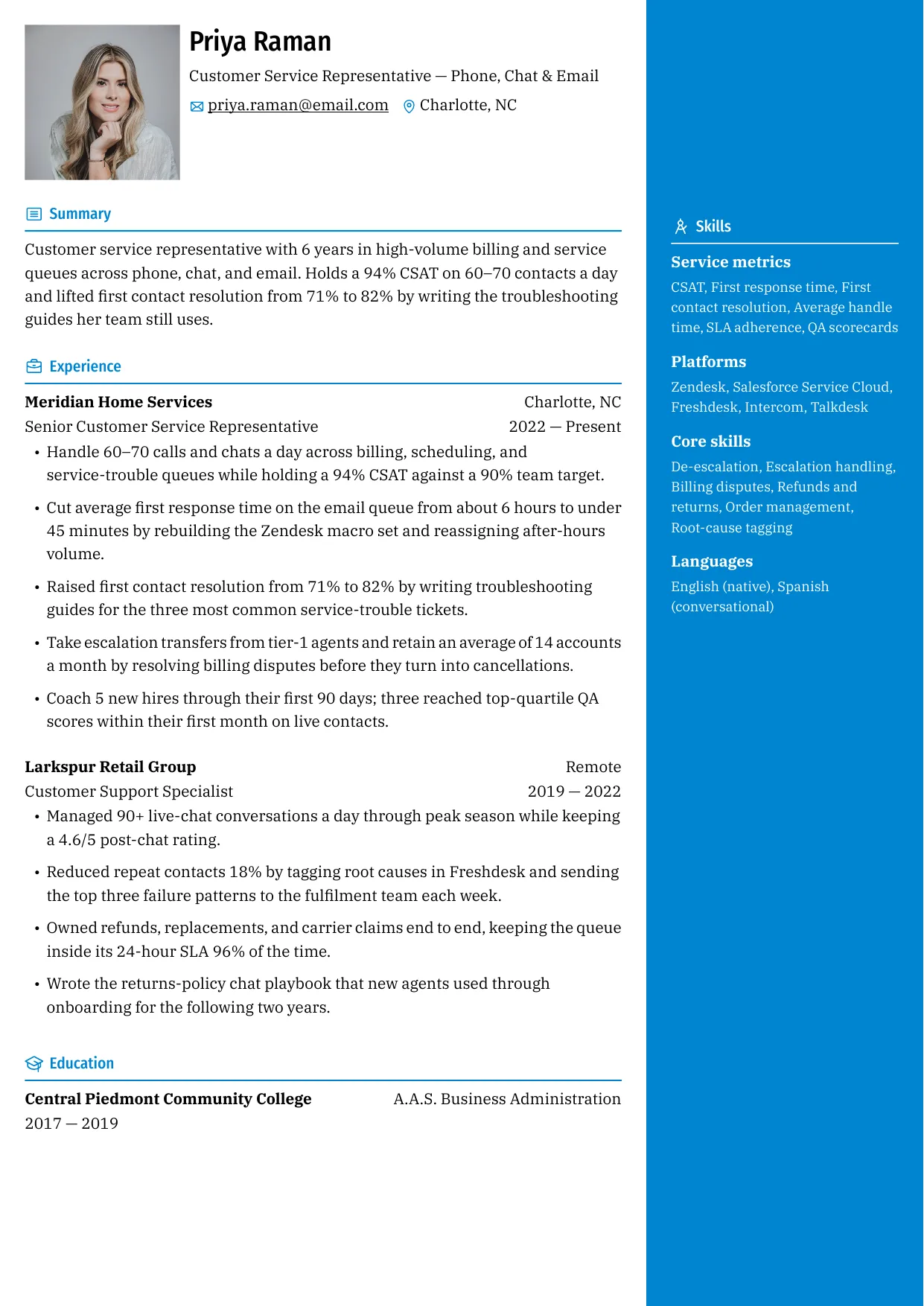
A one-page customer service resume written for the keyword pass and the human skim that follows it — the same structure our builder produces.
Showing 3 of 15 free templates — open the builder to browse every layout. All 15 are free.
Recommended sections for a customer service representative resume
- Summary — first, and short. Your strongest metric belongs in it.
- Experience — reverse-chronological. The last five years carry the decision; give earlier roles one line each.
- Skills — directly after experience, grouped into metrics, platforms, and service skills.
- Certifications — placed above education when they apply to the queue you support, with the year earned.
- Education — last and shortest. A high-school diploma covers most representative roles unless the posting names a degree.
How to write customer service bullets that survive the skim
Every strong service bullet answers three questions: what changed, what you did to change it, and how large the change was. A bullet that only lists duties leaves the reader unable to tell whether you handled five contacts a day or a hundred. Rewrites in the pattern to aim for:
- Instead of “Responsible for answering customer calls”: “Answered 65–70 calls a day across billing and scheduling queues with a 94% CSAT against a 90% team target.”
- Instead of “Handled escalations”: “Took escalation transfers from tier-1 agents and retained an average of 14 accounts a month by resolving billing disputes before cancellation.”
- Instead of “Used Zendesk”: “Rebuilt the Zendesk macro set, cutting average first response time on the email queue from about 6 hours to under 45 minutes.”
- Instead of “Good communication skills”: “Wrote the chat playbook for the returns policy that every new agent used through onboarding.”
Where a number genuinely is not available, describe scale instead — the queue you owned, the product line, the size of the customer base. A bullet with no scale reads as filler, because every other applicant is also claiming patience.
Customer service keywords and tools (2026)
Use the posting's terms for the channels and platforms you honestly ran. Ticket systems, telephony platforms, and metric names are the terms most often matched, and regional spelling matters: a US posting usually says “call center” and “representative,” while a UK or Irish posting may say “call center” and “advisor.” Use the employer's spelling.
- Metrics: CSAT, first response time (FRT), first contact resolution (FCR), average handle time (AHT), resolution rate, SLA adherence, QA score
- Ticket and CRM platforms: Zendesk, Salesforce Service Cloud, Freshdesk, Intercom, HubSpot Service Hub, ServiceNow
- Telephony and routing: Talkdesk, Genesys, Five9, Amazon Connect, Avaya
- Channels: inbound and outbound phone, live chat, email, SMS, social media, self-service knowledge base
- Core skills: de-escalation, escalation management, root-cause tagging, refunds and returns, order management, billing disputes
- Reporting: contact reasons, ticket volume, backlog ageing, trend reporting, quality scorecards
ATS tips for customer service resumes
- Use the title the employer used. If the posting says “Customer Service Representative” and your business card said “Client Experience Associate,” list the standard title and mention the internal one inside a bullet.
- Keep the file single-column with conventional headings. A sidebar looks good on paper, but parsers frequently read it out of order or skip it.
- Spell metric names out at least once — “first contact resolution (FCR)” — because systems tokenise abbreviations differently.
- Experience bullets should carry the platform names; a skills list alone will not. A bullet that names Zendesk within an outcome survives a relevance filter that a bare list does not.
- Keep your phone number, email, and availability in the document body rather than a header, text box, or image. Screening tools ignore images outright and read header text unreliably.
- Avoid tables, graphics, and icon fonts for the contact block. Even where the text is real, the parse order can scramble which number belongs to which label.
None of these change what a hiring manager thinks of you — they only affect whether your words arrive intact. A plain structure costs nothing, and it removes one avoidable reason for an application to be passed over.
The formatting notes above decide whether your CSAT, first response time and Zendesk work survive the software. ShitResume puts every template on a single reading column, so what you see on screen is what the parser extracts and what leaves in the PDF or DOCX. No subscription is involved at any point.
ShitResume is completely free — every template, every PDF and DOCX export — and it runs entirely in your browser, so ticket notes, customer names and queue numbers never leave your machine. You are never asked to register, pay or start a trial. A service rep listens all day; the resume tool should not turn into one more queue.
Skills and keywords for this role
Use the terms that genuinely describe your work — an interviewer will ask about anything you list.
- Metrics: CSAT, first response time (FRT), first contact resolution (FCR), average handle time (AHT), resolution rate, SLA adherence, QA score, net promoter score (NPS)
- Ticket and CRM platforms: Zendesk, Salesforce Service Cloud, Freshdesk, Intercom, HubSpot Service Hub, ServiceNow
- Telephony and routing: Talkdesk, Genesys, Five9, Amazon Connect, Avaya
- Channels: inbound and outbound phone, live chat, email, SMS, social media, self-service knowledge base
- Core skills: de-escalation, escalation management, root-cause tagging, refunds and returns, order management, billing disputes, CRM data hygiene
- Reporting: contact reasons, ticket volume and backlog ageing, trend reporting, quality scorecards
Frequently asked questions
How do I show customer service experience if my job title was not “customer service”?
Translate the job into the terms a recruiter searches. Retail, food service, front-desk, and call-center work all involve handling complaints and working a queue, so lead with those outcomes and put the standard title in your headline: “Customer Service Representative — 4 years across retail and phone support.”
What numbers should I put on a customer service resume?
CSAT, contacts per day, first response time, and first contact resolution are the four most employers track, so use the ones you can explain in an interview. If your employer never shared the figures, describe scale instead — the queue you owned, the region, the daily volume. Never invent a percentage you cannot defend.
Should I list call center metrics like schedule adherence and occupancy?
Only when applying to a contact center that runs workforce management, where the manager will read them as familiar. Elsewhere they measure your attendance rather than your service, so a bullet about resolution rate or quality scores is worth more space. If you include them, pair them with an outcome.
How do I put de-escalation on a resume?
Show it happening rather than declaring it. A bullet such as “Took escalation transfers from tier-1 agents and retained an average of 14 accounts a month by resolving billing disputes before cancellation” tells the reader what a difficult conversation produced for the business. Anyone can write “excellent de-escalation skills”; a number and a context are what get remembered.
Do I need a certification to work in customer service?
Generally no. Options such as HDI's customer service and support center certifications, or the CXPA's Certified Customer Experience Professional, matter mainly when moving into team lead, quality, or workforce roles. Some sectors do impose requirements — insurance, healthcare, and financial services may need a license, an exam, or a background check — and those rules vary by employer and jurisdiction.
How long should a customer service resume be?
One page covers almost every representative role, even with a decade of experience, because the reader needs your best numbers rather than a full history. Two pages make sense when you are moving into supervision and need to show team scope, coaching, or workforce planning alongside queue work.
Should I include short-term or seasonal customer service jobs?
Yes, and label them honestly: “Seasonal Customer Support Specialist, November 2024 — January 2025.” Seasonal hiring is normal in retail and travel, and hiding the dates invites a question that a two-word label would have answered. Keep it to one or two bullets unless it is your most relevant experience.