Mechanical Engineer Resume
A mechanical engineering resume is read two ways: a recruiter checks whether your tools and product context match the team, and a parser decides whether your file is readable at all. Below is a complete worked example, the sections that carry the most weight, and the vocabulary — CAD platforms, tolerancing, simulation, manufacturing process — that job postings actually use.
Free forever. No account, no card, no catch — your data never leaves your device.
What a mechanical engineer resume must include
- A headline that names your discipline — design, manufacturing, thermal, HVAC, automation, test. “Mechanical Engineer” alone does not tell a hiring manager which team you belong on.
- A three or four line summary with your years of experience, your core CAD and analysis stack, and one result you can defend in an interview.
- Experience bullets that name the artefact you owned and the constraint you designed against: cost, mass, cycle time, yield, or a standard you had to satisfy.
- A projects, patent or portfolio section when your job history does not reach the industry you are targeting.
- A skills block split by category — CAD, simulation, manufacturing, standards — so a reviewer can match you to a stack in seconds.
- Education with your degree, and a license line only if you actually hold the license.
The strongest mechanical resumes read like a record of ownership rather than a tool inventory. Every bullet should answer one question: what would have been worse if you had not been there?
Mechanical Engineer Resume Example
Example resume
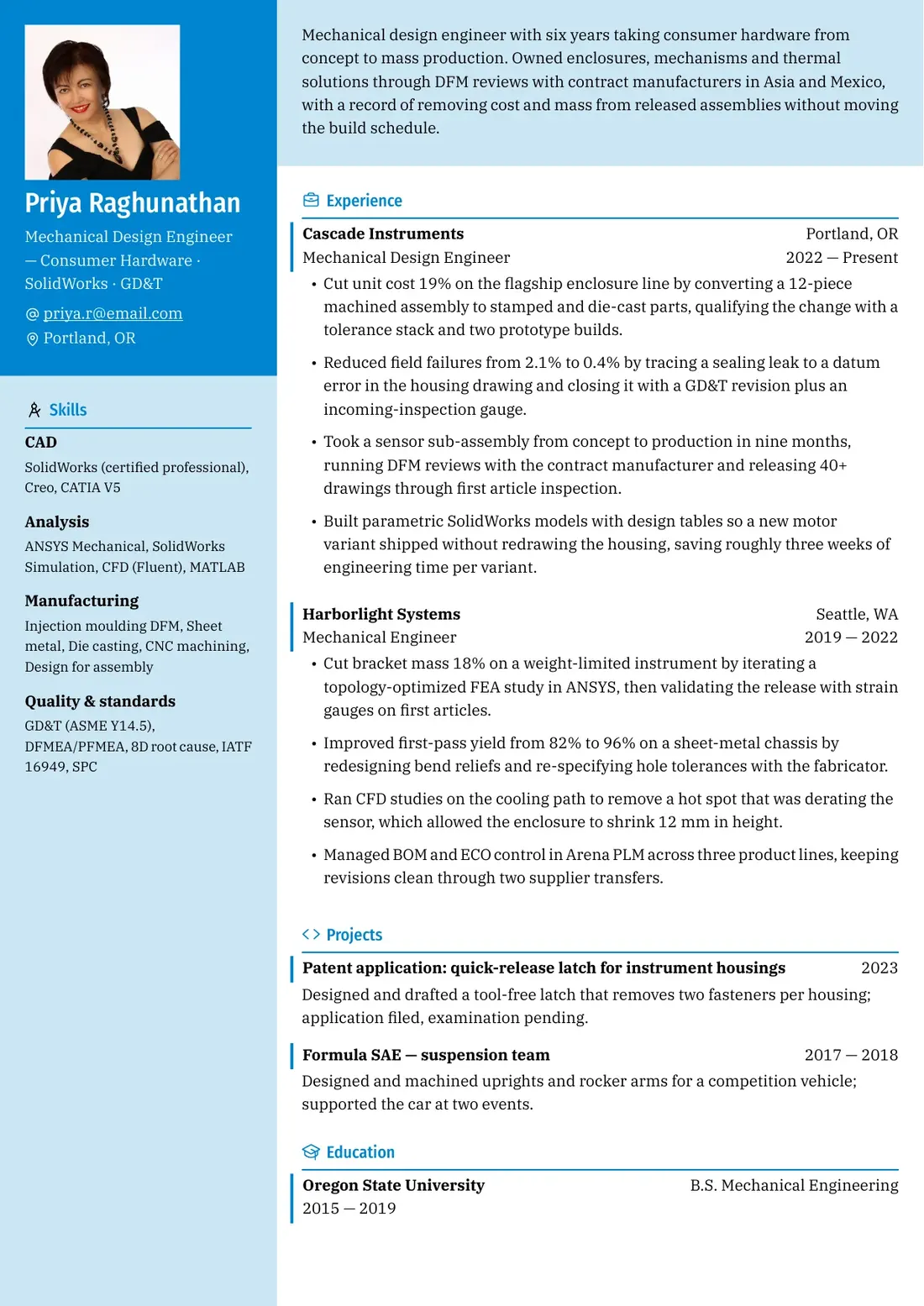
A production-focused mechanical design resume: enclosures, mechanisms and thermal work taken from concept through mass production. Single-column and ATS-safe.
Showing 3 of 15 free templates — open the builder to browse every layout. All 15 are free.
Turning responsibilities into results
Hiring managers read for evidence that you have already done the job. “Responsible for enclosures” says nothing about whether you could do it again. Name the part, the constraint and the measurable change.
- Instead of “responsible for sheet metal enclosures”: Redesigned a 14-piece welded enclosure as a 5-piece stamped assembly, cutting unit cost 22% and removing two weld operations from the line.
- Instead of “used SolidWorks daily”: Rebuilt the drive-train assembly as a parametric model with design tables, so a new motor option shipped without redrawing the housing.
- Instead of “worked with suppliers”: Ran a tolerance stack on a gearbox interface failing at 3% of builds, traced it to a datum error, and closed it with a drawing revision that held across four production lots.
- Instead of “performed FEA”: Cut bracket mass 18% by iterating a topology-optimized study, then validated the release with strain gauges on the first prototypes.
Recommended sections for a mechanical engineer resume
- Summary — discipline, years, core CAD and simulation stack, one quantified result.
- Experience — reverse-chronological. Lead each bullet with the outcome, then the method and the tool behind it.
- Skills — grouped by CAD, simulation, manufacturing process, standards, and any scripting or analysis software you use (MATLAB, Python, Minitab).
- Projects or patents — a capstone, a competition team, a granted or pending patent, or a released product. Valuable when your titles do not match the industry you are applying into.
- Licenses and certifications — PE license with the jurisdiction, FE exam status, GD&T training, Six Sigma belt, welding or NDT qualifications. Put only what you hold.
- Education — degree, school, graduation year. Coursework earns space only as a new graduate without internships.
Mechanical engineer skills and keywords
Screening systems match your resume against the wording of the posting, so mirror the exact terms where you genuinely have the experience. A reviewer reading the same list wants context: “SolidWorks” is a keyword, “parametric sheet-metal and weldment models” says what you can be handed on day one.
- Design and CAD: SolidWorks, Creo, CATIA V5/V6, Siemens NX, Inventor, AutoCAD, parametric modeling, design tables, weldments, drafting
- Analysis: FEA (ANSYS Mechanical, Abaqus, SolidWorks Simulation), CFD (Fluent, Star-CCM+), thermal, modal, fatigue, hand calculations, tolerance stack-up
- Manufacturing process: injection moulding DFM, sheet metal, die casting, CNC machining, welding and joining, additive manufacturing (FDM, SLS, DMLS), assembly fixture design
- Quality: GD&T to ASME Y14.5, DFMEA/PFMEA, 8D and 5 Whys root cause, statistical process control, gauge R&R, first article inspection
- Program and lifecycle: BOM and ECO control, PLM (Teamcenter, Windchill, Arena), supplier qualification, PPAP, value engineering, cost and mass reduction
- Standards: ISO 9001, IATF 16949, ASME BPVC, ASTM material specifications, UL and CE safety compliance
ATS notes for mechanical engineering resumes
- Keep a single column. Splitting tools or a license list into a sidebar is the most common way a strong resume becomes unreadable — many parsers flatten columns in the wrong order.
- Use standard section headings: Experience, Education, Skills, Projects. A heading like “Hardware I Have Shipped” may be dropped entirely, taking its contents with it.
- Spell an acronym out once next to the short form — geometric dimensioning and tolerancing (GD&T), finite element analysis (FEA), computer-aided design (CAD). Reviewers and parsers search both spellings.
- Never place a part drawing, a simulation plot or a tolerance table as an image. If a reviewer needs to see a drawing, link to a portfolio page and keep your experience section as text.
- Export a text-based PDF or DOCX. A portfolio PDF assembled from scans will not parse at all.
- State license status precisely — “PE license, State of Texas” or “FE exam passed, PE pending” — rather than writing Professional Engineer before you are licensed.
ShitResume renders every template as one continuous column, so drawing revisions, GD&T callouts and tolerance figures survive parsing in the order an engineer would list them. It is completely free, there is no sign-up wall, and the PDF or DOCX comes straight out of the browser.
Formatting only decides whether your experience is read; it cannot rescue a resume with nothing to read. Put the work in the bullets first, then make sure the structure does not hide it. The ATS checker shows how a parser reads your file.
No template on ShitResume is held back for payment and no export is capped, the file stays on your machine while you work on it, and there is no registration to complete. For an engineer running a PE application and a product-design search at once, that means two finished resumes and a single browser tab.
Skills and keywords for this role
Use the terms that genuinely describe your work — an interviewer will ask about anything you list.
- CAD: SolidWorks, CATIA V5/V6, Creo, Siemens NX, Inventor, AutoCAD
- Simulation: FEA (ANSYS Mechanical, Abaqus), CFD (Fluent, Star-CCM+), thermal, modal, fatigue, tolerance stack-up
- Manufacturing: injection moulding DFM, sheet metal, die casting, CNC machining, welding, additive (FDM, SLS, DMLS)
- Quality & standards: GD&T to ASME Y14.5, DFMEA/PFMEA, 8D root cause, SPC, ISO 9001, IATF 16949
- Lifecycle & PLM: DFM/DFA reviews, BOM and ECO control, PLM (Teamcenter, Windchill, Arena), supplier qualification, PPAP
- Analysis tools: MATLAB, Python, Minitab, LabVIEW
Frequently asked questions
Do I need a PE license on my resume?
Only if it is relevant to the job and you genuinely hold it. Licensure is handled state by state in the US and separately in other countries, and it is common in structural, HVAC and public infrastructure work while most product design roles do not ask for it. Check the posting and the licensing board rather than assuming. If you are licensed, name the jurisdiction in a dedicated line. If you have passed the FE exam but are not yet licensed, write that plainly instead of implying otherwise.
How do I show CAD skills without turning the resume into a tool list?
Give the tools context. A skills block earns keyword matches, but the experience section is where the tool has to be doing something: parametric modeling for a configurable housing, a weldment drawing package, a surfacing change that fixed an assembly tolerance. Two or three tools shown in real work read far stronger than fifteen listed without evidence.
Should a mechanical engineer include drawings or a portfolio?
Not inside the resume file. A drawing or simulation plot pasted into the document becomes an image that a parser cannot read, and it consumes the space your results need. Keep the resume as text, host visuals on a portfolio page or a personal site, link to it from the header, and add a short line saying what the link contains so a reviewer knows it is worth a click.
How long should a mechanical engineering resume be?
One page for most candidates, two if you have roughly a decade of experience or a genuine mix of design, manufacturing and analysis ownership. Roles from ten years ago can collapse to a single line. Two pages only work when the second page is full; a half-empty page reads as padding and reviewers notice.
What should I write if my project never reached production?
Say what stage it reached and what you produced, because that is still real evidence — a validated prototype, a released drawing package, a written test report. Something like “prototype tested to 500 cycles; production release not completed” is honest and specific. Never imply a product shipped when it did not, since interviewers ask follow-up questions and a claim that collapses costs you the role.
Is GD&T and tolerance stack-up experience worth listing?
Yes, if you have it. It is one of the clearest signals that you have owned hardware rather than only modelled it, and it separates you from candidates whose work stopped at a 3D file. Name the standard you worked to — ASME Y14.5 is the common one in the US — and describe one decision it changed: a defect closed, a supplier qualified, or cost taken out of an assembly.
Do I need a master's degree to work as a mechanical engineer?
No. A bachelor's degree in mechanical engineering or a closely related field is the usual entry point, and plenty of senior engineers hold no further degree. A master's helps for research-heavy, thermal or simulation-specialist roles, and some employers fund one part-time. List the degree you hold and leave off anything you are still deciding about.