Human Resources Resume
An HR resume is read twice: by a parser that needs clean structure, and by a hiring manager who wants to know whether you have handled the difficult human situations the job contains. Below is a complete example, the sections recruiters expect, and the systems and credentials that separate a generalist from a specialist.
Free forever. No account, no card, no catch — your data never leaves your device.
What a human resources resume must include
- A headline naming your specialism — HR generalist, talent acquisition, total rewards, HRIS or employee relations — not just “Human Resources.”
- A summary leading with the workforce you supported: headcount, sites, hourly versus salaried mix.
- Bullets that pair a people outcome with the mechanism behind it, so the reader sees the work under the number.
- Your HRIS by name. Workday, BambooHR, ADP, SuccessFactors, Greenhouse and Lever are screening keywords, not decoration.
- The employment laws you have administered — compliance is the part of the role hiring managers worry about most.
- Credentials on one compact line, not a section of their own: SHRM-CP, SHRM-SCP, PHR or SPHR.
HR postings repeat themselves, which works in your favor: employee relations, compliance, onboarding and compensation appear in almost every one, so mirroring the posting's vocabulary is straightforward. What separates resumes is scope. “Supported 400 employees across three sites” tells a reader far more than “managed HR operations.”
Human Resources Resume Example
Example resume
A two-page HR manager resume covering employee relations, HRIS implementation and compensation. This is the structure our builder produces — switch templates, export PDF or DOCX, no account needed.
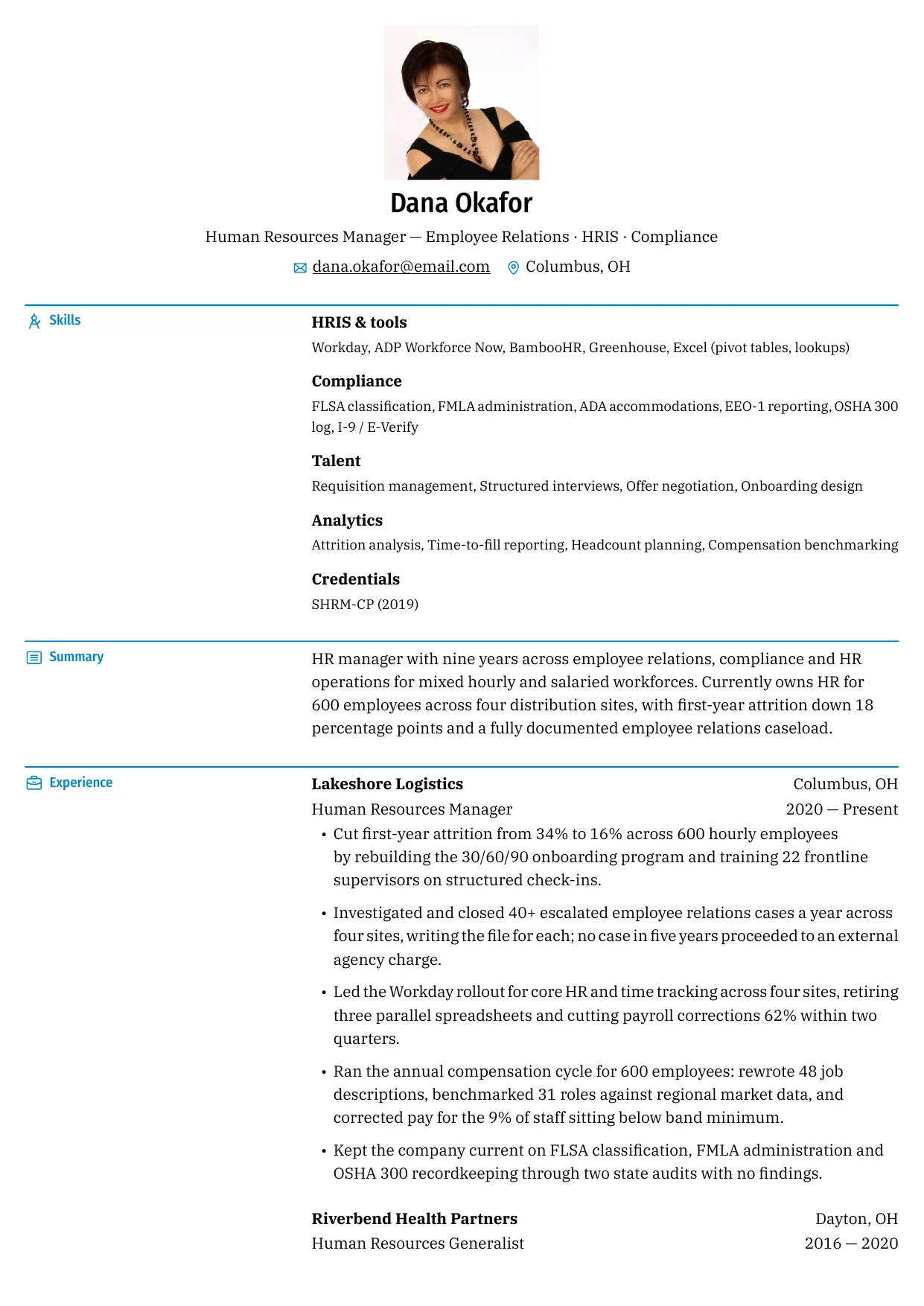
Showing 3 of 15 free templates — open the builder to browse every layout. All 15 are free.
How to write HR bullets that hold up to a skim
HR work is easy to describe in the passive voice, which is why most HR bullets read as a job description rather than a record. Lead with the outcome, then the mechanism, then the scale.
- Instead of “Responsible for onboarding new hires”: “Rebuilt onboarding for 200 annual hires across four sites, lifting 90-day retention from 76% to 89%.”
- Instead of “Handled employee relations”: “Investigated and closed 40+ escalated employee relations cases a year, each with a written file that withstood review by outside counsel.”
- Instead of “Worked on compensation”: “Benchmarked 31 roles against regional market data and corrected pay for the 9% of staff sitting below band minimum.”
- Instead of “Supported benefits administration”: “Rebuilt open-enrollment communication and raised benefits enrollment completion from 71% to 94% without adding headcount.”
People metrics worth putting on the page
Pick two or three you genuinely tracked. A number you cannot break down under questioning is worse than no number, because it invites the one follow-up you cannot answer.
- First-year and 90-day retention — the clearest evidence that your onboarding actually worked.
- Time-to-fill — name the role family, since clinical, technical and hourly pipelines differ enormously.
- Regrettable attrition — separates the turnover you wanted from the turnover that hurt.
- Offer acceptance rate — useful where you owned the negotiation or the closing process.
- Case volume and cycle time — for employee relations: how many cases, how fast, at what documentation standard.
Human resources skills and keywords
Group the list so a human can scan it and a parser can match it. Cut anything you would not want to be interviewed on: every line is an invitation to a question.
- HRIS and reporting: Workday, BambooHR, ADP Workforce Now, SuccessFactors, Excel pivot tables
- Compliance: FLSA exempt/non-exempt classification, FMLA, ADA interactive process, EEO-1 reporting, I-9 and E-Verify, OSHA 300 log
- Recruiting: Greenhouse, Lever, requisition management, structured interview scorecards, offer negotiation
- Total rewards: compensation band design, market benchmarking, benefits plan administration, open enrollment
- Employee relations: workplace investigations, performance improvement plans, manager coaching, policy drafting
- Analytics: attrition analysis, headcount planning, workforce reporting, engagement survey design
Certifications and credentials
Two credential families dominate: SHRM offers the SHRM-CP and SHRM-SCP, and HRCI offers the aPHR, PHR, SPHR and GPHR. Each sets its own education-and-experience eligibility rules and revises them, so check the current requirements with the issuing body before you register. Plenty of HR professionals hold neither and are hired on experience, but some employers ask for one.
- List the credential with the year you earned it — “SHRM-CP (2019)” — and name the certifying body in full once, since abbreviations vary by country.
- If you are studying toward one, say so plainly: “SHRM-SCP candidate, exam scheduled 2026.” Never list a certificate you have not been awarded.
- For international roles, note any country-specific labor law credential you hold rather than assuming a US certificate transfers.
ATS notes for human resources resumes
- Keep one column. Two-column layouts and sidebar boxes often get parsed out of order, scrambling the link between a job title and its dates.
- Use the headings an ATS expects — Summary, Experience, Education, Skills — rather than creative labels like “Where I've Made an Impact.”
- Spell acronyms out once with the short form in brackets — “Family and Medical Leave Act (FMLA)” — and keep dates in one format throughout. Tokenizers and date parsers are unforgiving of both.
- Put your HRIS names in the experience bullets as well as the skills list. A parser scoring a specific system weighs a bullet more than a comma-separated skill.
- Export a text-based PDF or a DOCX. Scans and image-only PDFs give a parser nothing to read, and many large employers now require DOCX at the application stage.
- Drop tables, text boxes and content in headers or footers. Anything that cannot be read linearly is discarded or reordered.
That is why every template here shares one linear structure: what you see is what the parser reads, and what the parser reads is what you export. Structure gets you into the pile; the specifics above move you through it.
HR systems parse resumes against the same posting language they store, so a title, a date range and an HRIS name need to land in the right fields. ShitResume keeps one linear structure behind every template, so what the parser extracts matches what you see on the page and the export does not reshuffle it. No account, no card, nothing to cancel.
ShitResume is free: every template and every export costs nothing, and the file is composed in the browser, so investigation notes, salary bands and employee names never leave the laptop. No account is created for the case files, no card is entered, and no trial clock starts. Update the page between open enrollment and the next round of interviews; the employment law keywords will survive the export.
Skills and keywords for this role
Use the terms that genuinely describe your work — an interviewer will ask about anything you list.
- HRIS & platforms: Workday, BambooHR, ADP Workforce Now, SAP SuccessFactors, Greenhouse, Lever
- Compliance & policy: FLSA classification, FMLA administration, ADA accommodations, EEO-1 reporting, I-9 verification, OSHA recordkeeping
- Talent acquisition: requisition management, structured interviewing, offer negotiation, employer branding
- Total rewards: compensation band design, market benchmarking, benefits administration, open enrollment
- People analytics: attrition analysis, time-to-fill, cost per hire, headcount planning, engagement survey reporting
- Employee relations: investigations and documentation, performance improvement plans, manager coaching, policy writing
Frequently asked questions
How long should a human resources resume be?
One page through about five years of experience; two pages after that if the second page is full rather than whitespace. HR resumes carry useful context — headcount, sites, compliance exposure — so two pages is common and accepted in the field.
Do I need a SHRM or HRCI certification to work in HR?
No. Many HR professionals are hired and promoted on experience alone, and most postings list a certificate as preferred rather than required. SHRM and HRCI are the two main credential families, and each sets its own eligibility rules, so check the current requirements with the issuing body before you register.
How do I show HR experience if my job title was not an HR title?
Lead with the HR work and let the title sit underneath it. Office managers and operations supervisors routinely run recruiting, onboarding, scheduling and employee relations without ever holding an HR title. Name the HR scope you owned and the headcount you covered, because those are the details a screener looks for.
Should I list every HRIS I have ever touched?
List the ones you can use unaided and group them by purpose. A long inventory of systems you logged into once reads as padding and invites questions you may not want. If you led an implementation or owned reporting in one platform, say that in a bullet instead.
How do I describe employee relations work without breaking confidentiality?
Describe the process and the aggregate, never the individual. Case volume, the types of matters you handled, your documentation standard and your timelines are all publishable. Names, medical details and the outcome of any single case are not.
Which metrics should an HR resume actually include?
Two or three you personally tracked and can explain line by line. First-year retention, time-to-fill for a specific role family, and a caseload figure are the strongest. Avoid HR-to-employee ratios, where published benchmarks vary widely by industry and headcount.
Is it worth tailoring an HR resume for every application?
Yes, and it is quicker in HR than in most fields because postings share so much vocabulary. Note the systems named, whether the role leans recruiting or employee relations, and the laws it mentions, then adjust your summary and two or three bullets.