Pilot Resume Template
Pilot recruiting starts with a document and a database. Whether you are applying to a Part 121 airline, a charter operator or a corporate flight department, someone — or something — is checking four facts before reading anything else: certificates and ratings, total and PIC time, aircraft types and recency of experience. This pilot resume template puts those facts in the order a chief pilot expects, keeps the hours in plain text a parser can read, and gives the experience section room for the operational detail that separates two candidates with the same logbook totals.
Free forever. No account, no card, no catch — your data never leaves your device.
Aviation hiring is verification-driven, and the resume is the first place the verification starts. A recruiter cross-checks the certificate, the ratings and the hours against the application profile, the logbook totals and the training record; a discrepancy at that stage costs more than a weak bullet ever would. That is why this template keeps the credential block above the fold and repeats the key hours in plain numbers rather than inside a chart, and why the experience entries are written around what you operated, where you operated and with what level of supervision.
What a pilot resume template needs to hold
- Certificates and ratings. Certificate type, ratings, type ratings with the aircraft series, and the currency of each one.
- Flight hours, broken out. Total, PIC, multi-engine, turbine, instrument and night time, stated as figures rather than ranges.
- Medical and documentation. Medical class and expiry, radiotelephone permit, passport, and the right to work in the country you are applying in.
- Aircraft types operated. The series you have actually flown on the line, with hours by type where the logbook supports it.
- Operational context. Part 121, Part 135, Part 91 or instruction, plus the route structure — international, high-altitude, short-field or hazardous-terrain operations.
- Training record. Initial, recurrent and line training without embellishment, because the training file is checked independently.
Section order for a pilot resume
- Header: name, current position and ratings, city and state, phone, email and a professional link if you keep one.
- Certificates and flight time: the credential block first, with the hours summary directly underneath.
- Summary: two or three lines naming the certificate, the type ratings, total hours and the operation you fly in today.
- Experience: reverse-chronological, with the operator, aircraft type, position and duty context on every entry.
- Education and training: degree, flight school, and the simulators or programs a recruiter would recognise.
- Skills: systems, procedures and administrative records grouped for the keyword scan.
Pilot resume example
Example resume
An airline first officer resume in this template: certificates and a flight-time breakdown in the sidebar, A320 and Embraer 175 type ratings named, and each role written around sectors, training cycles and operational conditions. Switch layouts in the builder and export PDF or DOCX — free, no account needed.
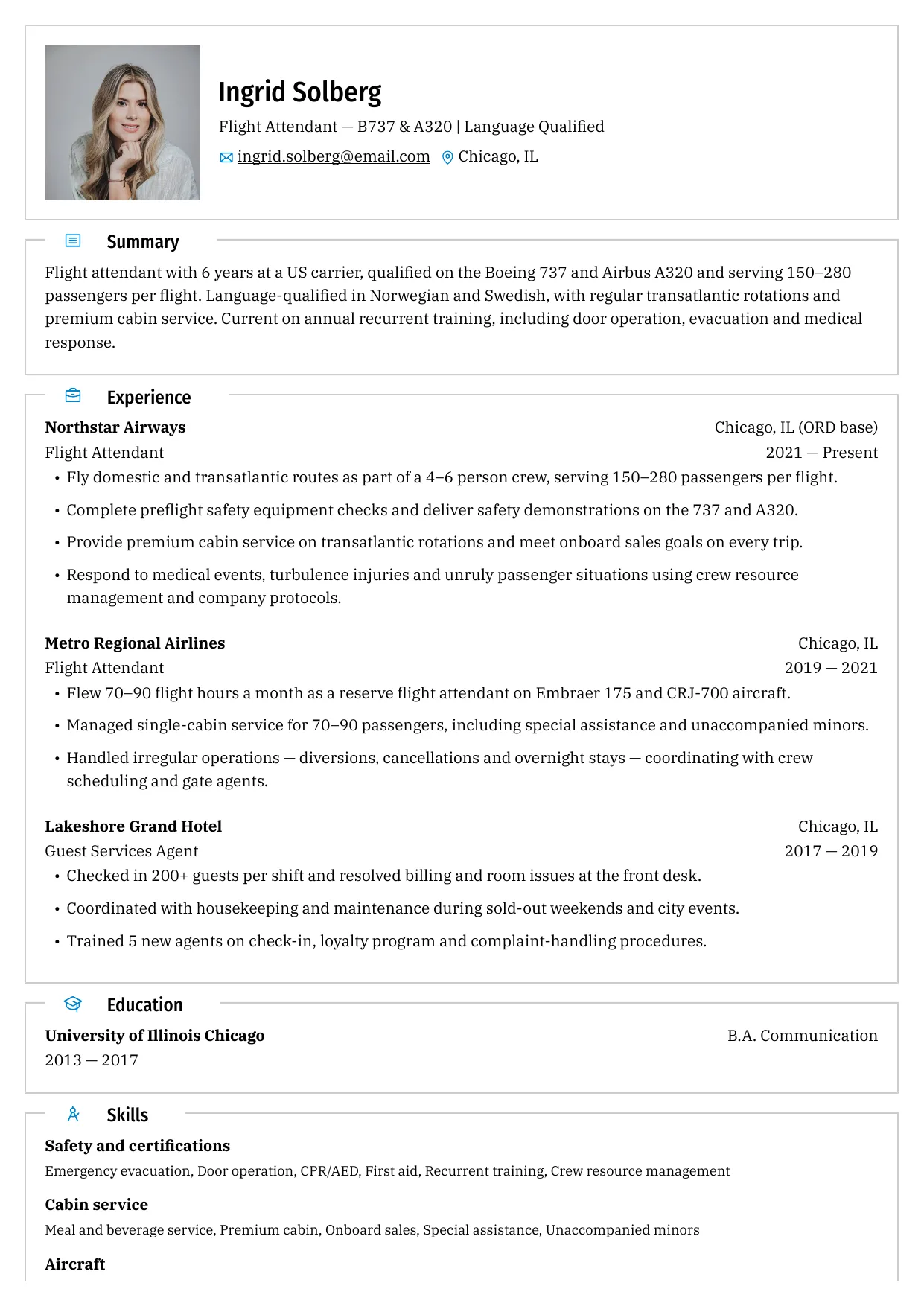
Showing 3 of 15 free templates — open the builder to browse every layout. All 15 are free.
How to present flight hours
Give the hours their own block and keep it consistent: total time, PIC, multi-engine, turbine, instrument and night, each as a number. Recruiters compare those figures against minimums in the posting, so a range like “3,000+” is less useful than “4,200” and a single undifferentiated total hides the category that actually qualifies you. If your logbook is split across digital and paper records, reconcile the totals before you write them down — an interview panel that finds two different totals will question the record, not the rounding.
How to write aviation experience bullets
- Lead with the operation, not the adjective. “Flew 70–90 hours a month on regional routes into 40 airports, including short-field and high-altitude fields” tells a chief pilot what kind of flying you have done.
- Name the aircraft in each role. The type belongs in the entry even when it is also in the header, because recruiters filter by type rating.
- Describe conditions, not just destinations. Winter operations, mountain airports, oceanic crossings, hazardous cargo and night freight are the details that differentiate two logbooks with the same hours.
- Include your non-flying duties. Safety reporting, fuel and weather planning, dispatch coordination, mentoring new first officers and simulator instruction all count as leadership evidence.
- Keep training outcomes factual. Initial and recurrent training completed, line checks passed, no failures — stated plainly, because the training file will confirm it.
ATS notes for pilot resumes
- Keep hours and currency dates in the main text flow; a table of hours or a graphic currency strip is exactly what parsers drop or scramble.
- Write type ratings with the manufacturer and series together — “Airbus A320”, “Embraer 175” — so a keyword match does not depend on one spelling.
- Use month and year on every role and every training entry; aviation recruiters compute recency from those dates.
- Spell out abbreviations on first use (airline transport pilot, instrument landing system) and then use the short form consistently.
- Keep the document to two pages unless the posting asks for more; a three-page career history is usually a sign that older roles were not compressed.
Common pilot resume mistakes
- Listing certificates without currency dates, which forces a recruiter to ask a question that could have been answered on the page.
- Reporting a single total-hours figure with no PIC, multi-engine or turbine breakdown.
- Putting flight hours inside a graphic or a progress bar, where the numbers are unreadable to both a parser and a printed copy.
- Describing the aircraft rather than the operation, so a wide-body type rating looks the same as a one-off ferry flight.
- Leaving out non-flying roles that show responsibility — dispatch, safety, training — because they did not happen in a cockpit.
- Using a photo-heavy or two-column layout for an airline portal that extracts text into a flat list.
This layout is one of the templates ShitResume ships, and the document behind it keeps certificates, hours and experience in one linear order rather than spread across boxes. ShitResume runs in the browser and stores the resume on your device, so a file carrying your licence numbers and logbook totals is never uploaded anywhere. Every layout, PDF and DOCX export is free, and no account is needed to start.
Skills and keywords for this role
Use the terms that genuinely describe your work — an interviewer will ask about anything you list.
- Certificates: airline transport pilot or commercial certificate, multi-engine land, instrument rating, type ratings
- Flight time: total time, PIC, multi-engine, turbine, instrument, night, cross-country
- Training: Part 121 or Part 135 experience, initial and recurrent training, line checks, LOFT, CRM
- Operations: IFR procedures, fuel planning and alternate selection, MEL/CDL, adverse weather, weight and balance
- Records: logbook accuracy, first-class medical, FCC radiotelephone permit, passport and visa status
- Systems: ForeFlight, Jeppesen charts, ACARS, electronic flight bag, Garmin and Honeywell avionics
Frequently asked questions
How long should a pilot resume be?
Two pages is the standard for an experienced pilot, and one page is enough for a flight instructor applying to a first airline job. Compress older or non-flying roles to a single line. The page count matters less than whether certificates, ratings and the hours breakdown are all visible without scrolling.
Where should flight hours go on a pilot resume?
In a dedicated block near the top, directly under the certificates. Break the total into PIC, multi-engine, turbine, instrument and night time, and use exact figures rather than ranges. Recruiters compare those categories against the minimums in the posting, and a single total does not answer that comparison.
Should I list every aircraft I have flown?
List the types you have operated on the line or in a training program that awarded a rating or endorsement. A ferry flight in a light twin is not the same experience as line flying, and overstating the list is easy for an interviewer to expose with one question about systems or limitations.
Do airlines want a resume or a completed application profile?
Most large operators require both: an application profile for the database and a resume for the recruiter. Keep the two consistent — same hours, same dates, same ratings — because a mismatch between the profile and the document is the fastest way to raise a question about the record.
How do I list a type rating that is not current?
Name the rating and state its status plainly, with the date it was last current. A lapsed rating is still evidence of training and systems knowledge; hiding the date suggests it was overlooked. If you are in a recurrent or requalification program, add the expected completion date next to it.
What should a flight instructor applying to a regional airline emphasise?
Instruction hours, checkride endorsements and first-attempt pass rates, because they show command judgement and communication under pressure. Add the weather and airspace conditions you fly in and any syllabus or curriculum work you authored, then keep the rest of the document to one page.