Executive Resume Template
An executive resume is read as a business case, not as a career history. The reader — a retained recruiter, a board member, a peer executive — wants to know the size of what you ran, what moved under your ownership, and whether your experience maps onto the problem the company has right now. This executive resume template gives the scope numbers a fixed place near the top, treats each role as a result rather than a duty, and keeps the document readable to the software that will parse it before a person does.
Free forever. No account, no card, no catch — your data never leaves your device.
Executive searches run through people, but the first filter is still mechanical. A retained firm stores your document in a candidate database, and a corporate portal parses it into fields before anyone reads the narrative. What survives both is a plain structure: a positioning summary, the scope of each role stated in numbers, and results that name the action and the outcome. What does not survive is a designed document that treats the resume as a brochure — a full-page graphic of a career timeline reads as evasion to a reader who is deciding whether to spend an hour with you.
What an executive resume template needs to hold
- A positioning summary, not an objective. Three lines naming the executive level, the business types you have run and the result a board would care about.
- Scope in numbers. Revenue or budget owned, headcount, number of sites or markets, and the reporting line — stated once in the summary and again in the current role.
- P&L and capital evidence. Margin movement, cost per unit, integration synergies, capital deployed; the numbers a board uses to judge operating judgement.
- Leadership bench results. Hires, promotions and succession outcomes, because a board is also buying the team you leave behind.
- Governance exposure. Board reporting, audit and risk committee work, investor communication and any regulated environment you have operated in.
- Two-page discipline. Twenty years of history compressed to what is relevant to the role on offer, with older roles carried as one-line entries.
Section order for an executive resume
- Header: name, target title, city and state, phone, email and one link — a profile or a board bio, not five social accounts.
- Summary: the positioning statement, with the largest scope numbers included in the first two sentences.
- Experience: reverse-chronological, each role opening with a scope line before the results.
- Board and advisory work: current and recent seats, committees and any governance training.
- Education and executive development: degrees, plus the programs that carry weight in your industry.
- Skills: grouped functional terms — leadership, operations, transactions, governance — for the keyword filter rather than for a human.
Executive resume example
Example resume
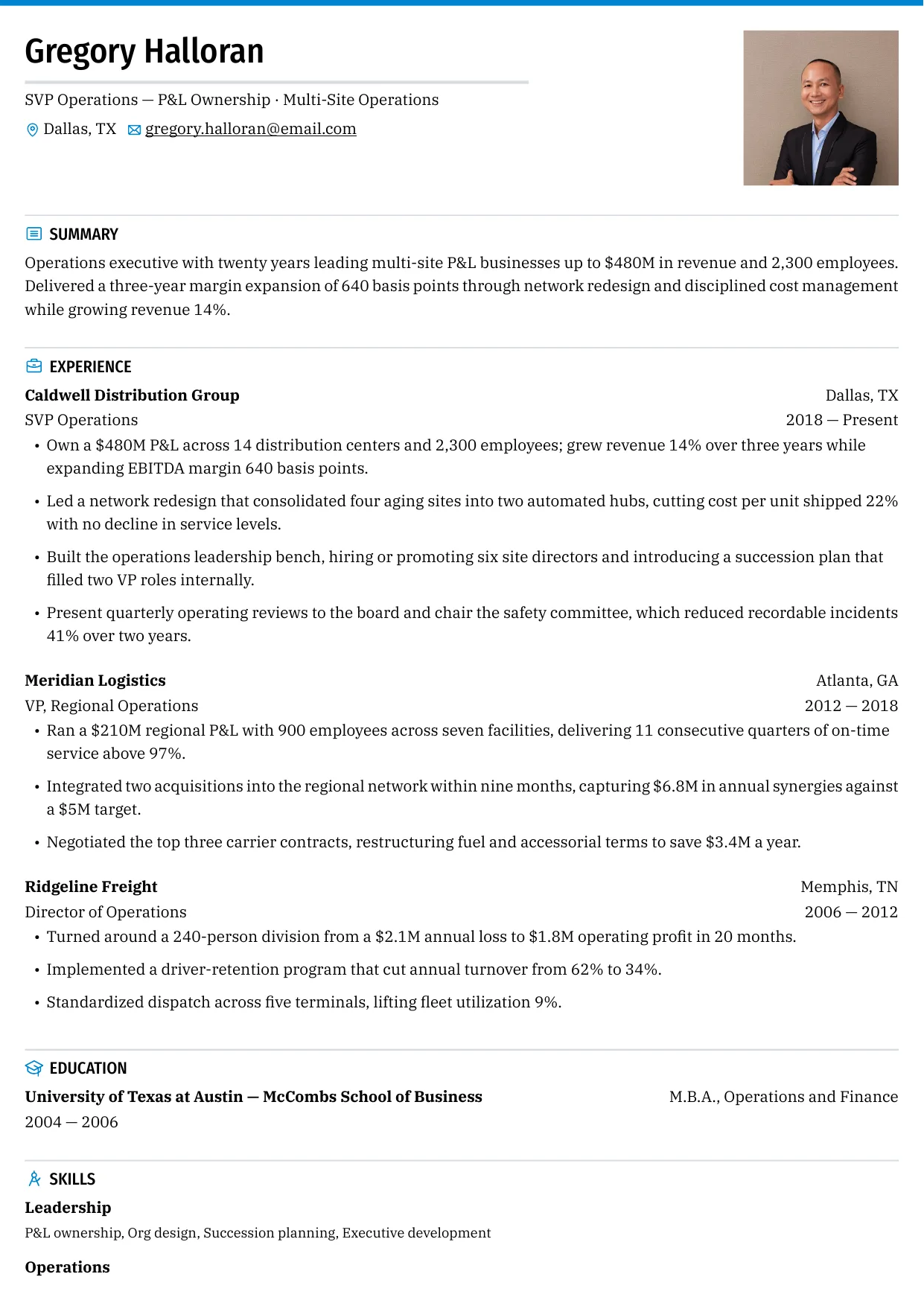
A two-page executive resume in this template: a $480M P&L in the first line of the summary, scope and EBITDA movement in every role, and board and safety responsibilities written as outcomes. Switch layouts in the builder and export PDF or DOCX — free, no account.
Showing 3 of 15 free templates — open the builder to browse every layout. All 15 are free.
How to write the scope line
Every senior role should open with one line that states what you owned: revenue or budget, headcount, sites, regions and the reporting relationship. Put it directly under the job title, in the same place on every entry. A recruiter scanning three roles should be able to read three scope lines in ten seconds and know the difference between running a $40M division and a $400M one. The scope line also anchors the numbers that follow: “cut cost per unit 22%” means something different at 200 employees than at 2,300.
How to write executive bullets
- Lead with the business outcome. Margin, revenue, cost per unit, retention, safety — the measures a board tracks, not the activities you performed.
- Name the mechanism. A network redesign, a pricing change, a succession plan or a renegotiated contract explains how the number moved and gives the interviewer something to question.
- Quantify the time frame. “Over three years” or “in 20 months” separates a durable result from a one-off quarter.
- Keep four bullets for the current role. More than that turns the page into a job description and pushes the earlier roles, which often hold the relevant turnaround or scale story, off the screen.
- Use the language of the industry you are targeting. The same work is “network optimisation” to a logistics board and “cost to serve” to a retail one; mirror the posting.
ATS notes for executive resumes
- Keep the document two pages at most and put the summary and current role inside the first page — a parser reads order, and older roles should not displace the scope numbers.
- Write organisation sizes as plain figures (“2,300 employees”, “14 sites”) rather than in a graphic; images and charts of scale are dropped entirely.
- Avoid a two-column layout that puts dates in a sidebar; if the extraction reorders the columns, tenure reads incorrectly and a recruiter may not correct it.
- Spell out acronyms once — EBITDA, P&L, M&A, NPS — because a filter may look for the expanded form in the posting.
- Keep the board and advisory block in the body text; a footer or page-header position is where parsers stop looking.
Common executive resume mistakes
- Opening with an objective statement that describes the job you want instead of the business you have run.
- Listing responsibilities without a single scope number, which makes a decade of leadership invisible to a scanner.
- Including every role from a thirty-year career at equal depth until the relevant recent history is buried.
- Using a photo-heavy or infographic layout for a corporate portal that extracts text into a flat list.
- Writing results with no mechanism, so the reader cannot tell whether the outcome came from strategy or from a favourable market.
- Leaving out board, advisory or turnaround work because it was unpaid or outside the job title.
This executive layout is one of the templates built into ShitResume, and the document behind it holds the same structure on screen and in the export: header, positioning summary, scoped roles, governance, education, skills. The builder runs entirely in the browser and stores the resume on your device, so a document containing compensation history and board details is not uploaded to a server. Every template and the PDF or DOCX export are free, with no account required.
Skills and keywords for this role
Use the terms that genuinely describe your work — an interviewer will ask about anything you list.
- Leadership: P&L ownership, org design, executive hiring, succession planning, board management
- Scope: revenue, EBITDA, headcount, site count, geography, customer base
- Operations: multi-site operations, network redesign, continuous improvement, M&A integration
- Governance: board and investor reporting, risk and audit, compliance, safety
- Commercial: contract negotiation, pricing, retention, partnerships, channel strategy
- Systems: ERP (SAP, Oracle), BI dashboards, workforce planning, capital allocation models
Frequently asked questions
How long should an executive resume be?
Two pages is the working standard, and three are acceptable for a C-suite candidate with board seats, public-company experience or a portfolio of transactions. Older roles should shrink to a single line each. The test is relevance, not length: page two should carry evidence a search committee needs, not a repeated summary.
Should an executive resume include a photo or an infographic?
No, in most markets. A photo invites bias concerns and an infographic of a career timeline is unreadable to a parser and uninformative to a board member. Keep the document text-first, single-column if the portal is an older system, and spend the space on scope and results instead.
Where do board and advisory roles go?
Give them their own short section after experience when they are current, and include committee work and governance training there. A board seat that is still active is relevant evidence of judgement; an advisory role from a decade ago can sit as a single line unless it maps directly onto the industry you are targeting.
How do I write a resume when I signed an NDA or cannot name a client?
Describe the business, the scope and the outcome without naming the counterparty — “a $90M industrial distributor” or “a national retail account” works. Recruiters accept anonymised descriptors; what they will not accept is a result with no scale attached at all.
Do I need a different version for a recruiter and for a company portal?
Use the same master document but adjust two things: for a retained recruiter, keep the full scope detail and the board work; for a corporate portal, mirror the posting's vocabulary in the summary and skills block and keep the format plain. Both versions should be two pages or fewer.
What if my most recent title sounds less senior than my responsibilities?
State the scope explicitly in the first bullet of that role — budget, headcount, reporting line and geography — and let the numbers carry the level. A functional title with a $200M P&L is a more useful signal to a search committee than a title with no scope attached.