Resume in Spanish: How to Write One (With Example)
If you are applying to a role where the posting is in Spanish, your resume should be too — a translated document that keeps English structure and literal wording reads as machine output. Spanish resumes follow their own conventions: different section names, different expectations about personal data and photos, and regional differences between Spain and Latin America. This guide covers what changes, with a full Spanish-language example.
Free forever. No account, no card, no catch — your data never leaves your device.
The first thing to get right is the word itself. In Spain and most of Latin America, the document is a currículum (often “CV”); resumen means “summary” and using it for a resume marks the text as a translation. If the job posting says “currículum,” your document is a currículum. Beyond the name, the differences are practical: section titles, the treatment of personal data, and how much detail each market expects.
When you actually need a Spanish resume
- The posting is in Spanish. This is the clearest signal, and it applies in Madrid, Mexico City and Miami alike.
- The role requires Spanish professionally. A bilingual customer success or sales role may want both versions — Spanish for the hiring manager, English for HR.
- You are applying through a local portal. National job boards in Spanish-speaking countries (InfoJobs, Computrabajo, Bumeran) expect the local format and language.
- You are not sure. Match the language of the posting. When a company lists the job in both languages, send the version matching the language of the interview.
Spanish resume section names
- Perfil profesional — the summary (also “Resumen profesional” or “Objetivo profesional” for an objective).
- Experiencia profesional — work experience, newest first.
- Formación académica — education (Spain); “Educación” is more common in Latin America.
- Habilidades or Competencias — skills. “Conocimientos” also appears for technical knowledge.
- Idiomas — languages, with levels defined: básico, intermedio, avanzado, profesional, nativo.
- Certificaciones — certifications, with issuing body and year.
- Referencias — references; the same modern rule applies: a separate sheet on request.
Photo, personal data and other local conventions
- Photo: still common in parts of Latin America and in some traditional Spanish sectors; optional and fading in tech and international companies. If you include one, use a professional headshot — and remember ATS parsers ignore images.
- Personal data: date of birth, nationality and marital status appear on traditional CVs in some markets, but modern advice — and anti-discrimination norms in many companies — favour omitting them. Never include ID numbers, full home addresses, or anything you would not share publicly.
- Length: one page for under ten years of experience; Spain's traditional CV can run to two with more history. Same logic as any market: the second page must earn itself.
- Dates: DD/MM/YYYY or month names — “marzo 2022 — actualidad.” Pick one format and keep it everywhere.
- Spanish variants: check whether the posting uses “tú” or “usted” register and European or Latin American vocabulary (e.g., ordenador vs computadora). Mirror the posting's variant where you can tell.
Translate, adapt, or rewrite?
- Never machine-translate the whole document. Automatic translation gets grammar roughly right and register, idiom and keyword matching wrong. A translated resume is recognisable within one paragraph.
- Adapt the structure first. Rename sections to the Spanish conventions above, reformat dates, and re-order blocks if the market expects it (Formación first for recent graduates, Experiencia first otherwise).
- Rewrite the keywords, not just the words. If the Spanish posting says “gestión de proyectos” and “Power BI,” those exact terms belong in your summary and skills — not their literal English counterparts translated back.
- Have a native speaker review it if you are not fluent. One hour of review prevents the errors a recruiter notices in the first ten seconds.
Spanish resume example
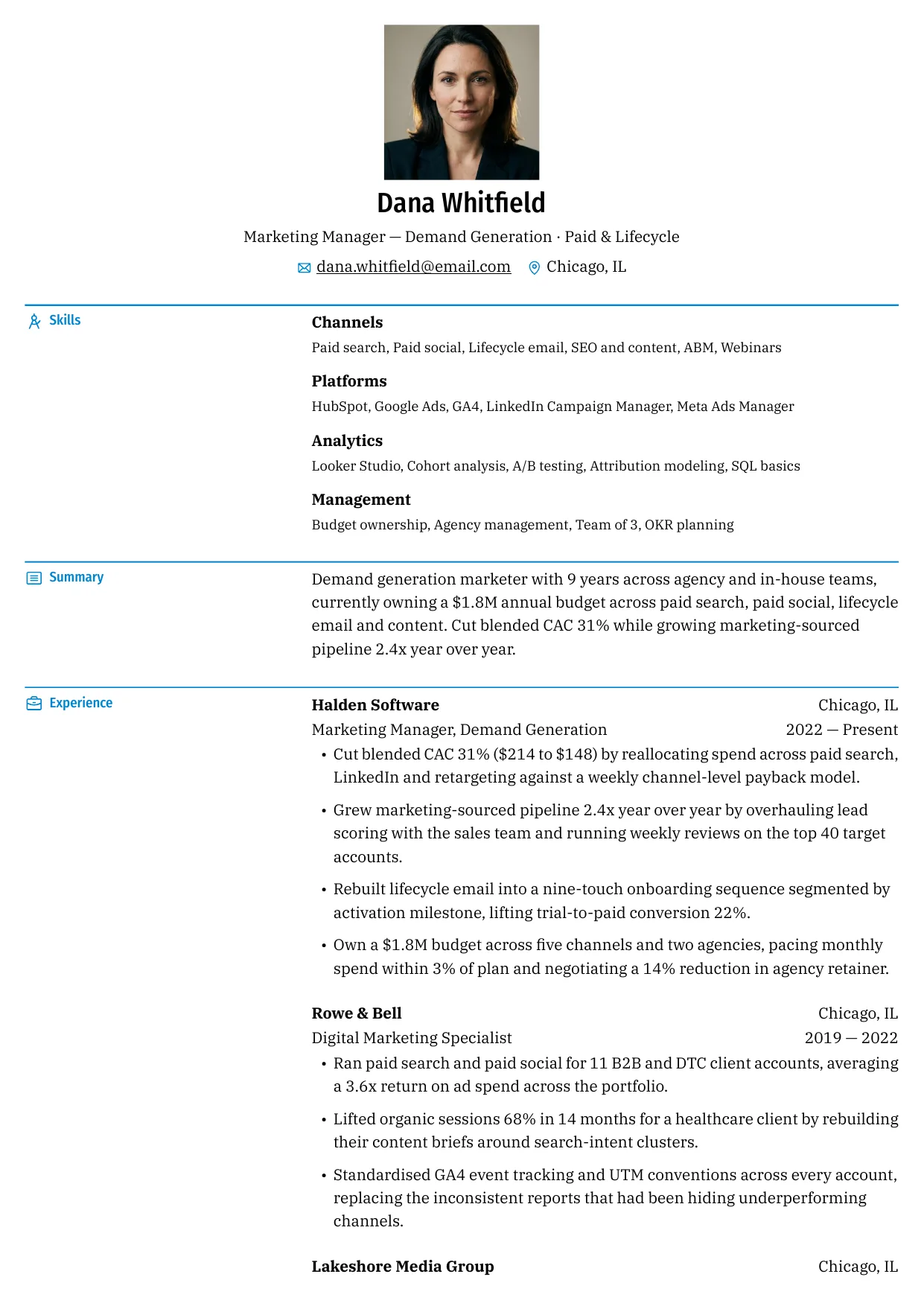
The example below is a Spanish-language resume for a marketing role, written natively rather than translated: Spanish section names, Spanish keywords that match a Spanish-language posting, and accents preserved as real text. The structure is still linear and ATS-safe.
Ejemplo de currículum
A one-page Spanish resume, single column and ATS-safe. The same structure our builder produces — export PDF or DOCX, no account needed.
Showing 3 of 15 free templates — open the builder to browse every layout. All 15 are free.
A table of common terms
- Resume → Currículum / CV (never “resumen”)
- Summary → Perfil profesional
- Objective → Objetivo profesional
- Work experience → Experiencia profesional
- Education → Formación académica / Educación
- Skills → Habilidades / Competencias
- Certifications → Certificaciones
- Languages → Idiomas
- Achievement → Logro / Resultado
- Current → Actualidad / presente
ATS notes for Spanish resumes
- Keep accents as proper UTF-8 characters (á, é, í, ó, ú, ñ). They are part of the words; stripping them creates misspellings instead of safer text.
- Use the posting's exact terms — Spanish ATS matching is as literal as its English counterpart. “Atención al cliente” and “servicio al cliente” can differ in a match.
- Include both the Spanish term and, where standard, the English one for technical tools: “gestión de CRM (Salesforce)” is safer than either alone.
- Standard headings in the local language. A parser configured for Spanish sections may not recognise an English “Experience” heading — and vice versa.
- Same layout rules as anywhere: single column, no tables, no text in images, dates as real text.
Common mistakes
- “Resumen” for the document title. It means summary — a false friend that instantly signals a translation.
- Word-for-word translation of achievements. “Led” becomes “lideré,” which is rarely how the achievement would be phrased natively. Rewrite the sentence, keep the number.
- Inconsistent formal register. Mixing “tú” and “usted” phrasing across the document reads as sloppy; Spanish postings usually carry a consistent register to mirror.
- Ignoring regional variant. Sending an Argentine-flavoured CV to a Madrid employer (or the reverse) is usually understood but reads as slightly off; mirror the posting.
- No native review. If you are not fluent, this is the single highest-value step, and it is cheaper than the mistake.
Whatever language the resume is in, the structural rules hold: plain text, standard headings, single column. ShitResume renders the document as one linear block — accents included — so a Spanish resume survives the ATS the same way an English one does.
Skills and keywords for this role
Use the terms that genuinely describe your work — an interviewer will ask about anything you list.
- Terminology: “currículum” (or CV) in Spain and most of Latin America — “resumen” means a summary, not a resume
- Section names: Perfil profesional, Experiencia profesional, Formación académica, Habilidades / Competencias, Idiomas, Certificaciones
- Structure: same reverse-chronological logic as an English resume; one to two pages
- Date format: DD/MM/YYYY or “marzo 2022 — actualidad”; keep one style throughout
- Photo and personal data: common in parts of Latin America, increasingly optional; never include ID numbers on a public-facing file
- ATS: mirror the Spanish posting's exact terms, keep accents as proper UTF-8 text, never run the document through machine translation only
Frequently asked questions
Do I need a Spanish resume to apply in Spain or Latin America?
For roles with Spanish-language postings, yes. Match the language of the posting. International companies in these markets often accept English for technical roles, but a Spanish version still signals respect for the local process — and local job boards expect the local format.
Is “resumen” the right word for a resume in Spanish?
No — that is a false friend. “Resumen” means “summary.” The document is a “currículum” (or “CV”) in Spain and across Latin America. Using “resumen” in the document header reads as a machine translation and undermines the rest of the file.
Should a Spanish resume include a photo?
It depends on the market and sector. Photos remain common in parts of Latin America and some traditional industries in Spain, but are optional and increasingly omitted in tech and international companies. If you include one, use a professional headshot and remember that ATS parsers ignore images entirely.
How do I handle Spanish accents for ATS?
Keep them as proper UTF-8 characters — á, é, í, ó, ú, ñ are part of the words, and stripping them creates misspellings rather than safety. Export to PDF or DOCX with embedded fonts and selectable text, then copy a paragraph from the export to check that accents survive the pipeline.
Can I just translate my English resume into Spanish?
No — full machine translation fails on register, idiom and keyword matching. Adapt the structure and section names, rewrite achievement bullets natively while keeping the numbers, and mirror the posting's exact Spanish terms in your summary and skills. Have a native speaker review the result if you are not fluent.
What are the main differences between a Spanish CV and an English resume?
Terminology (currículum vs “resumen”), section names (Formación académica, Experiencia profesional, Habilidades), date format (DD/MM/YYYY), and local conventions around photos and personal data. The core structure — reverse chronological, outcomes with numbers, one to two pages — is the same.