Theatre Resume Template
A theatre resume is two documents wearing one name. The audition version is a credits list, read fast for the productions, roles and directors attached to your name. The version a production office, theatre company or university processes is a working history that has to be legible to whoever manages contracts and payroll. This theatre resume template keeps the credits scannable at the top of the page, then carries production and teaching work below in a structure an arts organisation can actually process.
Free forever. No account, no card, no catch — your data never leaves your device.
Casting a production is a matching exercise with a deadline. A director or casting associate is looking for evidence that you have carried a comparable role in a comparable venue — the same style, a similar size of house, a similar rehearsal period. The credits list answers that question and nothing else should get in its way. What follows the credits is what an employer reads when you are being hired rather than cast: production work, teaching, front-of-house and administrative roles, written with the same date discipline as any other job history.
What a theatre resume template needs to hold
- Union status. Equity or SAG-AFTRA membership — or a clear statement that you are non-union and available — near the top, because it determines how a contract can be issued.
- A credits list with a fixed format. Production, role, company, director where relevant, venue and year, in the same order on every line.
- Training and technique. Conservatory or degree program, the technique you trained in and the voice, speech or movement work behind it.
- Special skills. Dialects, dance styles, stage combat certifications, instruments and singing range, listed with an honest level.
- Production and administrative work. Stage management, rehearsal scheduling, wardrobe, box office or teaching — the employment that pays between contracts.
- Contact block and links. Email, phone, city and a link to a reel or profile, kept in the body of the document rather than in a header.
Section order for a theatre resume
- Header: name, performing identity, union status, city, phone, email and one link.
- Credits: the performance list, newest first, formatted one line per production.
- Special skills and training: dialects, movement, stage combat, singing range, conservatory and technique.
- Experience: production, teaching and administrative roles with dates, written as employment.
- Education: degree or conservatory program, with the graduation year.
Theatre resume example
Example resume
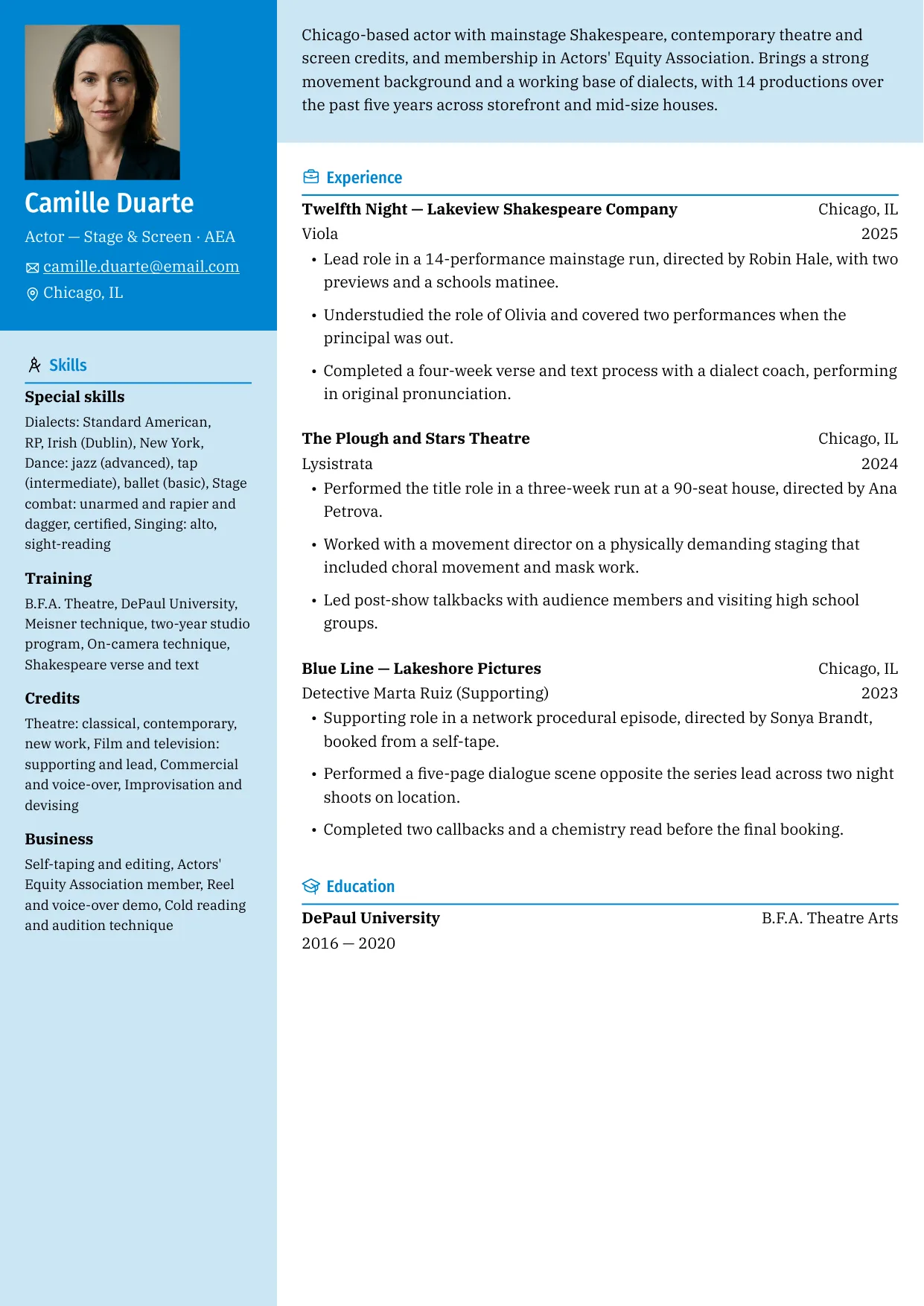
A stage actor's resume in this template: Equity membership and special skills in the sidebar, production credits with role, company and director in the main column, and a touring credit showing the working history. Switch layouts in the builder and export PDF or DOCX — free, no account needed.
Showing 3 of 15 free templates — open the builder to browse every layout. All 15 are free.
How to format the credits list
One production per line, in the same order every time: production title, role (or your production role, such as stage manager), company or producer, director, venue and year. Italicise play titles if the format allows it, but never rely on styling alone — the words have to make sense when the formatting is stripped. Mark understudy, swing and cover work explicitly instead of folding it into the principal credit. Readings, workshops and developmental productions can be listed together under a separate heading so a director can tell them apart from full runs at a glance.
Writing production and stage-management experience
- Name the scale of the production. Venue capacity, run length and company size give a hiring producer the context the credit line cannot hold.
- Describe the paperwork you owned. Rehearsal reports, schedules, cue sheets, contracts and props budgets are the deliverable of a stage-management role.
- Include teaching and workshops. Residencies, post-show talkbacks and school programs are paid work in the sector and belong in the history.
- Keep the run dates accurate. A three-week run and a six-month tour are different jobs; a producer checks availability against the dates on the page.
- Add front-of-house and box office work. It shows how a venue operates and often converts into a contract when a production needs an extra hand.
ATS notes for theatre resumes
- Keep the credits in text form — a scanned programme page or a photo of a poster is unreadable to a parser and to a screen reader.
- Use month and year where a contract ran longer than a single run, and the year alone for a one-off production.
- Spell out abbreviations once — Actors' Equity Association (AEA), stage management (SM) — then keep the short form consistent.
- Keep the contact block, union status and links in the body of the document; page headers and footers are routinely skipped.
- Use standard section headings alongside the credits list so a university or arts organisation's portal can map the document to its own fields.
Common theatre resume mistakes
- Listing a role without the company or director, which leaves a casting associate unable to check the credit.
- Mixing one-night readings into the main credits list as if they were full productions.
- Leaving off non-union work when the page is thin; the sector expects a mix, and an empty history reads as inexperience.
- Using a heavily designed layout for an arts organisation's application portal, where the extraction process flattens the page.
- Writing special skills at a level you cannot demonstrate in a callback room.
- Forgetting the production and teaching history that supports a move into stage management, producing or education work.
The layout above is one of the templates ShitResume ships, and the document behind it keeps credits, skills and employment in one linear order on every screen. ShitResume runs in the browser and saves the resume on your device, so a file carrying your union status and contract history is never uploaded to a server. Every layout and every PDF or DOCX export is free, and no account is required to start.
Skills and keywords for this role
Use the terms that genuinely describe your work — an interviewer will ask about anything you list.
- Union status: Actors' Equity Association, SAG-AFTRA, or non-union availability
- Credits: classical, contemporary, musical, devised work, readings and workshops
- Special skills: dialects, dance, stage combat, singing range, puppetry, improvisation
- Training: conservatory or BFA/MFA, acting technique, voice and speech, movement
- Production: stage management, rehearsal scheduling, lighting and sound calls, wardrobe
- Business: self-taping, audition reels, cold reading, contract and per-diem paperwork
Frequently asked questions
How is a theatre resume different from a standard resume?
Credits come first and are formatted as a list, because casting decisions are made by matching productions and roles rather than by reading responsibilities. A standard application resume leads with employment. This template holds both, so one document can go to an audition and to a production office.
How long should a theatre resume be?
One page for auditions, two at most when training, special skills and production experience are included. Ten years of credits is usually the useful window; older productions can be compressed to a single line or dropped once they stop supporting the roles you are being seen for.
Should I list non-union credits on an Equity resume?
Yes. A credits list that only shows union work usually means the early career is missing, and directors can tell. Keep the same format for union and non-union credits, and state your union status once at the top rather than annotating every line.
Where do special skills and training belong?
Directly under the credits, in grouped lines: dialects with a level of proficiency, dance styles, stage combat certifications, instruments and singing range. Training follows with the program and technique named. Both are read when a production needs a specific ability, so vague entries cost you the callback.
Does a theatre resume need to be ATS-friendly?
For auditions, a human reads it, so formatting matters less — but a theatre company, university or arts organisation may still process the same file through an application portal. Use selectable text, standard headings and real dates, and both readers get what they need from one document.
What should production staff include on a theatre resume?
Production credits with the venue, run length and your role, the paperwork you owned — rehearsal reports, schedules, cue sheets, budgets — and any teaching or workshops you ran. Stage managers and technicians should also list the software and equipment they operate, such as QLab, ETC consoles or Vectorworks.